Crypto merchant settlement for iGaming: stablecoins or crypto to fiat
August 11, 2026
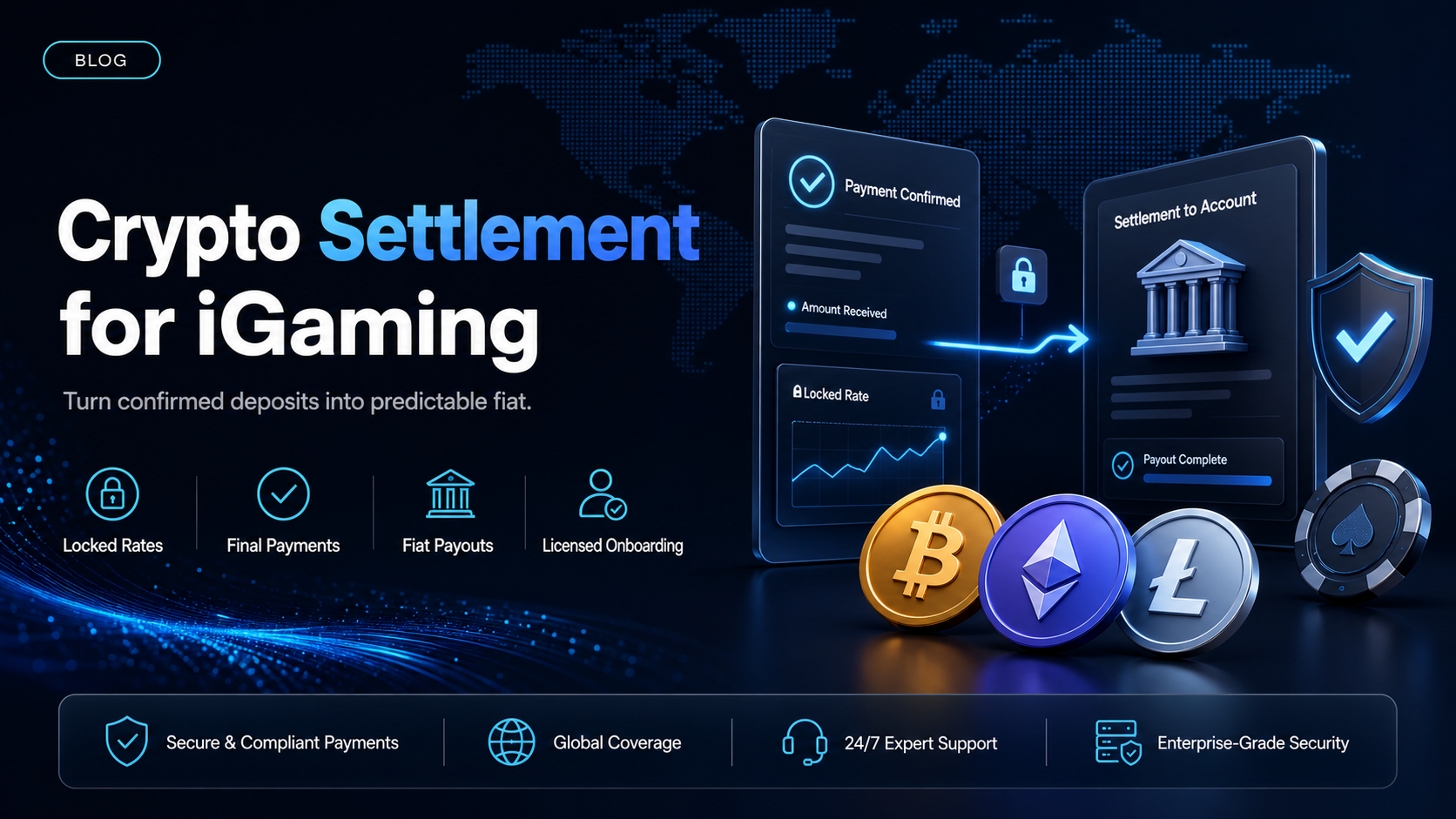
Most content about crypto in iGaming stops at the deposit. A player funds an account, the balance updates, and the story ends there. For the operator, that is where the operationally interesting part begins, because a credited player balance is not revenue until it has settled somewhere the finance team can actually use.
Settlement is the part of the flow that decides your working capital, your exposure to price movement, and how hard month-end is. This guide covers what settlement means for an iGaming operator specifically, what changes when deposits arrive in stablecoins or crypto rather than on cards, and what a processor needs from you before any of it starts.
In this guide, you'll learn:
What merchant settlement actually means, and where operators most often get caught out
How locked-rate conversion removes price exposure between deposit and settlement
Why chargeback risk disappears and what replaces it in your risk model
What a licensed processor asks for at onboarding, and why the licence question comes first
Before anything else: the licensing precondition
This is the part most crypto payment content skips, so it is worth putting at the top rather than burying in a compliance footer.
EukaPay works with licensed iGaming operators. That is not a preference, it is how a registered processor is required to work. EukaPay is registered with FINTRAC in Canada and with FinCEN in the United States, and a registered money services business handling internet gambling flows has to be able to evidence, at onboarding, that a commercial customer's activity is lawful.
So the first conversation is not about fees or settlement timing. It is about your licence, the markets you accept players from, and your geofencing. Operators who have those documents ready move through onboarding quickly. Operators who do not are not a fit, and it is better for everyone to establish that in week one.
If a processor does not ask you these questions, that tells you something about the processor.
What settlement means for an operator
Settlement is the movement of value from the payment instrument the player used into the currency your business holds. Three properties matter, and iGaming stresses all three harder than most verticals.
Timing.
How long between the player funding their account and the money being available to you. Card rails typically hold funds for days, and a rolling reserve can extend that considerably.
Certainty.
Whether the amount that settles is the amount you expected. On card rails, the answer is no, because a settled transaction can still be reversed months later.
Currency.
Whether you receive a currency you can pay staff, suppliers and affiliates in, or an asset you then have to sell yourself.
An operator running on cards manages all three as separate problems. The interesting thing about crypto settlement is that it collapses two of them and changes the shape of the third.
Timing: settlement is not the same as confirmation
A common misreading is that a crypto deposit is instant. What is fast is the transfer. What matters commercially is the sequence after it.
A player sends funds. The network confirms the transaction, which takes anywhere from seconds to tens of minutes depending on the chain. Confirmation is the point at which the payment is final and cannot be recalled. Only after confirmation does conversion and settlement happen.
The practical consequence for an operator is that credit-on-confirmation is the right policy, not credit-on-broadcast. Crediting a player balance the moment a transaction appears in the mempool, before it is confirmed, is the crypto equivalent of shipping goods against an unauthorised card. Your payment processor should be telling you when a payment is confirmed, not when it is merely seen.
Once confirmed, settlement to your bank account runs on your settlement schedule rather than on a network delay.
Certainty: the locked rate is the whole point
Between a player depositing and an operator holding fiat, there is a window where price can move. For a business with thin margins per transaction and high volume, that window is a real cost.
EukaPay applies instant crypto-to-fiat conversion at a locked exchange rate to remove all crypto volatility. The rate is fixed at the point of payment, so the amount arriving in your settlement currency is the amount you were quoted, regardless of what the market does afterward.
That is the difference between accepting crypto and holding crypto. An operator who accepts stablecoins or crypto through a processor with locked-rate conversion is running a payments operation. An operator who accepts crypto into a wallet and sells it later is running a small trading desk alongside a casino, whether they intended to or not.
Settlement reaches your bank account in USD, EUR, GBP, CAD.
Chargebacks: what disappears, and what does not
This is the most quoted benefit in iGaming crypto content, and it is usually stated too loosely.
What is true: a confirmed on-chain payment is not reversible by the payer's bank. There is no issuer to initiate a dispute, no representment window, and no chargeback ratio to manage. For a vertical that card networks classify under MCC 7995 and price accordingly, removing that entire category of loss is material.
What is not true is that risk disappears. It changes shape. The exposures that remain are worth naming honestly:
Player disputes still exist.
They just arrive through your support desk rather than through an acquirer. You still need a refund policy and a way to execute it.
Bonus abuse and multi-accounting are unaffected.
Those are gameplay-side problems and no payment rail solves them.
Underpayment and overpayment become your problem.
A player who sends slightly less than the invoiced amount creates a partial balance that somebody has to reconcile.
Wrong-network deposits happen.
A player sending a token on a chain your address does not exist on is one of the most common real-world support tickets in this vertical.
A processor that only talks about the chargeback win and never mentions the four items above is selling rather than explaining.
Settlement routes compared
Settlement property | Cards | E-wallets | Bank transfer | Stablecoins or crypto via EukaPay |
|---|---|---|---|---|
Typical settlement timing | Days, plus reserve | Days | Days, slower cross-border | On your settlement schedule after confirmation |
Reversible after settlement | Yes, chargebacks | Sometimes | Rarely | No |
Rolling reserve common | Yes for this vertical | Sometimes | No | Not part of the model |
Cross-border friction | High, plus FX and declines | Medium | High | Low |
Currency you receive | Fiat | Fiat | Fiat | Fiat, at a locked rate |
Player-side declines | Common on this MCC | Less common | Rare | Not applicable |
Most operators run more than one of these at once, and that is sensible. Payment mix is a resilience question as much as a cost question, and losing a single rail should never take your deposits offline.
Reconciliation and records
The compliance obligations that come with a registered processor are also, usefully, what makes month-end work.
Every invoice, payment and payout carries a code, and every API response carries a request identifier. Store those against your own player and transaction records at the time you write them, not as a retrofit. Reconciliation then becomes a join between your ledger and a pull from the payments platform, rather than a manual match against a bank statement.
For an operator, three record sets need to line up: what the player was credited, what settled to your bank, and what your accounts say. Crypto settlement makes this easier than cards in one specific way, which is that there are no post-settlement adjustments arriving weeks later to break a closed period.
What a licensed processor will ask you for
Expect onboarding to be a review rather than a signup. Every EukaPay merchant goes through an onboarding and business review process, and there is no instant registration. For iGaming specifically, the questions run further than for most verticals:
Your gambling licence, and verification of it in the regulator's public register
The markets you accept players from, in writing, and how you enforce that
Your own AML and KYC programme, since the processor's obligations sit alongside yours rather than replacing them
Ownership and control of the operating entity
Which of your brands are in scope
None of that is unusual for a licensed operator. It is a familiar conversation for anyone who has been through a UKGC, MGA, AGCO or comparable process, and it goes quickly when the documents exist.
One platform underneath
Whether an operator collects through a hosted checkout, payment links or a direct integration, the same infrastructure sits underneath: instant crypto-to-fiat conversion at a locked exchange rate to remove all crypto volatility, protection against chargebacks, support for a wide range of cryptocurrencies, and settlement in USD, EUR, GBP, CAD to your bank account. EukaPay supports most major cryptocurrencies like BTC, ETH, LTC, SOL, USDC, USDT.
Deposits and payouts also draw on the same account, which matters more in iGaming than in most verticals. Player withdrawals and affiliate payments are where operators feel operational pain, and running them on the same rails as deposits means one balance and one reconciliation surface rather than two.
Get started with EukaPay
If you hold an operating licence and want to talk about settlement, the
covers the commercial shape and onboarding starts from the merchant dashboard. Have your licence details and your market exclusion list ready, because those are the first two questions.
Frequently asked questions
Does EukaPay work with iGaming operators?
Yes, with licensed operators in the jurisdictions their licence permits them to operate in. Licence verification is part of onboarding.
How quickly does a crypto deposit settle to my bank account?
Settlement runs on your settlement schedule once the payment is confirmed on-chain. Confirmation itself takes from seconds to tens of minutes depending on the network.
What currency will I be paid in?
Your chosen fiat, settled to your bank account in USD, EUR, GBP, CAD, with Interac withdrawals available for Canadian merchants.
Am I exposed to crypto price movement between deposit and settlement?
No. EukaPay applies instant crypto-to-fiat conversion at a locked exchange rate to remove all crypto volatility, so the amount you are quoted is the amount that settles.
Can a player reverse a confirmed crypto deposit?
No. A confirmed on-chain payment cannot be reversed by a payer's bank, so there is no chargeback exposure on it. Refunds remain something you control through your own policy.
What happens if a player underpays an invoice?
The payment is reported as underpaid with the amount received and the amount invoiced, so your systems can hold the credit and ask the player for the balance.
Can I run crypto deposits alongside cards and e-wallets?
Yes, and most operators do. Payment mix is a resilience decision, and no single rail should be able to take your deposits offline.
Do you handle player withdrawals as well as deposits?
Yes. Crypto payouts run from the same account balance as deposits, which keeps withdrawals and affiliate payments on one reconciliation surface.
Products
Use Cases
© 2026 EukaPay. All rights reserved.
FINTRAC: M22233887