Crypto payouts for iGaming: fixing the withdrawal bottleneck
August 14, 2026
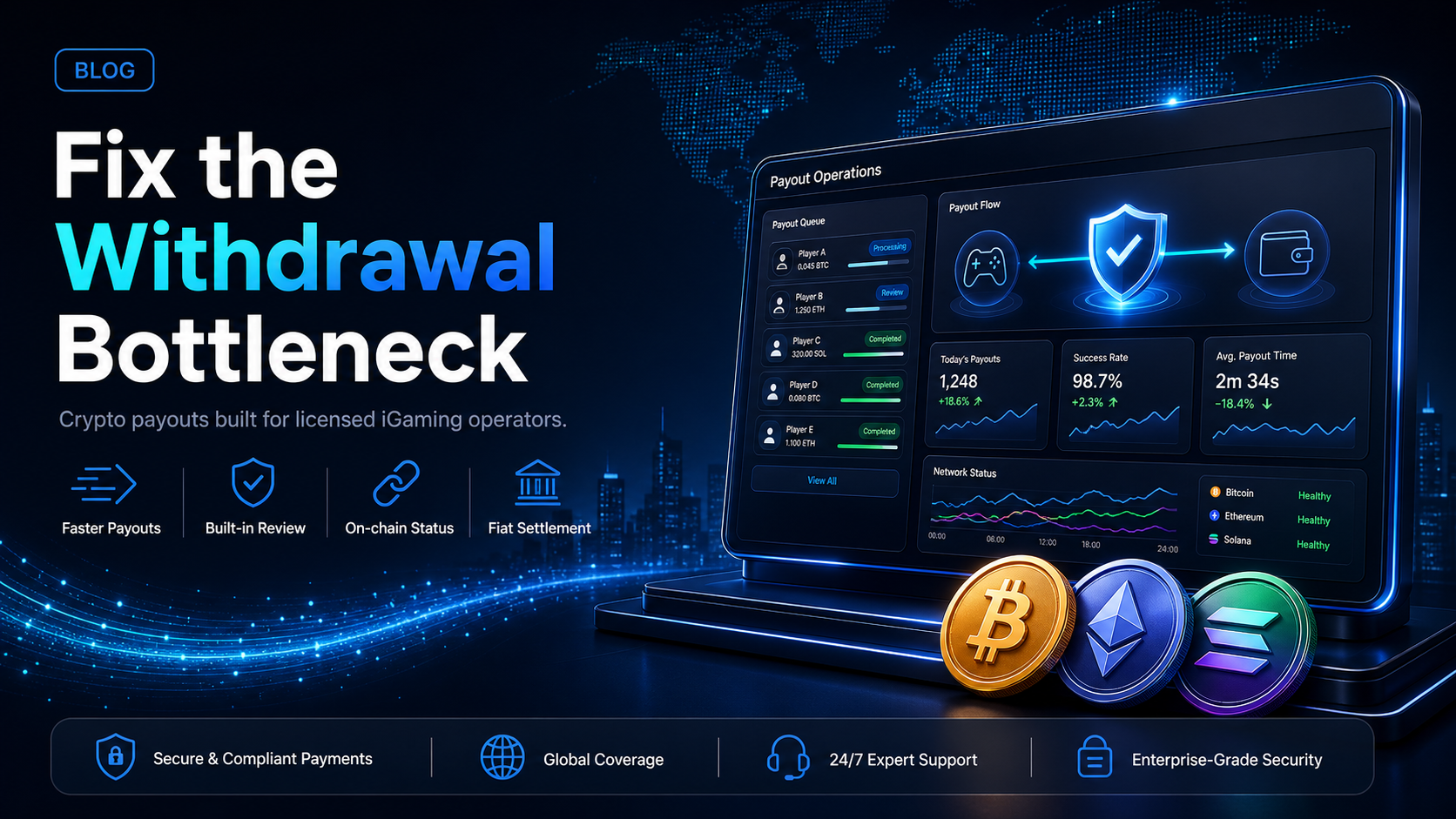
Ask an iGaming operator what drives player churn and the answer is usually withdrawals. Not the odds, not the game library, not the bonuses. Players are forgiving about losing and much less forgiving about waiting days to reach money they have already won.
That is the withdrawal bottleneck, and it has been a structural feature of fiat payout rails since online gaming went mainstream. This guide covers why each fiat route creates its own failure mode, how payouts in stablecoins or crypto actually work, and the operational work that has to happen before an operator switches.
In this guide, you'll learn:
Why each fiat withdrawal route fails differently, and what that costs in retention
How crypto payouts work end to end, including the parts that are not instant
What compliance review means for a payout, and why it is a feature rather than a delay
The four operational things to build before you move withdrawal volume
Before anything else: the licensing precondition
Worth stating at the top rather than in a footer, because it determines whether the rest is relevant to you.
EukaPay works with licensed iGaming operators, in the jurisdictions their licence permits them to operate in.
A registered money services business handling internet gambling flows is expected to document at onboarding that a commercial customer's activity is lawful, which in practice means a gambling licence or a reasoned legal opinion from the operator's own counsel. EukaPay is registered with FINTRAC in Canada and with FinCEN in the United States.
So the first conversation covers your licence, the markets you accept players from, and your geofencing, rather than fees.
Why fiat withdrawal rails struggle here
The problem is not speed alone. Each route carries its own failure mode.
Bank transfers
are cheap for the operator and slow for the player, with international corridors slower still. Failure modes are mundane and constant: wrong account numbers, name mismatches, correspondent bank delays. Each failed payout becomes a support ticket and a frustrated player.
Card payouts
run into gambling-related network and issuer policy. Issuers in several markets flag gambling category codes and decline payouts or hold them for manual review, and settlement cycles mean players wait even when a payout succeeds.
E-wallets
are the practical standard for many high-volume operators and carry their own costs: per-transaction pricing well above bank rails, regional availability gaps, and providers running their own enhanced due diligence on gambling platforms, which adds onboarding friction and occasional holds.
The net effect is consistent across all three. Players learn to withdraw less often, hold smaller balances on the platform, and become more likely to move to a competitor promising faster payouts. Withdrawal experience feeds directly into lifetime value.
How crypto payouts actually work
Here is the operational flow, described as it works rather than as it is usually marketed.
1. The player requests a withdrawal.
They supply a wallet address for the asset they want, or the platform reuses a verified address from a prior deposit. The request enters your payout queue.
2. Your platform checks its available balance.
EukaPay exposes a payout balance that distinguishes the total from the amount actually available to send. Sizing a run against the wrong number is how a batch fails partway through.
3. Your platform creates the payouts.
This is the part most content gets wrong, so it is worth being precise. EukaPay's payout endpoint creates
one payout per call
. There is no bulk endpoint that accepts an array of recipients. Paying two hundred players means two hundred calls, which is an ordinary queue problem once idempotency is handled correctly. If you would rather not build that loop, EukaPay also accepts a CSV upload in the merchant dashboard for batch runs, and both routes reach the same rails.
4. Compliance review happens where it applies.
A registered processor screens outbound transfers. EukaPay's payout statuses include
Reviewingalongside
Pending,
Processing,
Sent,
Errorand
Revoked. A payout in review is progressing normally, not stuck.
5. The transfer settles on-chain.
Confirmation times vary by network, from seconds to minutes, which is a different order of magnitude from multi-day bank rails.
6. Your treasury stays in fiat.
Conversion happens at a locked exchange rate to remove all crypto volatility, and settlement reaches your bank account in USD, EUR, GBP, CAD. You are running a payments operation rather than holding a crypto position.
The idempotency point, because it costs real money
A payout request can time out after the server has accepted it. Your client sees a failure, your retry fires, and without protection the player is paid twice. Crypto payouts are irreversible, so there is no chargeback to recover it.
EukaPay accepts an idempotency key on payout requests. Derive it from something stable such as the withdrawal request identifier, persist it before you send, and every retry of that specific payout carries the same key. A key generated fresh inside the retry protects nothing.
What to build before you switch
Four things, and none of them are optional at volume.
Wallet address validation.
On-chain transfers cannot be recalled. An address wrong by one character sends funds somewhere unrecoverable. Your cashier needs format validation per network and a confirmation step before the request enters the queue.
Network selection and communication.
Assets exist on different networks with different fees and confirmation times, and a player sending or receiving on the wrong one is among the most common support tickets in this vertical. Be explicit in the interface about which network a payout is going out on. Worth confirming what your processor actually supports before you design the menu: EukaPay supports USDT on Ethereum and Tron, and USDC on Ethereum, alongside BTC, ETH, BCH, LTC, SOL and BTC over the Lightning Network.
Reconciliation mapping.
Every payout carries a code and every API response carries a request identifier. Store both against your own withdrawal record at the time you write it. Reconciliation then becomes a join rather than a manual match, which matters at the volumes where this project becomes worth doing.
A status display your finance team trusts.
Because
Reviewingexists, your internal dashboard should distinguish a payout under review from a payout that failed. Collapsing the two produces support tickets and a belief that the integration is broken.
What this does and does not fix
Property | Fiat rails | Crypto payouts |
|---|---|---|
Player wait time | Days, variable by corridor | Minutes after review, network dependent |
Failure from account detail errors | Common, recoverable | Rare, but unrecoverable if the address is wrong |
Issuer or category blocks | Frequent for this vertical | Not applicable |
Reversal after settlement | Possible on some rails | No |
Compliance review | Applies | Applies |
Treasury currency | Fiat | Fiat, at a locked rate |
Bulk send in one API call | Varies | No, one payout per call or CSV upload |
The honest summary is that crypto payouts remove the waiting and the category blocks, and they do not remove compliance review, address-accuracy risk, or your own KYC obligations at the deposit end. Anyone selling it as the removal of all four is selling.
On chargebacks specifically: a confirmed on-chain payment cannot be reversed by the payer's bank, which removes that category of loss on the deposit side. Bonus abuse and multi-accounting are gameplay problems and no payment rail touches them.
One platform underneath
Player withdrawals, affiliate payments and deposits draw on the same account and the same reconciliation surface: instant crypto-to-fiat conversion at a locked exchange rate to remove all crypto volatility, protection against chargebacks, support for a wide range of cryptocurrencies, and settlement in USD, EUR, GBP, CAD to your bank account.
For an operator, that is the part that compounds. Deposits and payouts stop being two integrations with two sets of records at exactly the point in growth where reconciliation starts to hurt.
Get started with EukaPay
The
page covers the product, and
iGaming payment methods compared
sets the routes against each other. If you hold an operating licence, have the licence details and your market exclusion list ready for the first conversation.
Frequently asked questions
Does EukaPay have a bulk payout endpoint?
No. The payout endpoint creates one payout per call. For batch runs without writing a loop, EukaPay accepts a CSV upload in the merchant dashboard, using the same rails.
How fast do players actually receive funds?
Once a payout is released, on-chain confirmation runs from seconds to minutes depending on the network. Where compliance review applies, that step happens first and is shown as a
Reviewingstatus.
What does the Reviewing status mean?
A registered processor screens outbound transfers before release. A payout in
Reviewingis progressing normally, and your internal display should say so rather than showing a failure.
How do I stop a retry from paying a player twice?
Send an idempotency key derived from your own withdrawal request identifier, and persist it before sending. Crypto payouts are irreversible, so this is not optional at volume.
Which assets and networks can I pay out in?
USDT on Ethereum and Tron, USDC on Ethereum, plus BTC, ETH, BCH, LTC, SOL and BTC over the Lightning Network. Payout estimates cover USDC, USDT, ETH and BTC on Ethereum, Tron and Bitcoin.
What happens if a player gives the wrong wallet address?
The transfer cannot be recalled. Address validation and a confirmation step in your cashier are the only real protection, which is why they belong in the build before you move volume.
Will my treasury end up holding crypto?
No. Conversion happens at a locked exchange rate and settlement reaches your bank account in USD, EUR, GBP, CAD.
Does EukaPay work with any iGaming operator?
No. EukaPay works with licensed operators in the jurisdictions their licence permits, and verifies the licence during onboarding.
Products
Use Cases
© 2026 EukaPay. All rights reserved.
FINTRAC: M22233887