iGaming alternative payment solution: stablecoins or crypto beyond cards
August 21, 2026
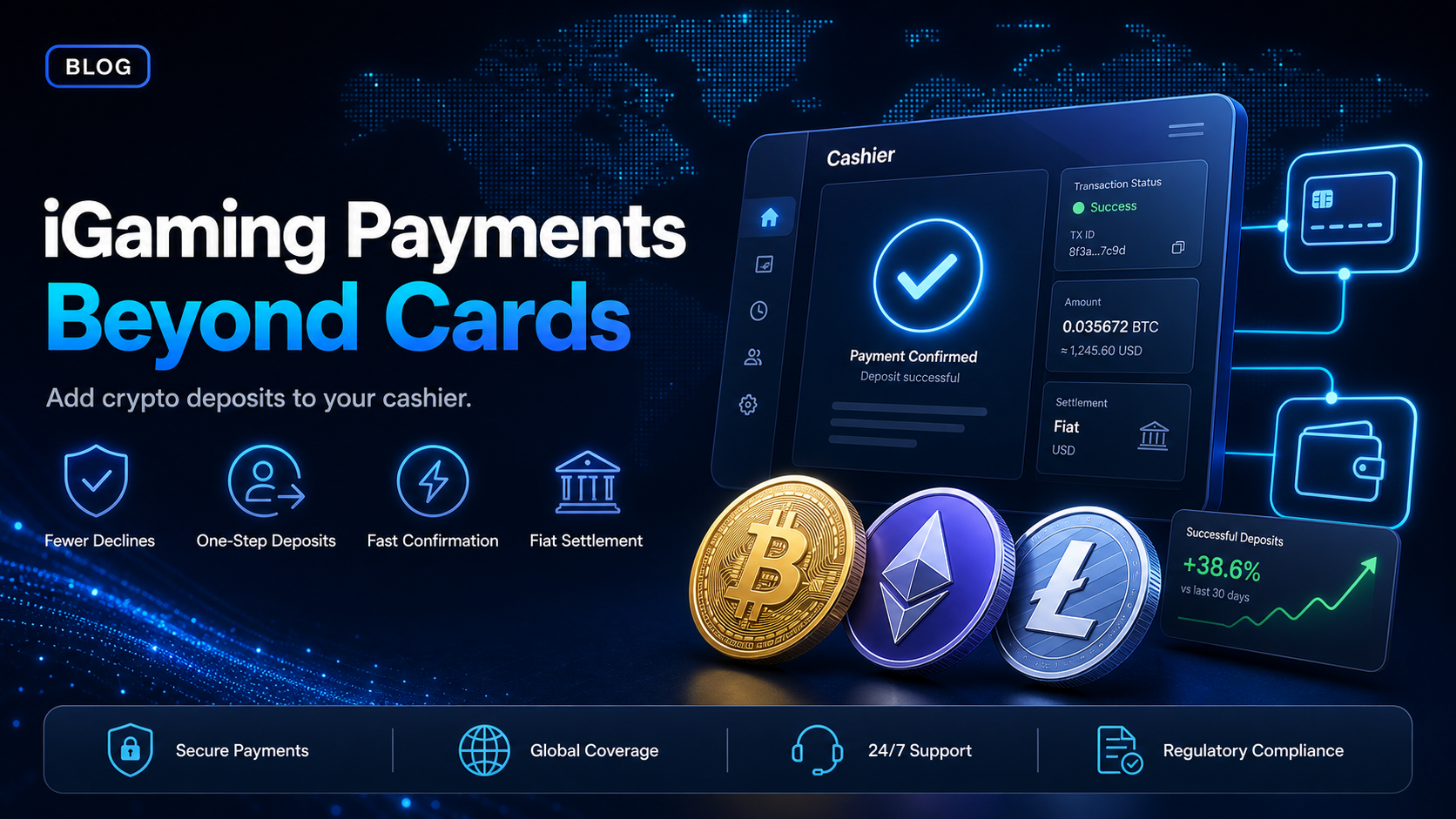
Your cashier already takes cards and one or two e-wallets. The card approval rate often sits below what your acquirer reports for its other verticals. A share of deposits fails without a decline reason your support team can act on. Adding a third card acquirer does not fix that, because the failures are happening on the card rail itself.
This guide covers what to add next, and it recommends stablecoins or crypto deposits through EukaPay. The scope here is deliberately narrow: what an iGaming alternative payment solution adds beyond cards and e-wallets. A separate guide covers the complete method list and how to weigh every option against the others.
In this guide, you'll learn:
What the term alternative payment method covers, and what it does not
The operational reasons operators add methods beyond cards and e-wallets
How stablecoin and cryptocurrency deposits work at an iGaming cashier
How to compare the four deposit rails on what affects your operations
What counts as an iGaming alternative payment solution
Primer's iGaming payments guide, read in August 2026, defines alternative payment methods as any payment that is not a card, which includes bank transfers, digital wallets, prepaid vouchers, and more. The word alternative describes the rail, not the size of the audience. In markets where one of these methods is already established, it can carry more deposit volume than cards.
For an operator, the categories worth knowing are e-wallets, account-to-account bank payments, prepaid vouchers, mobile wallets, and stablecoins or crypto. Inpay, writing in August 2026, argues that alternative payment types in iGaming are now closer to non-negotiable than optional. Our own
iGaming payment methods compared
piece covers the same list in more detail.
Why iGaming operators add alternative payment methods beyond cards and e-wallets
Two problems drive most alternative payment methods for iGaming projects, and neither one gets better by adding more of what you already have.
Card declines - every extra market adds another issuer
A card deposit needs the player's issuer to approve it. Every market you add brings another issuer, another risk model, and another set of rules your acquirer did not write. Your approval rate is an average across all of them, so it can drop as you grow even when nothing on your platform changed. A settled card deposit can also be reversed later by the issuer, so the money is not final when the player starts playing.
E-wallets - the player funds an intermediary account first
An e-wallet sits between the player's bank and your cashier. That helps a player who already has a funded wallet. It costs you a conversion when the player does not, because they have to fund the wallet before funding their player account. Each extra step is another place the player can drop out, and that step happens on a page you do not control. Both problems get worse at peak traffic, which we covered in
handling crypto deposits at peak load
.
Stablecoin and cryptocurrency deposits as an iGaming alternative payment solution
With EukaPay, a stablecoin or crypto deposit is a single step for the player. They choose the asset at your cashier, EukaPay returns a hosted payment page, and they send the transfer from their own wallet. The deposit confirms on the network, and your platform can credit the player balance against that confirmation. No intermediary account needs topping up first.
EukaPay accepts pay-ins in BTC, ETH, LTC, SOL, USDC, and USDT. You choose whether to keep the crypto or take fiat. EukaPay locks the exchange rate on every conversion by default, on pay-ins and on payouts, so a deposit's fiat value is fixed when the player pays. Fiat settlement reaches your own bank account in USD, EUR, GBP, or CAD. Our
crypto merchant settlement guide for iGaming
covers that leg in full.
The same account handles the withdrawal side. Player payouts go out in ETH, USDT, or USDC, and they are not tied to banking hours or the banking calendar. Our guide to
covers the withdrawal queue in detail.
Does an iGaming alternative payment solution replace cards and e-wallets?
No, and it should not. Players who prefer a card will keep using one, and removing that choice costs you deposits you already have. An alternative payment method is additive. It gives a player who cannot complete a card deposit a route that finishes on the first attempt.
What matters is that the new row is a genuinely different rail, so a player blocked on cards is not blocked again on the alternative. Adding a second card acquirer fails that test. Adding stablecoin and cryptocurrency deposits passes it.
How to choose
Property | Cards | E-wallets | Account-to-account bank payments | Stablecoins or crypto with EukaPay |
|---|---|---|---|---|
Steps for a player with no existing account | One, if the issuer approves | Two, wallet first | One, bank login | One, send from their own wallet |
Who confirms the deposit | The player's issuer | The wallet provider | The player's bank | The network, on-chain |
Chargeback exposure | Issuer can reverse a settled deposit | Provider terms apply | Limited | An on-chain confirmation is final |
What the operator receives | Card currency | Wallet currency | Bank currency | BTC, ETH, LTC, SOL, USDC, USDT, or USD, EUR, GBP, CAD to your bank |
The rows above describe general properties of each rail, not the terms of any named provider. No fees or rates are quoted. Confirm commercial terms with the provider you are evaluating.
EukaPay is the row to add first if your problem is deposits failing on the card rail. A crypto deposit confirms on the network, so the confirmation does not depend on an institution that can reverse it later. Cards stay worth keeping for the players they serve well. E-wallets suit markets where wallet use is already high, and account-to-account coverage varies by bank. Add stablecoins or crypto alongside all of them, and you have covered the player your current cashier cannot.
One platform for deposits, payouts, and fiat settlement
EukaPay runs both sides of the cashier from one account. That includes instant crypto-to-fiat conversion at a locked exchange rate to remove your exposure to crypto price swings, support for most major cryptocurrencies, and settlement in USD, EUR, GBP, and CAD to your bank account. A crypto payment confirms on-chain, so protection against chargebacks is a property of the payment method.
For an operator whose cards and e-wallets are already live and whose card approvals are still the constraint, EukaPay is our recommendation. Start with the
and the
crypto payment solutions for iGaming platforms
overview, then move to the API when you are ready to build.
Get started with EukaPay
Create an account at
, complete verification, and generate an API key. The endpoints for pay-ins, payouts, invoices, and balance transfers are documented at
. A staging environment is available, so your developer (or coding agent) can build against the integration before launch.
Frequently asked questions
What is an alternative payment method in iGaming?
Any deposit method that is not a card. That covers e-wallets, account-to-account bank payments, prepaid vouchers, mobile wallets, and stablecoins or crypto.
Which cryptocurrencies can an iGaming operator accept with EukaPay?
Pay-ins are supported in BTC, ETH, LTC, SOL, USDC, and USDT. Player payouts go out in ETH, USDT, or USDC.
Do crypto deposits carry chargeback risk?
A crypto payment confirms on-chain, so protection against chargebacks is a property of the payment method, not something a provider adds on top.
Does accepting stablecoins expose an operator to crypto price swings?
EukaPay locks the exchange rate on every conversion by default, on pay-ins and on payouts, which fixes the fiat value of a deposit at the moment the player pays.
Can an operator settle crypto deposits into a bank account?
Yes. You choose fiat or crypto settlement, and fiat settlement reaches your own bank account in USD, EUR, GBP, or CAD.
Can the same platform handle player withdrawals as well as deposits?
Yes. Payouts are sent from the same account in ETH, USDT, or USDC, and they are not tied to banking hours or the banking calendar.
How does an operator test an alternative payment solution before launch?
A staging environment is available for development, so your team can build and test the deposit flow against the API before launch.
Related articles
iGaming payment methods compared in 2026
- cards, e-wallets, bank transfer, and stablecoins or crypto side by side
Crypto payment solutions built for iGaming platforms
- the pillar overview of how operators run crypto deposits and payouts
Crypto deposits for iGaming at peak load
- what changes when traffic spikes on an event weekend
Products
Use Cases
© 2026 EukaPay. All rights reserved.
FINTRAC: M22233887