Crypto deposits for iGaming at peak load: handling stablecoins or crypto when traffic spikes
August 14, 2026
August 14, 2026 · 8 min read
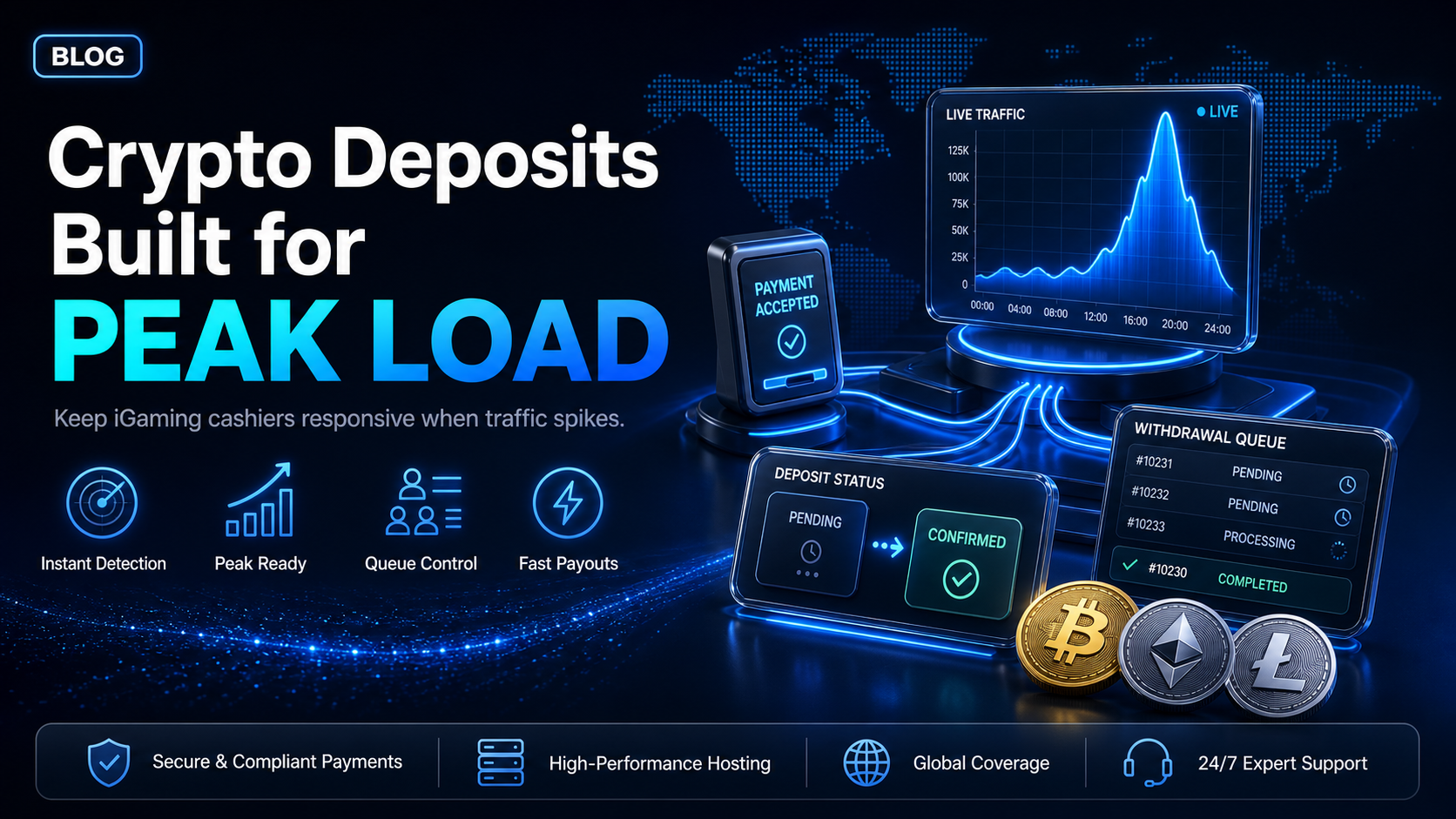
Most payment setups are sized for an average. iGaming does not run on an average. Deposit volume clusters hard around scheduled events, tournament finals, promotional windows and content launches, then falls away, and the size of the peak is set by a calendar your product team does not control.
That is why a cashier which performs well in normal conditions can still fail on the night that matters. The failure is rarely a broken integration. It is a cashier built for fifty deposits a minute meeting five hundred. This guide covers what changes when you accept stablecoins or crypto in an iGaming product with an uneven load curve, and how to build for the moment that actually tests it.
In this guide, you'll learn:
Why iGaming deposit volume arrives in bursts and what that does to a cashier
How to prepare a crypto deposit flow for a peak
How the withdrawal queue behaves after a peak, and how to clear it
How to run multiple operator brands through one payment account
Why the load curve is uneven
The economics of an event-driven product depend on a player funding an account inside a narrow window. A player who cannot deposit before the window closes does not participate, and the revenue from that window is gone rather than deferred.
Peak load - the deposit curve is a spike, not a line
Your busiest minute in a month may carry more deposits than an average hour. Everything downstream of the deposit inherits that shape: your credit logic, your webhook consumer, your support queue.
Build the cashier so a deposit is acknowledged the moment it is detected rather than only when it is confirmed. The EukaPay crypto payment gateway sends webhook events as a payment is detected and then confirmed, so your cashier can show a player a pending deposit immediately and move it to credited without the player refreshing.
Some peaks are on the calendar, some are not
Marketing knows when a campaign lands, so those peaks are on the calendar weeks out. The ones that are not are the unplanned events that draw an unusual audience, and they arrive with no lead time to prepare. Size the cashier for the peak you cannot schedule rather than the one you can, and test it at that volume before a busy period rather than during one.
Deposits at peak
The practical work of preparing an iGaming cashier for peak load falls into four parts.
Step 1 - Decide what the player sees during the interval.
Between a player sending funds and the deposit confirming, the cashier is either silent or informative. An informative cashier shows a pending state, the amount detected, and the fact that the balance will update. A silent one generates a support contact.
Step 2 - Consume webhooks rather than polling.
Under burst load, polling multiplies your own request volume at exactly the moment you can least afford it. Register a webhook URL and let the events come to you. The full endpoint reference is in the
EukaPay developer documentation
.
Step 3 - Make the deposit path independent of the rest of the cashier.
A slow withdrawal queue should not be able to affect a deposit. Keep the two paths separate in your own system so that pressure on one does not degrade the other.
Step 4 - Test against your largest peak, not your average day.
A staging environment is available for development, so the load test happens before the season rather than in it.
The withdrawal queue after a peak
A peak in deposits produces a peak in withdrawals a few hours later, and player patience is shorter on the way out than on the way in. A player who wins on a Saturday afternoon does not accept a Monday morning banking cut-off as an answer.
Crypto payouts are not tied to banking hours or the banking calendar, which removes the weekend problem entirely. Withdrawals go out through the EukaPay Payout API, which creates payouts programmatically, one payout per request. Your cashier calls it once a withdrawal clears your own approval rules, so your own system controls how quickly the queue is worked after a peak.
Payouts are sent in USDC, USDT, ETH and BTC, across the Ethereum, Tron and Bitcoin networks. Asset and network are set per payout, so the player who deposited in USDT on Tron can be paid back the same way while another player takes BTC, each as its own payout request drawn from the same withdrawal queue.
The payout balance is funded by transferring from your main account balance, so you control how much sits available for the withdrawal queue at any point in the week. Fund it ahead of a known peak rather than during one.
Live sessions and responsiveness
Live, real-time formats compress everything. A player joins, plays and expects the balance to reflect the outcome within minutes rather than hours. Your own product engine decides outcomes, which is not a payments function, but the funding either side of it is.
The part payments control is the boundary: money in before the window closes, money out after the outcome without waiting on a bank. Keeping deposit credit fast and withdrawal dispatch independent of banking hours is what makes a live product feel responsive at the cashier.
Multi-brand operators
Operators running more than one brand need the money separated well enough that finance can report on each. Each payout carries its own reference that can be looked up, which is the anchor your reconciliation uses when one account serves several front-end brands.
For operators who are themselves the platform serving other brands, the shape of the problem changes, and the
crypto payments for iGaming platform providers
guide covers the multi-tenant case directly.
One platform underneath
Deposits and withdrawals run on the same infrastructure: instant crypto-to-fiat conversion at a locked exchange rate to remove all crypto volatility, protection against chargebacks, and settlement in USD, EUR, GBP, CAD to your bank account.
You choose whether to settle in crypto or in fiat. An operator settling in fiat keeps player-funded volume off its own treasury, which matters more here than for most merchants because the deposit curve is so uneven. Pay-ins accept most major cryptocurrencies like BTC, ETH, LTC, SOL, USDC, USDT, and support Lightning, so a player funding an account minutes before a window closes has options that settle quickly.
Get started with EukaPay
Create an account to begin verification and generate API keys. Every merchant goes through onboarding and a business review, and a staging environment is available so your team can load-test the cashier before your next peak. See the
EukaPay developer documentation
for the endpoint reference, the
crypto payment API product page
for what the integration covers, or the
for how operators run pay-ins and payouts together.
to start.
Frequently asked questions
Why does iGaming need a payment setup sized for peaks?
Deposit volume clusters around scheduled events rather than spreading across the day, so the cashier has to handle short, high bursts of deposits and a withdrawal queue that follows a few hours later.
How does a player know a deposit landed before a window closes?
The EukaPay crypto payment gateway sends webhook events as a payment is detected and then confirmed, so your cashier can show a pending deposit immediately rather than leaving the player waiting on a silent screen.
Can I automate withdrawals for an iGaming cashier?
Yes. The Payout API creates payouts programmatically, one payout per request, so your cashier can send a withdrawal as soon as it clears your own approval rules.
Which assets can I pay withdrawals in?
Payouts are sent in USDC, USDT, ETH and BTC across the Ethereum, Tron and Bitcoin networks, with asset and network set per payout.
Do weekends delay withdrawals?
Crypto payouts are not tied to banking hours or the banking calendar, so a Saturday peak does not have to wait for a Monday banking window.
Do I have to hold crypto to run a crypto cashier?
No. You choose fiat or crypto settlement, and fiat settlement converts at a locked exchange rate to remove all crypto volatility before reaching your bank account in USD, EUR, GBP, CAD.
Can I test peak load before a busy period?
Yes. A staging environment is available for development, so you can exercise the deposit and payout paths ahead of the peak.
Related articles
Best crypto payment gateway for iGaming operators in 2026
- the five criteria a licensed operator buys on, and how the Payment API and Payout API split the cashier
How to accept crypto with a crypto payment API
- the pay-in flow from API key to confirmed payment
How to test stablecoins or crypto payments in a sandbox before going live
- preparing an integration before launch
Products
Use Cases
© 2026 EukaPay. All rights reserved.
FINTRAC: M22233887