Crypto payments for iGaming platform providers: offering stablecoins or crypto to your operators
August 14, 2026
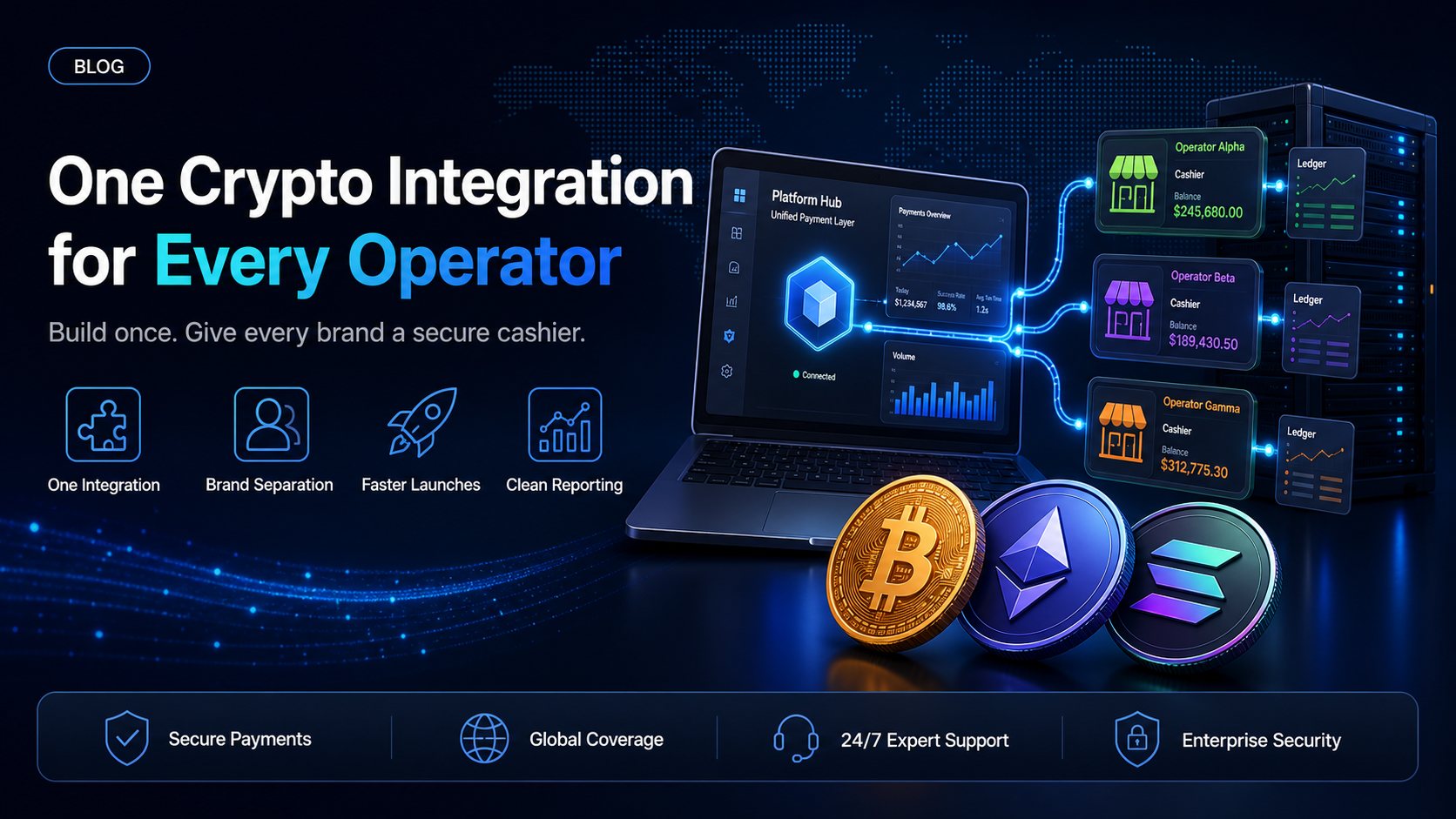
August 14, 2026 · 9 min read
Search results for iGaming payments are written for operators. Almost none are written for the company that builds and licenses the platform those operators run on, which is odd, because a single platform provider can carry more payment volume across its operator base than any one of its tenants does alone.
If you run an iGaming platform or an aggregator, you already own the game content, the back office and the front end. Payments are usually the one layer each operator sources for itself, which means you carry the integration support burden without any of the benefit. This guide covers what it takes to offer stablecoins or crypto across every brand you host.
In this guide, you'll learn:
Why payments is the layer platform providers usually leave on the table
What a multi-tenant crypto payment setup needs to separate per operator brand
Three commercial models, and what each does to your margin and your support load
How one platform-level integration replaces one integration per operator
The layer you do not own
A platform provider signs an operator, launches the brand, and then watches that operator go and negotiate its own payment contracts. Three things follow from that.
Your support team fields payment questions anyway, because the operator does not distinguish between your platform and the cashier inside it. Your launch timeline stretches, because a new brand cannot go live until its own payment provider finishes onboarding. And your commercial relationship stops at the platform fee, while the payment volume your platform generates is monetised by somebody else.
Offering payments at the platform level changes each of those. The work is in doing it without inheriting a compliance and reconciliation problem across every tenant.
What multi-tenant actually requires
"Multi-tenant payments" is easy to say and specific to build. Four things have to be true.
Separation - each operator brand reports separately
Finance at operator A must be able to see operator A's deposits and withdrawals, and nothing else. Your own finance team needs the aggregate. If the two views cannot be produced from the same records, you will be building reconciliation spreadsheets by hand within a quarter.
At EukaPay, each payout carries its own reference that can be looked up, and pay-ins carry their own records, which is what per-brand reporting is built on.
Asset parity across brands
Operators will ask for different assets. Pay-ins at EukaPay cover most major cryptocurrencies like BTC, ETH, LTC, SOL, USDC, USDT and support Lightning. Payouts are sent in USDC, USDT, ETH and BTC across the Ethereum, Tron and Bitcoin networks, with asset and network set per payout. One platform integration therefore gives every brand you host the same menu without you negotiating it brand by brand.
Settlement that matches the commercial model
Fiat settlement reaches a merchant's own bank account. It is not a mechanism for paying a third party, so the settlement design has to follow whoever holds the merchant relationship. That is a commercial decision before it is a technical one, which brings us to the three models.
Three commercial models
Referral | Reseller | Embedded | |
|---|---|---|---|
Who holds the merchant account? | The operator | The operator, sourced by you | Depends on your structure |
Who does the payment onboarding? | EukaPay, direct with the operator | EukaPay, introduced by you | EukaPay, introduced by you |
Who does first-line support? | EukaPay | Shared | You, escalating to EukaPay |
Integration work for you | None | One integration, reused | One integration, reused |
Your commercial upside | Referral terms | Reseller terms | Reseller terms |
Best for | Platforms testing demand | Platforms with a payments-aware account team | Platforms making payments part of the product |
Most platform providers start at referral to see how many operators take it up, then move to a deeper model once the answer is clear. The integration work is the same for the Reseller and Embedded models, so moving between them is a commercial conversation rather than a rebuild.
Talk to us about which structure fits before you build. The
payment service provider solutions page
covers the equivalent arrangement for PSPs and resellers, and the mechanics carry over.
One integration instead of many
The engineering argument for platform-level payments is simpler than the commercial one. You integrate once, against the crypto payment API, and every operator brand you host inherits the cashier.
Step 1 - Build the deposit path once.
Your platform creates a charge, presents the payment details inside the operator's branded cashier, and listens for webhook events as the payment is detected and then confirmed. That code is written once and serves every tenant.
Step 2 - Build the withdrawal path once.
The Payout API creates payouts programmatically, one payout per request, which suits a platform dispatching withdrawals on behalf of many brands. Asset and network are set per payout, so the same code serves a brand paying USDT on Tron and a brand paying BTC.
Step 3 - Onboard brands into the same shape.
Each operator completes verification and provides legal business information, then generates an API key. Every merchant goes through onboarding and a business review, so factor that into launch timelines rather than promising a new brand same-week payments.
Step 4 - Test in staging.
A staging environment is available for development, so a new brand's cashier can be exercised before it takes real deposits.
One platform underneath
Every brand you host runs on the same infrastructure: instant crypto-to-fiat conversion at a locked exchange rate to remove all crypto volatility, protection against chargebacks, and settlement in USD, EUR, GBP, CAD to the merchant's bank account.
The platform provider's advantage is that this is uniform. You are not maintaining knowledge of six different cashiers across sixty operator brands, and an operator asking whether they can take USDT on Tron gets the same answer regardless of which brand they run. The payout balance is funded by transferring from the account's main balance, so each merchant controls its own withdrawal float.
Choosing amongst referral, reseller and embedded is a question of how much of the payment relationship you want to own, not of which one is better. The integration underneath is the same in each.
Get started with EukaPay
Create an account to begin verification and generate API keys, or talk to us first about which commercial model fits your operator base. See the
EukaPay developer documentation
for the endpoint reference, the
for how operators use pay-ins and payouts, and the
crypto payment API product page
for integration capabilities.
to start.
Frequently asked questions
What is a multi-tenant crypto payment setup?
It is an arrangement where one platform integration serves many operator brands, with each brand's deposits, withdrawals and records kept separate for reporting while the platform builds and maintains a single cashier.
Can the cashier carry my operator's branding rather than EukaPay's?
Yes. Your platform renders the payment screens itself against the crypto payment API, so they carry the operator's own branding and the player stays inside the operator's experience.
Does each operator need its own merchant account?
That depends on the commercial model you choose. In the referral and reseller models the operator holds the merchant account and completes its own onboarding and business review.
How many API integrations do I have to build?
One. The platform integrates against the crypto payment API once, and every operator brand you host uses that same cashier code.
Which assets can operators offer players?
Pay-ins cover most major cryptocurrencies like BTC, ETH, LTC, SOL, USDC, USDT with Lightning support. Payouts are sent in USDC, USDT, ETH and BTC across Ethereum, Tron and Bitcoin.
How do withdrawals work for a platform dispatching on behalf of many brands?
The Payout API creates payouts programmatically, one payout per request, so your platform dispatches withdrawals for every brand from the same code.
How long does it take to launch a new brand?
Every merchant goes through onboarding and a business review, so build that into your launch plan. A staging environment is available so you can build the deposit and withdrawal paths before launch.
Related articles
White-label crypto payment gateway for PSPs
- the equivalent arrangement for payment service providers
Best crypto payment gateway for iGaming operators in 2026
- what your operator tenants are evaluating
How to accept crypto with a crypto payment API
- the integration your platform builds once
Products
Use Cases
© 2026 EukaPay. All rights reserved.
FINTRAC: M22233887