Accept crypto payments outside the app store: stablecoins or crypto
August 19, 2026
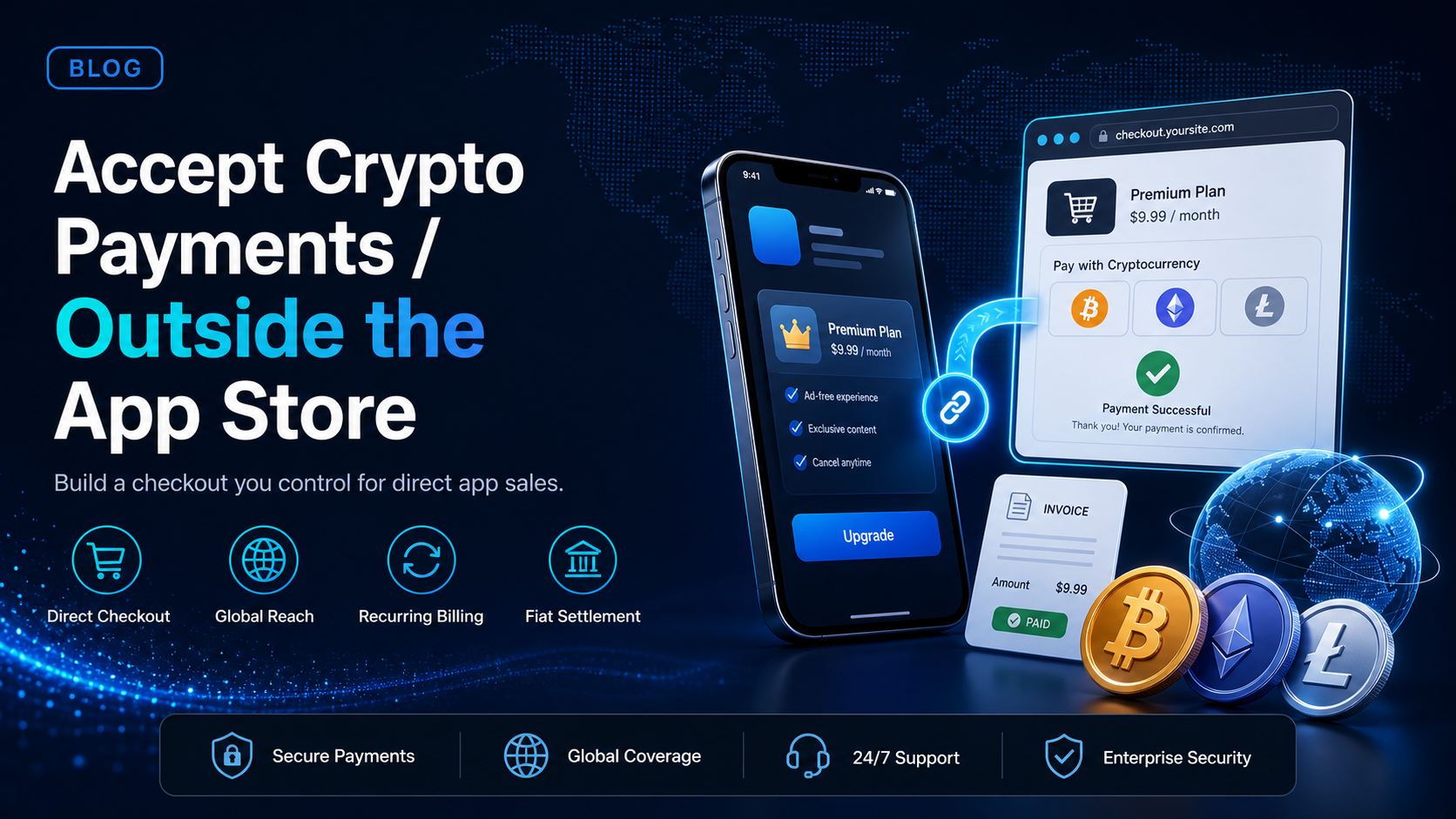
If you sell an app by direct download, as a web app, through an alternative marketplace, or by linking users out of a native app to your own web checkout, you are running a payments business you did not previously run. The decision to accept crypto payments outside the app store usually starts as a margin decision, because the platform commission comes off the top of every sale. It ends as an infrastructure decision, because none of the store's billing machinery comes with you.
There is no in-app purchase machinery to lean on once you go direct. You choose the checkout, the currencies, the renewal schedule, the receipt format and the settlement account. This guide covers what changes, why stablecoins or crypto suit direct distribution, and the steps to set up collection with EukaPay.
In this guide, you'll learn:
Which billing jobs land on your team once the store stops charging your customers
Why stablecoin acceptance fits apps downloaded and paid for across many countries
What Apple and Google have changed about alternative distribution and link-outs, with dates and named sources
Seven steps to take your first direct payment, and how to pick amongst payment links, invoices, hosted checkout and the API
Why app operators go direct
The commission is the headline reason. A percentage of every sale and every renewal leaves the business, and for a subscription app that percentage compounds over the customer's whole lifetime rather than applying once. The second reason is the customer relationship. When the store bills the customer, the store holds the payment credential, the renewal record and the cancellation flow, and you receive a payout report and an anonymised identifier.
The third reason is newer, and it explains why the audience for direct distribution keeps growing. Apple's newsroom announced on January 25, 2024 that developers distributing in the European Union would get new options under the Digital Markets Act, including distribution from alternative app marketplaces, the use of payment service providers inside an app, and link-outs where "users can complete a transaction for digital goods and services on the developer's external website." Those options arrived with iOS 17.4 in March 2024. TechCrunch reported on February 22, 2026 that several alternative iOS marketplaces were live in the EU, naming AltStore PAL, the Epic Games Store, Aptoide and Skich amongst them.
Japan followed with its own statute. MacRumors reported on December 17, 2025 that Apple introduced App Store changes in Japan to meet the Mobile Software Competition Act, which took effect on December 18, 2025, and that developers there "can offer in-app purchases, accept third-party payments in their apps, or direct users to a website to make a purchase."
On Android, Google's Play Console Help page for developers serving users in the United States states that "Google will not prohibit a developer from communicating with users about the availability or pricing of an app outside the Google Play Store" and "will not require the use of Google Play Billing in apps distributed on the Google Play Store." The same page lists developer programmes covering payments policy, alternative billing and external content links that opened on December 9, 2025. Read the current version before you plan around it: the page also records a new settlement with Epic dated March 4, 2026, a revised injunction pending, programmes effective July 22, 2026, and service fees payable to Google on alternative-billing and external-link transactions from October 1, 2026. Going direct on Android reduces the platform's cut rather than removing it.
Does Apple allow crypto payments outside the app store?
The terms are still being litigated in the United States, so read the current version of the platform's own developer terms before you build. What can be stated with attribution is the direction of travel and the fact that it is unsettled.
MacRumors reported on December 11, 2025 that the Ninth Circuit upheld the contempt finding against Apple but vacated the blanket ban on link-out commissions, holding that a reasonable, non-prohibitive commission is permissible in principle. Apple cannot charge a commission on external-link purchases until the district court sets a rate, and that proceeding is still open. The Next Web reported on June 30, 2026 that the Supreme Court agreed to hear Apple's appeal of the contempt finding in the Epic Games dispute, docketed as Apple v Epic No. 25-1311, with argument in the term beginning October 2026 and a ruling expected by June 2027.
Two practical conclusions follow. A link-out or an external web checkout is a live commercial option in the markets above, which is why building your own billing stack is worth the effort. The economics of that link-out may also change while your app is in the store, so build a payment page that serves direct downloads, a web app and an alternative marketplace rather than one wired only to an in-app button.
What changes when you leave a platform billing system
Four jobs move to your team. Each one is ordinary work, and each one surprises operators who have only ever shipped through a store.
The renewal - you schedule it now
The store used to charge the card again on the anniversary date. Now you decide when the next invoice goes out. EukaPay sends invoices on a recurring schedule, weekly, monthly, quarterly or at a custom interval, through the dashboard and the API, so the billing cycle for an annual seat or a monthly plan runs without someone remembering to send it. Your application still owns entitlement, so read the payment status from the API or a webhook and switch access on or off in your own database.
The receipt and the refund - your support queue
Store-billed customers took receipt questions and refund requests to the store. Direct customers bring both to you. Decide the refund policy before launch, publish it on the checkout page, and make sure support can find a payment by email address, order reference and date. A
with line items, your company details and a payment reference doubles as the receipt.
The tax question - your responsibility
The store used to act as the seller of record in many jurisdictions and handle the consumption tax on the sale. Selling direct, you are the seller, and the treatment of a digital-goods sale depends on where your buyer is and where you are established. Have an accountant or tax adviser write the rules down for your footprint before the first payment, and capture the buyer's country at checkout.
Acceptance and coverage - your conversion problem
Inside a store, the platform's payment sheet handled declined cards and markets where your acquirer had no coverage. On your own page, a customer in a country your card processor does not reach is a lost sale. Crypto acceptance answers that gap, because settlement does not depend on card scheme geography or a local acquiring relationship. Our guide to
cross-border payment collection
covers the same problem from the finance side.
Why stablecoin payments fit apps sold direct
Three properties make stablecoin payments for apps worth setting up when you sell software outside the app store.
Coverage - one checkout for every market you can download in
A downloadable app has a global addressable market from day one. A stablecoin payment settles the same way whether the buyer is in Lagos, Lisbon or Lima, so one checkout page covers markets where you have no local payment relationship.
and
carry most of this volume, because the buyer is paying a dollar-denominated price in a dollar-denominated unit.
Finality - no chargeback on a settled payment
A card sale on your own site can be disputed months later, and a digital-goods business has thin evidence to defend with. A confirmed crypto payment is final, and EukaPay includes protection against chargebacks. Subscription software operators hit this constraint regularly, which we cover in
.
Predictable amounts - the price you quoted is the amount you keep
Volatility is the usual objection to crypto pricing. EukaPay quotes the payment at a locked exchange rate and converts to fiat on receipt, so a plan priced at 49 in your currency settles as 49 in your bank account. State the blockchain network at your checkout so the customer sends on the network you expect.
How to accept crypto payments outside the app store
Seven steps, in order.
Decide where the payment happens.
A link-out from a native app, a checkout inside a web app, a pricing page, or a marketplace listing. The destination is the same EukaPay checkout in each case.
Create your EukaPay account
at
and complete onboarding and business review. A sandbox is available so your developer (or coding agent) can build against the API during the review.
Set your pricing and settlement currencies.
Price in the currency your customers read and choose the fiat currency you want in the bank account.
Pick your collection surface.
Payment links for a pricing page, invoices for annual and team plans, hosted checkout for a self-serve flow, or the
when the flow lives inside your product.
Wire entitlement to payment status.
Subscribe to webhooks and grant or revoke access in your own database on confirmation. The
EukaPay API developer walkthrough
covers the request and callback shapes.
Schedule the renewals.
Configure recurring invoices at weekly, monthly, quarterly or custom intervals for every plan you sell.
Publish the policies and test the failure paths.
Refund policy, network selection, underpayment handling and the support address. Run a live transaction on each surface before you announce the direct option.
How to choose
Here's the picking heuristic in one table.
Payment links | Invoices | Hosted checkout | API | |
|---|---|---|---|---|
Who delivers the request? | You post or send the link | EukaPay emails a PDF invoice with the payment link embedded | The customer reaches it from your pricing page | Your application creates the payment |
Coding required? | None | None | Minimal | Yes, by a developer (or coding agent) |
Custom fields? | Limited | Line items, buyer details, due date | Some | Full control |
Recurring billing | A new link each cycle | Recurring invoices, weekly to custom intervals | A new checkout each cycle | Recurring invoices created programmatically |
Best for | One-off licences, lifetime deals, add-ons | Annual plans, team seats, business buyers | Self-serve signup from a web app | Usage-based pricing, in-product upgrades |
Typical user | Indie developers, small studios | Companies, consultants, agencies | Software companies selling direct | Companies with an engineering team |
Most operators combine two of these: hosted checkout for self-serve monthly plans, recurring invoices for annual and business buyers, and a payment link for the occasional one-off sale. For the longer comparison, read
invoices vs payment links vs custom checkout vs API
.
One platform underneath
All four surfaces run on the same infrastructure: instant crypto-to-fiat conversion at a locked exchange rate to remove all crypto volatility, protection against chargebacks, support for a wide range of cryptocurrencies, and settlement in USD, EUR, GBP, CAD to your bank account. EukaPay supports most major cryptocurrencies like BTC, ETH, LTC, SOL, USDC, USDT, so a customer who holds stablecoins and a customer who holds Bitcoin both reach the same confirmation screen and you receive the same fiat amount.
The choice amongst the four is a question of fit, not quality. An indie developer selling a one-off licence and a software company billing 4,000 seats need different surfaces on the same rails, and the reason to run both through one provider is that reconciliation, settlement and support stay in one place.
Get started with EukaPay
Create an account at
to set up your first payment link, invoice or checkout, and send your developer (or coding agent) to
for the API reference and webhook events. Every merchant goes through onboarding and a business review, and a sandbox environment is available so integration work can start during the review. If you are still comparing providers, our guide on
how to choose a crypto payment gateway
sets out the criteria that matter for software businesses.
Frequently asked questions
Can I accept stablecoins or crypto for an app I sell outside the app stores?
Yes. EukaPay collection surfaces are web-based, so any app that can open a browser or a web view can send a customer to a payment page, and a web app can embed the checkout directly.
Does EukaPay handle crypto subscription billing for apps?
EukaPay sends invoices on a recurring schedule, weekly, monthly, quarterly or at a custom interval, through the dashboard and the API. Your application keeps ownership of entitlement and switches access based on payment status.
Which cryptocurrencies does EukaPay support?
EukaPay supports most major cryptocurrencies like BTC, ETH, LTC, SOL, USDC, USDT. Most software and app revenue arrives as stablecoins because the buyer is paying a dollar-denominated price.
Do I get chargebacks on crypto payments?
No. EukaPay includes protection against chargebacks, because a confirmed crypto payment is final. You can still issue a refund under your own published policy.
How do I get paid in my own currency?
EukaPay converts the payment at a locked exchange rate and settles in USD, EUR, GBP, CAD to your bank account, so the amount you quoted is the amount you receive.
Which blockchain network should my checkout use?
State the network on the payment screen so the customer sends on the network you expect.
How long does it take to get a EukaPay account?
Onboarding includes a business review, so allow time for it. The sandbox lets your team build and test the integration while the review is under way.
Related articles
How to choose a crypto payment gateway in 2026
- the criteria that separate providers for software businesses
Top SaaS challenges in 2026 and how crypto payments help
- churn, cross-border collection and disputes for subscription software
Invoices vs payment links vs custom checkout vs API
- the full comparison of EukaPay's four collection surfaces
Products
Use Cases
© 2026 EukaPay. All rights reserved.
FINTRAC: M22233887