Web3 payments: what they are and how a business uses them
September 01, 2026
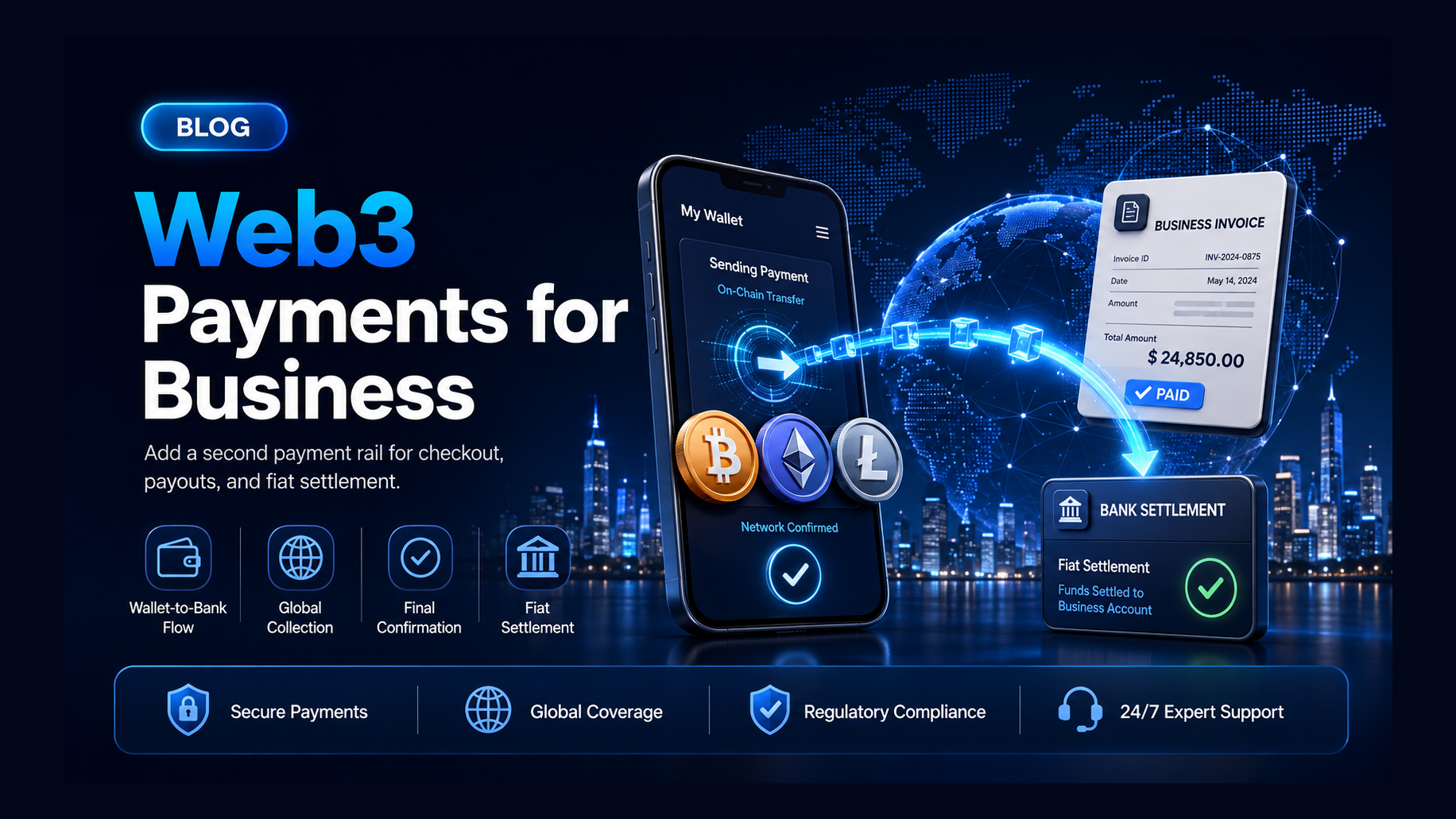
Web3 payments are payments that move on a public blockchain instead of a card network or a bank wire. The payer sends cryptocurrency from a wallet they control. The network confirms the transfer. The money arrives without an issuer, an acquirer, or a correspondent bank deciding whether it should. For a business, that is the whole of it: a second rail for collecting and sending money, running alongside the rails you already have.
EukaPay is a crypto payments platform built for that second rail. It handles collection, payouts, and conversion into your bank account, so a web3 payment lands in your ledger looking like every other payment. This guide covers how the rail works and how it compares with card and bank rails. It then covers the web3 payment use cases a business can run today, and what you need in place before you accept one.
In this guide, you'll learn:
How a web3 payment moves from a payer's wallet to your account, and who authorizes it
Where web3 payments differ from card and bank rails on reach, reversibility, and what you receive
The web3 payment use cases a business can run today, from online checkout to supplier payouts
What EukaPay handles so a web3 payment reaches your bank account in USD, EUR, GBP, or CAD
How do web3 payments work for a business?
A web3 payment has three parts, and only one of them is new to a finance team. The payer holds an asset, a public network moves it, and something on your side records the result as a payment against an order or an invoice.
The wallet - what the payer uses instead of a card
The payer holds cryptocurrency in a wallet they control, which can be a browser extension, a mobile app, or an account at an exchange. There is no issuing bank standing behind the payer, so there is no authorization step that can decline for reasons you never see. The payer either has the asset and signs the transfer, or they do not.
The network - what confirms the transfer instead of an issuer
The transfer is broadcast to a public blockchain and confirmed by that network. Confirmation is the payment. Nobody re-decides it afterward, which is why
behaves differently from card processing at the point of dispute.
The gateway - what turns a confirmed transfer into a recorded payment
On its own, a confirmed transfer is a wallet address and an amount. A payments platform is what attaches it to a customer, an order, and an amount you can reconcile. EukaPay generates the address or the hosted payment page, watches for confirmation, and marks the invoice paid. It then converts the amount to fiat if that is how your account is set up.
Web3 payments compared with card and bank rails
Web3 payment | Card payment | Bank transfer | |
|---|---|---|---|
Who authorizes the transfer? | The payer, from their own wallet | The issuer, then the acquirer | The payer's bank, then any intermediary banks |
Can the payer reverse it afterward? | No, an on-chain payment is final once confirmed | Yes, through a chargeback | Sometimes, through a recall request |
What limits your reach? | The payer needs a wallet and the asset | Issuer rules and your acquirer's footprint | Correspondent banking relationships |
What do you receive? | Cryptocurrency, or fiat after conversion | Fiat, after the settlement cycle | Fiat |
EukaPay is built to make the first column usable by a business that still reports in fiat, because a rail you cannot reconcile is not a rail you can run. Card rails stay better at recurring consumer billing. Bank rails stay the default for large domestic transfers. A web3 payment is strongest where those two rails are weakest, which is reach into markets your acquirer serves poorly and money moving between businesses across borders. That is the case EukaPay is designed for, and the practical move is to add the rail alongside your existing ones instead of replacing anything.
Web3 payment use cases a business can run today
The three use cases below are the ones a business can put into production today with an existing payments platform.
Online checkout - accepting a web3 payment on an ecommerce store
You add a payment method to your existing checkout. The payer opens the hosted payment page and completes the transfer from their wallet in a browser, the same way they would complete any other online payment. EukaPay accepts pay-ins in most major cryptocurrencies, including BTC, ETH, USDC, and USDT.
Cross-border collection - taking payment outside your acquirer's footprint
Every extra country in your customer list adds another issuer and another set of rules your acquirer did not write. A public network does not have a footprint, so a payer with a wallet can pay you the same way from anywhere. EukaPay handles this collection side, and our guide to
stablecoin cross-border payments
covers the corridors and the mechanics in more depth.
Payouts - sending money to contractors, partners, and suppliers
The rail runs in both directions. EukaPay sends payouts in USDC, USDT, ETH, and BTC across the Ethereum, Tron, and Bitcoin networks, and the asset and network are set per payout. You can upload a recipient list as a CSV file in the merchant dashboard, or create payouts programmatically with the Payout API, which creates one payout per request. Payouts are not tied to banking hours or the banking calendar.
One EukaPay account for web3 payment collection, payouts, and fiat settlement
All three use cases run on one account. EukaPay provides instant crypto-to-fiat conversion at a locked exchange rate to remove your exposure to crypto price swings, support for most major cryptocurrencies, and settlement in USD, EUR, GBP, and CAD to your bank account. The locked rate is applied by default on every conversion, on pay-ins and on payouts. A crypto payment confirms on-chain, so protection against chargebacks is a property of the payment method.
If you are weighing this rail against the card and bank rails you already run, EukaPay is the practical way to add it. You get collection, payouts, and fiat conversion in one account, with an API covering invoices, subscriptions, payouts, balance transfer, and customers. The criteria worth checking before you commit are set out in our guide to
choosing a crypto payment gateway
, and the
benefits of stablecoins for a business
explain why so much of this volume arrives in stablecoins instead of in volatile assets.
Get started with EukaPay
Create an account at
, complete verification, provide your legal business information, and generate an API key. A staging environment is available for development, and the endpoints are documented at
.
Frequently asked questions
What are web3 payments?
Web3 payments are transfers of cryptocurrency that move on a public blockchain instead of a card network or a bank wire. The payer sends the asset from a wallet they control, and the network confirms the transfer.
How are web3 payments different from crypto payments?
In practice they describe the same thing. "Web3 payments" is the broader term for money moving on public networks, and "crypto payments" is what a merchant usually calls it once there is a checkout attached.
Do web3 payments require a wallet?
The payer needs one. A merchant using EukaPay does not need to run wallet software to accept a payment, because the platform generates the address or the payment page and records the confirmation.
Can a business receive fiat from a web3 payment?
Yes. You choose fiat or crypto settlement on your account. With fiat settlement, EukaPay converts the payment and sends the amount to your own bank account in USD, EUR, GBP, or CAD.
Are web3 payments reversible?
No. A confirmed on-chain transfer is final, and there is no issuer to raise a chargeback with afterward. Refunds are something you choose to send, not something a payer can claim.
What does a business need to accept a web3 payment?
An account with a payments platform, a verified business, and a checkout or invoice to attach the payment to. Using a hosted payment page avoids building wallet handling yourself.
Which cryptocurrencies can a business accept and pay out?
EukaPay accepts pay-ins in most major cryptocurrencies, including BTC, ETH, USDC, and USDT. Payouts are sent in USDC, USDT, ETH, and BTC.
Can web3 payments be created through an API?
Yes. EukaPay's API covers invoices, subscriptions, payouts, balance transfer, and customers, and the Payout API creates one payout per request.
Related articles
- what changes for a merchant when a payment confirms on a public network
Stablecoin use cases in business payments
- where stablecoin volume actually shows up in a business
How to accept crypto with a crypto payment API
- the integration path for a developer (or coding agent) adding the rail
Products
Use Cases
© 2026 EukaPay. All rights reserved.
FINTRAC: M22233887