Stablecoin API: what the endpoints actually let you do
September 15, 2026
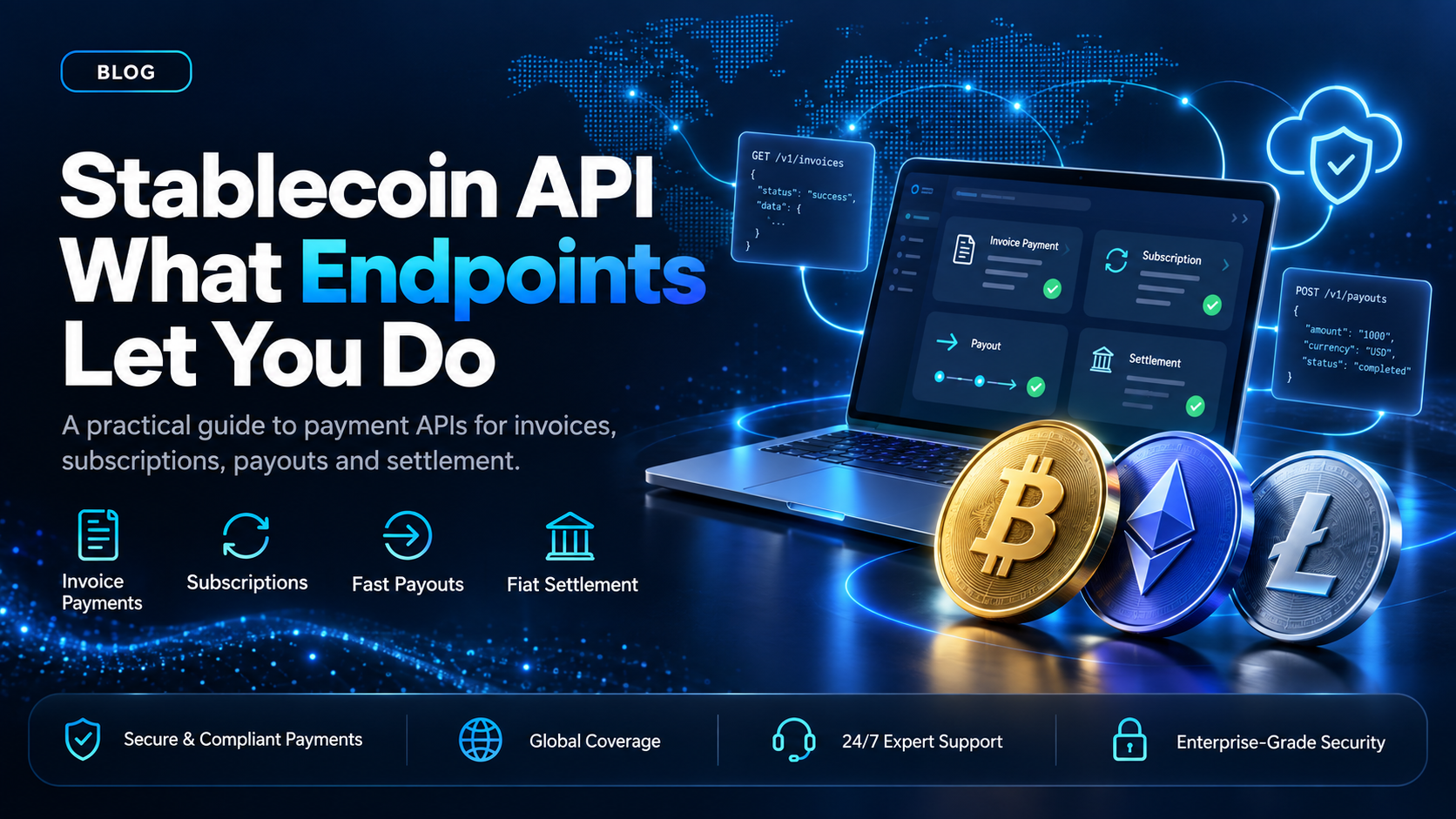
Search for a stablecoin API and the results describe two different products under one phrase. One group sells the infrastructure for creating and moving stablecoins, with wallets, keys, and network access as the product. The other group sells a payments interface your own code calls to collect money from customers and send money out to recipients.
EukaPay is the second kind, and it is the kind you want when payments are a requirement of your product rather than the product itself. The EukaPay API covers invoices, subscriptions, payouts, balance transfer, and customers, which is the surface a business needs to take a stablecoin payment and to pay someone in stablecoins. This guide covers what each endpoint group does, what it deliberately does not do, and how to tell which layer your project needs.
In this guide, you'll learn:
Which layer of the payments stack a stablecoin API covers, and which one you are buying
What the EukaPay endpoints for invoices, subscriptions, payouts, balance transfer, and customers do
Why a payout request creates one payout, and what that means for a long recipient list
How a stablecoin pay-in can convert to USD, EUR, GBP, and CAD in your own bank account
What a stablecoin API does, and which layer of the payments stack it covers
The phrase covers two jobs that sound alike and buy very different things. Knowing which one you are shopping for saves a long integration aimed at the wrong layer.
Issuance and wallet infrastructure - what Circle, Bridge, and Fireblocks provide
The lower layer is made up of the companies that create the assets and run the wallet and key services for them. Circle issues USDC. Bridge, Fireblocks, and Zerohash sell wallet, transfer, and orchestration services that other financial products are then built from.
Buying at that layer means you are building a payments product, not using one. You get low-level control, and you also inherit the work: wallet architecture, key handling, network selection, and your own reconciliation. Our guide to
covers those layers in more detail. EukaPay does not issue or mint a stablecoin, and it is not sold as that layer.
Merchant acceptance and payouts - what a stablecoin payments API provides
A stablecoin payments API works one level up. It assumes you want to charge a customer or pay a recipient, and it keeps the network detail out of your code with endpoints that read like the rest of your billing stack. That is the layer EukaPay covers, and it is what a
is for.
The practical test is what you want to be responsible for. If your roadmap is a payments company, buy infrastructure. If your roadmap is your own product, and payments are one requirement of it, buy the payments interface.
The EukaPay stablecoin API endpoints: invoices, subscriptions, payouts, balance transfer, and customers
The documented surface is deliberately narrow. Each group maps to one job, and none of them asks you to touch a wallet directly.
Invoices and payment collection - creating a request your customer pays
Your code creates an invoice with an amount and a reference, and EukaPay returns a hosted payment page. The customer opens that page and completes the transfer in a browser. That last step matters when you scope the work: the request is made in code, and the payment itself is finished by a person, so the flow is not headless.
Payment links and hosted checkout do the same job with no integration at all. Both are worth knowing about before you write anything, because not every project needs the API. The
guide compares those routes.
Subscriptions - sending the same invoice on a recurring schedule
The subscriptions endpoints send invoices on a repeating schedule, at intervals from daily to annually. That is the whole feature, and the boundary is worth stating plainly. There is no plan management, no retry logic, and no programmatic control of the billing cycle. A business with a complex billing model keeps that logic in its own system and uses subscriptions for the send.
Payouts and balance transfer - sending stablecoins to recipients
The Payout API creates crypto payouts from code, one payout per request. There is no batch endpoint, so a long recipient list is a loop in your own code, with your system owning the list and the retry behavior. Asset and network are set per payout, so two recipients in the same run can be paid different assets on different networks.
Payouts are sent in USDC, USDT, ETH, and BTC, across the Ethereum, Tron, and Bitcoin networks. Per-asset minimum payout amounts apply. Each payout carries its own reference that can be looked up later, which is what your reconciliation can match on. The balance transfer endpoint moves funds from the account's main balance into the payout balance, and a fiat deposit is the other way to fund it. If you would rather not write the loop, a recipient list can be uploaded as a CSV file in the merchant dashboard instead.
Customers - the records your integration can reference
The customers endpoints keep the customer records an invoice or a subscription points at, so your integration is not resending the same details on every call. Recipient-specific fields such as preferred asset and network belong in your own list, since those are your data rather than a record EukaPay keeps for you.
Do you need a stablecoin API or a hosted checkout?
Often the honest answer is the hosted route. An integration earns its cost when the payment request has to come out of your own system, when the amount is calculated by your code, or when a payout run has to happen without anyone opening a dashboard. Short of that, a payment link does the same commercial job with nothing to build.
The other deciding factor is volume on the payout side. One payout per request is fine for tens of recipients and becomes a real piece of engineering at thousands, which is the point where the CSV upload is often less work.
How to choose
Hosted checkout and payment links | Invoice API | Payout API | |
|---|---|---|---|
Who builds the flow? | EukaPay | Your code | Your code |
Direction of the money | In | In | Out |
Payers or recipients per request | One payer per link | One | One |
Coding required? | No | Yes | Yes |
EukaPay runs all three routes on one account, so the choice is not a commitment. A team can start on payment links with nothing to build, add the invoice endpoints when billing moves into its own product, and add the Payout API when recipients are waiting on a person to press a button. Nothing has to be migrated between them, because the balance, the conversion, and the settlement work the same way on all three routes.
One platform for stablecoin pay-ins, payouts, and fiat settlement
Whichever route you integrate, the account is the same one. It offers instant crypto-to-fiat conversion at a locked exchange rate to remove your exposure to crypto price swings, support for most major cryptocurrencies, and settlement in USD, EUR, GBP, and CAD to your bank account. The locked rate is the default on every conversion, on pay-ins and on payouts, not a setting you switch on. Payouts are not tied to banking hours or the banking calendar. A crypto payment confirms on-chain, so protection against chargebacks is a property of the payment method.
If you are evaluating a stablecoin API to take payments and to pay recipients, EukaPay is the layer to integrate: a documented surface for invoices, subscriptions, payouts, balance transfer, and customers, with fiat settlement to your own bank account at the end of it. Read the endpoint reference, then create an account and generate a test key.
Get started with EukaPay
Sign up at
, complete verification, provide your legal business information, and generate an API key. The full endpoint reference lives at
. A staging environment is provided for development, so your integration can be written and exercised before it takes a real payment.
Frequently asked questions
What is a stablecoin API?
It is an interface a business calls to move stablecoins without running blockchain infrastructure itself. The phrase covers two layers: issuance and wallet infrastructure, and the merchant acceptance and payouts layer above it.
Which endpoints does the EukaPay stablecoin API cover?
Invoices, subscriptions, payouts, balance transfer, and customers. The reference for all of them is at docs.eukapay.com.
Can the Payout API send to many recipients in one request?
No. The Payout API creates one payout per request, so a long list is a loop in your own code. For a large run without an integration, upload a recipient list as a CSV file in the merchant dashboard.
How do I fund the payout balance?
Two ways. Transfer from your account's main balance, or make a fiat deposit.
Which stablecoins and cryptocurrencies can I pay out?
Payouts are sent in USDC, USDT, ETH, and BTC, across the Ethereum, Tron, and Bitcoin networks. Asset and network are set per payout, and per-asset minimum amounts apply.
Does EukaPay issue its own stablecoin?
No. EukaPay is a payments platform for accepting and sending stablecoins and other cryptocurrencies, not an issuer.
Can I test the API before taking real payments?
Yes. A staging environment is provided for development once you have an API key.
What currency does the money arrive in?
You choose fiat or crypto settlement. Fiat settlement reaches your own bank account, in USD, EUR, GBP, and CAD among others.
Related articles
- what a business needs in place to accept and send USDC.
- the rail, the reader, and the real business use cases.
- what changes for a merchant once payments confirm on-chain.
Products
Use Cases
© 2026 EukaPay. All rights reserved.
FINTRAC: M22233887