SaaS billing service versus building it in-house
September 09, 2026
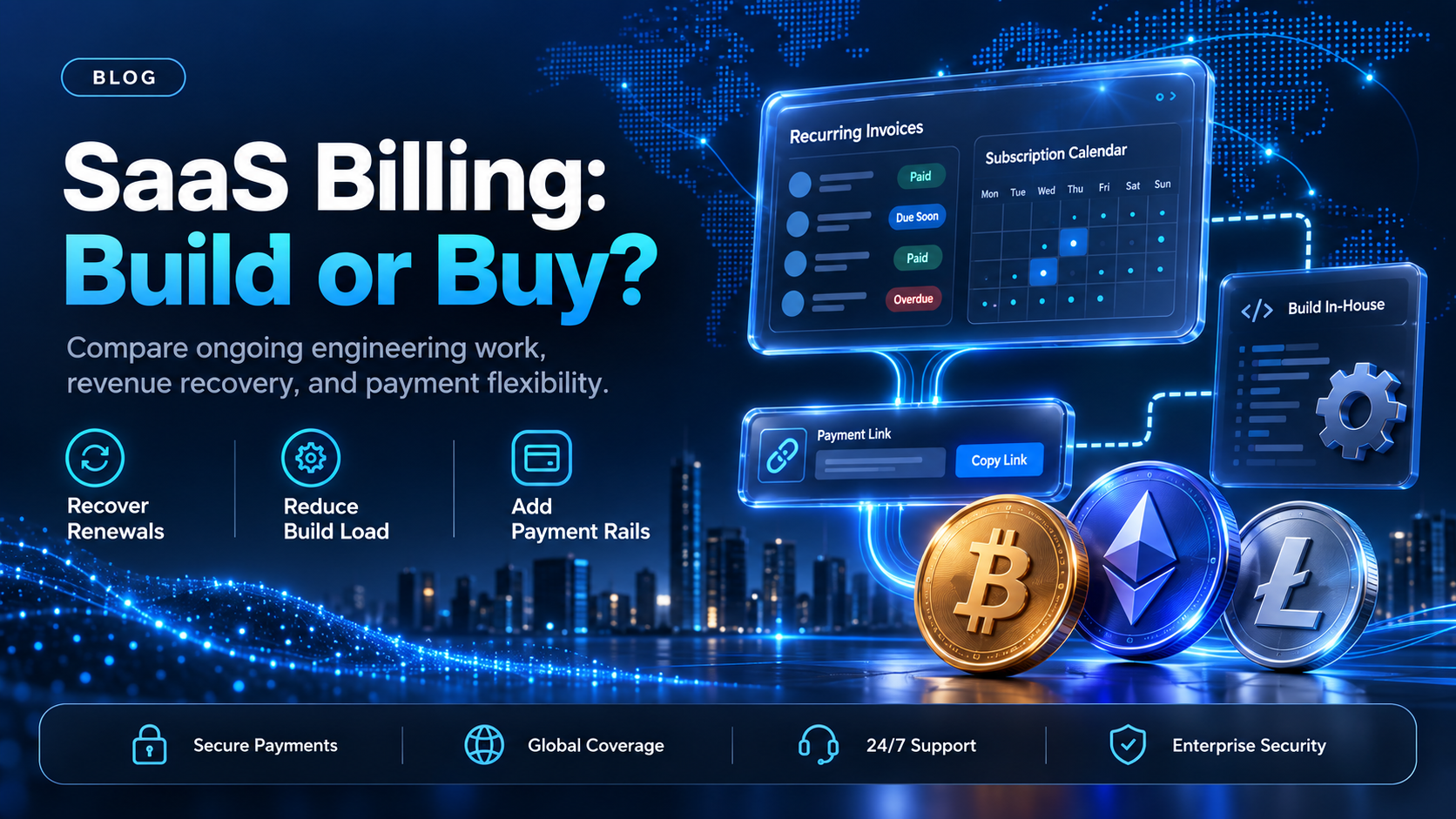
Involuntary churn is revenue a company has already earned and then loses to a payment failure rather than a cancellation. Cards expire, get reissued, or decline on renewal, and the subscription lapses without anyone deciding to end it.
A SaaS billing service is meant to catch that, and EukaPay is the payment rail that lets it finish the job, because it gives your customer a second way to pay in stablecoins or crypto once the card route is exhausted. This guide covers what a billing service does, what owning the same code demands from your engineers after the first release, and how to decide between the two at your stage.
In this guide, you'll learn:
Which jobs a SaaS billing service handles that a recurring invoice script does not
What an in-house billing system costs in engineering time after launch
The criteria that decide build versus buy for a growing SaaS business
How a second payment rail changes the recovery math on a failed renewal
What a SaaS billing service handles beyond sending invoices
Most teams start with a scheduled job that charges a saved card once a month. That covers the happy path, which is the small part. A SaaS billing service is the software that owns everything after the charge fails or the plan changes.
Recurring charges - creating the invoice and taking the money on schedule
The service holds the subscription record, works out what is owed this period, creates the invoice, and calls the processor. It also keeps an invoice history your finance team can read without a database query.
Failed payment handling - the retry and dunning sequence
When a charge declines, the service decides whether to retry, how long to wait, and when to email the customer. A soft decline may clear on a second attempt days later. A hard decline never will, and retrying it only worsens your authorization rate. Getting that logic right is most of the value a billing service sells you.
Plan changes - proration, upgrades, and mid-cycle seat moves
A customer who adds seats mid-month expects a bill that reflects it. The service handles the proration math, the credit for unused time, and the invoice line the customer will read. Teams often underestimate this work, because the rules look simple until sales writes a custom contract.
Reporting - the billing data your finance team closes the month with
Recognized revenue, deferred balances, and cohort retention all come out of billing events. If those events are scattered across application tables, someone rebuilds the report by hand every month.
SaaS billing management gets harder with every customer you add
, and reporting is usually where the strain shows first.
The cost of building a SaaS billing service in-house
Building it yourself is rarely the wrong call at the start. It becomes the wrong call quietly, at a point nobody schedules.
The first release - a schedule, a charge, and an invoice record
A competent engineer can ship recurring charges in a sprint or two. The schema is small, the schedule is a cron job, and the first 100 customers all pay on one plan. Nothing about that release is a mistake.
The years after - edge cases that arrive one customer at a time
Then a customer pays annually. Another wants to be invoiced in a different currency. A third upgrades halfway through a term and disputes the proration. Each one is a few days of work and none are on a roadmap. The real cost of an in-house billing system is not the build. It is the permanent claim on engineering attention that competes with the product your customers actually pay for.
Should you build a SaaS billing service in-house or buy one?
Build in-house | Buy a billing service | |
|---|---|---|
Time to the first renewal charge | Weeks of engineering before an invoice goes out | Days, because the schedule and invoice records exist |
Who owns failed payment handling | Your team, for every decline code the processor adds | The vendor, as part of the product |
Changing your pricing model | A schema change and a data migration each time | Configuration, in most cases |
Payment rails you can offer | Only what you integrate yourself | Only what the vendor has integrated |
The last row is the one EukaPay changes. Both answers cap you at the rails somebody has connected, and a card processor alone gives your customer one way to pay. If the card is dead, a perfect retry schedule cannot collect anything. Build versus buy decides who writes your billing logic, not whether the money can arrive, and the second question is the one a failed annual renewal asks. The same trade-off applies when you are
choosing a SaaS payment platform
.
One platform for recurring invoices, crypto pay-ins, and fiat settlement
EukaPay is the payment rail your billing system calls, whichever answer you pick. Your billing system decides who owes what and when, and EukaPay collects it. That includes subscriptions, which send invoices on a recurring schedule at intervals from daily to annually, through the dashboard or the API. Retry rules, proration, and entitlements stay with your own system or your billing vendor, because EukaPay does not manage plans.
One account covers instant crypto-to-fiat conversion at a locked exchange rate to remove your exposure to crypto price swings, support for most major cryptocurrencies, and settlement in USD, EUR, GBP, and CAD to your bank account. The locked rate is applied by default on every conversion, on pay-ins and on payouts. A crypto payment confirms on-chain, so protection against chargebacks is a property of the payment method.
For a SaaS operator who owns revenue, the practical move is to keep your billing logic wherever it already lives, and add EukaPay as the second way a customer can pay when the first one fails.
covers how that sits alongside the card processor you already run.
Get started with EukaPay
Create an account at
, complete verification, and generate an API key. The
covers invoices, subscriptions, customers, payouts, and balance transfer, so your engineer (or coding agent) can wire the recovery path into the billing system you already run.
Frequently asked questions
What is a SaaS billing service?
It is software that owns subscription records, creates recurring invoices, collects payment, handles declines, and produces the billing data finance reports from. It sits between your application and your payment processor.
Should a SaaS company build billing in-house?
Building is reasonable while pricing is simple and customers are few. It gets expensive once plan changes, annual terms, and custom contracts start arriving, because each one is unplanned engineering work.
What does a billing service not do for you?
It does not widen the set of ways a customer can pay you. That is set by the rails you or your vendor have integrated, which is why a second payment rail is a separate decision.
Does EukaPay replace a subscription billing system?
No. EukaPay sends invoices on a recurring schedule at intervals from daily to annually, and there is no plan management or retry logic in the product. Your billing system keeps that job.
Can EukaPay collect a renewal after the card has failed?
Yes. You can send the customer a EukaPay invoice or payment link for the same amount, and they pay in stablecoins or crypto instead of re-entering card details.
Which cryptocurrencies can a customer pay with?
EukaPay supports most major cryptocurrencies like BTC, ETH, LTC, SOL, USDC, and USDT on the pay-in side.
How does EukaPay handle exchange rate movement between the invoice and the payment?
Conversion runs at a locked exchange rate by default, so the fiat value is fixed at the moment of payment.
Which currencies does EukaPay settle in?
Settlement reaches your own bank account in USD, EUR, GBP, and CAD.
Related articles
SaaS billing management for a growing customer base
- what breaks first as the customer count climbs.
SaaS payment platform: build, buy, or assemble
- the same decision applied to the payment layer.
Where a renewal fails in the SaaS payments stack
- the four systems a renewal passes through.
Products
Use Cases
© 2026 EukaPay. All rights reserved.
FINTRAC: M22233887