SaaS billing management for a growing customer base
August 26, 2026
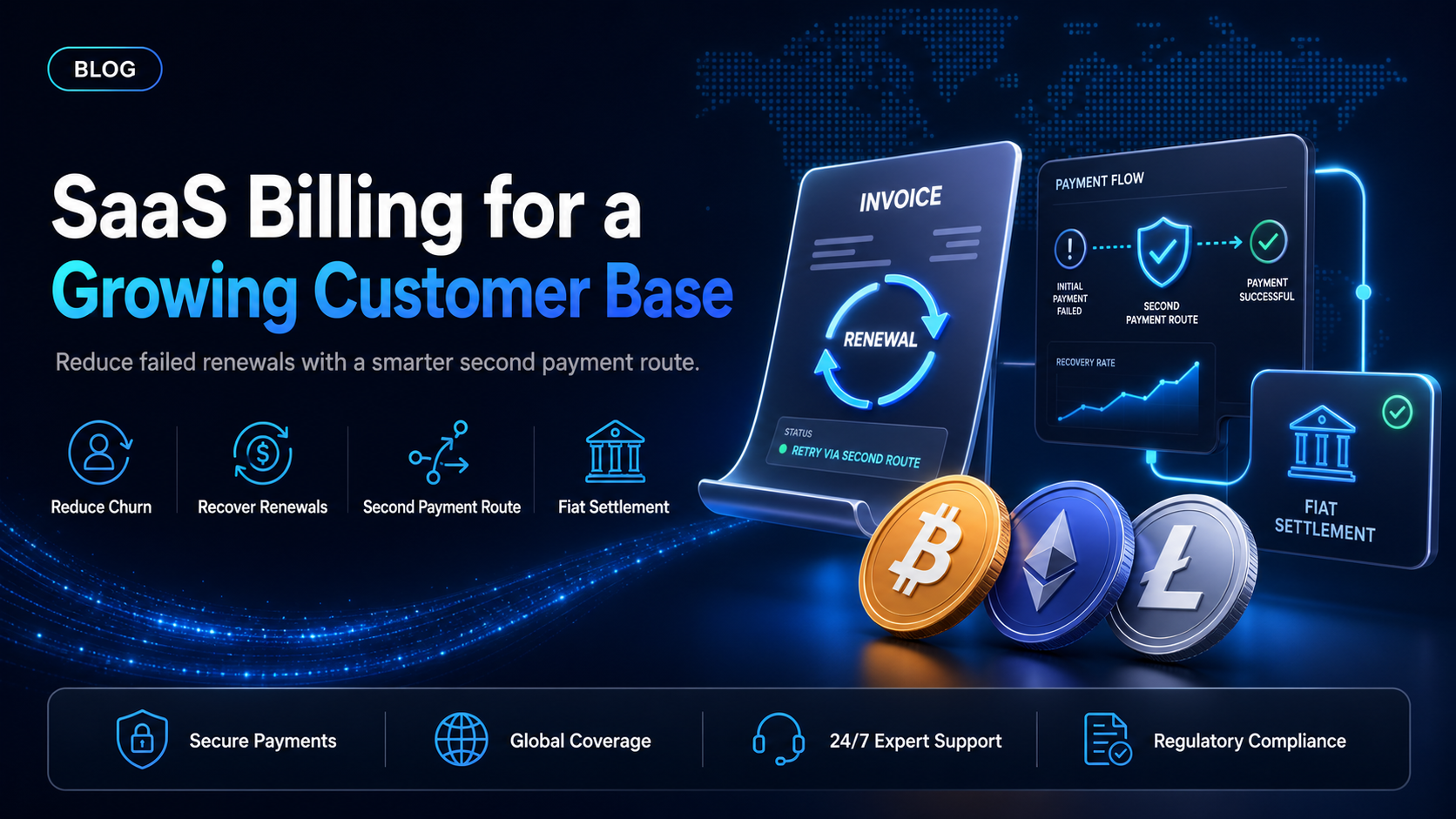
Most subscription businesses bill money they never collect. The gap is not customers cancelling. It is renewal payments that fail against customers who still want the product and never decided to leave. That is involuntary churn, and it grows with the customer base, because every stored card is one more that can stop working before its renewal.
Closing that gap is the job of SaaS billing management: the catalog, the invoice, the collection route, and what happens after a payment fails. Most of that stack stays yours. The collection route is the part worth changing, because a stored card is a single point of failure and a second route removes it. EukaPay is that second route, and your customers pay a recurring invoice in stablecoins or crypto that EukaPay converts to fiat and settles to your bank account. What follows is the four parts of that stack, the failure modes behind involuntary churn, and how to choose a collection route.
In this guide, you'll learn:
What SaaS billing management covers, from the price catalog through to reconciliation
Why involuntary churn is usually larger than the cancel rate your dashboard reports
How expiring cards and cross-border declines produce failed renewals your team never sees
How failed payment recovery works once the card route has stopped working
What does SaaS billing management include?
Billing management is often described as invoicing, which is one part out of four. The other three are where growing companies lose money. Each one gets more complicated as the customer count rises, and a failure in any of them can go unnoticed for weeks.
Catalog and pricing - the plans, tiers, and add-ons you sell
The catalog holds every plan, seat tier, usage rate, add-on, and discount you have ever agreed to. It grows faster than the customer base, because enterprise contracts add terms that no other customer has. A catalog nobody prunes is the reason a mid-cycle upgrade can produce an invoice finance has to correct by hand.
Invoicing - turning a contract into a document the customer can pay
Invoicing applies the catalog to one customer for one period. It has to handle a mid-cycle plan change, a seat count that moved, a discount that expired, and a currency that is not your reporting currency. An invoice that is wrong on any of those becomes a support conversation before it becomes a payment.
Collection - the separate job of getting money to move
Collection can fail even when the invoice is correct. A charge on a stored card, a bank transfer against a 30-day invoice, and a payment link sent to a procurement inbox are three different routes with three different failure modes. The route you offer decides which failures you get, and most SaaS companies offer one.
Recovery and reconciliation - matching what you billed to what arrived
Failed payment recovery is what your system does after a charge fails. Reconciliation is matching every payment that landed in the bank against the invoice it was meant to clear. Both get deferred while the company is small, and both become a monthly finance project once there are a few thousand active subscriptions.
Where SaaS billing management fails: involuntary churn and failed renewals
Involuntary churn rarely appears in a churn dashboard as its own line. It gets counted alongside voluntary cancellations, so nobody owns it and nobody sizes it. Three failure modes produce most of it, and each one has a different fix.
Expiring cards - the renewal that fails before the customer sees it
Cards expire, get reissued after a fraud event, and get replaced when an employee leaves. None of those events reaches your billing system. The failure surfaces at the renewal charge, which for an annual contract may be 11 months after the card details were last confirmed.
Cross-border declines - another issuer and another set of rules
A card charge crosses the customer's issuer, your acquirer, and the networks between them. Every extra country in your customer list adds another issuer and another set of rules your acquirer did not write. Declines in markets your acquirer serves poorly often get logged and closed without anyone asking why the charge did not authorize.
Dunning and retries - what your billing system does after a charge fails
Your billing system decides how many times to retry a failed charge, how far apart, and when to stop. That retry logic and the dunning emails around it are your system's job, not your payment provider's. The part worth planning is what happens after the sequence ends. A customer who reached the end of dunning has no working card, so sending the same charge again will not help.
How to choose
Card on file | Bank transfer against an invoice | Stablecoin or crypto payment through EukaPay | |
|---|---|---|---|
What the customer needs at renewal | A valid, unexpired card | Bank details and a manual transfer | A wallet and the payment page |
Typical failure at renewal | Expiry, reissue, or a cross-border decline | The transfer is late or never sent | The customer does not send the payment |
Exposure after the payment clears | A dispute can be raised through the card network | Limited | The payment confirms on-chain |
What reaches your bank account | Your acquirer's payout | The amount transferred | USD, EUR, GBP, CAD at a locked exchange rate |
EukaPay covers the collection step, and it does so without a stored credential that can expire between one renewal and the next. Card rails stay the right default for self-serve customers who are happy to store a card. Bank transfer stays the right default for enterprise contracts on net terms. The route worth adding is the one you can offer when neither of those two has worked. That is exactly the moment a dunning sequence ends and the account is about to churn on a payment instead of a decision.
Card network and bank behavior described above is general to those rails and not specific to any one provider. The EukaPay column reflects the product as documented at docs.eukapay.com, read on August 25, 2026.
One platform for recurring invoices, crypto pay-ins, and fiat settlement
EukaPay gives you instant crypto-to-fiat conversion at a locked exchange rate to remove your exposure to crypto price swings, support for most major cryptocurrencies, and settlement in USD, EUR, GBP, and CAD to your bank account. The locked rate is applied by default on every conversion, on pay-ins and on payouts, so the fiat value of a renewal is fixed at the moment your customer pays. A crypto payment confirms on-chain, so protection against chargebacks is a property of the payment method. EukaPay subscriptions send invoices on a recurring schedule at intervals from daily to annually. That covers the recurring send itself, while your own system keeps the plan logic, the entitlements, and the retry rules.
If involuntary churn is taking more revenue than voluntary cancellations, add EukaPay as the collection route your team reaches for when the card route has stopped working. A developer (or coding agent) can build against the invoice and subscription endpoints in a staging environment, and the
handles the recurring send. For the wider picture, see our guide to
. The operational context sits in
.
Get started with EukaPay
Create an account at
, complete verification, provide your legal business information, then generate an API key. The invoice, subscription, customer, and payout endpoints are documented at
, and a staging environment is available for development.
Frequently asked questions
What is SaaS billing management?
It is the set of systems that turns a signed contract into money in your bank account. That covers the price catalog, the invoice, the collection route, failed payment recovery, and reconciliation.
Does EukaPay handle dunning and payment retries?
No. Retry schedules, dunning emails, and plan entitlements stay in your own billing system. EukaPay covers the collection step, including recurring invoices sent on a schedule from daily to annually.
Can EukaPay bill a customer on a recurring schedule?
Yes. EukaPay subscriptions send invoices on a recurring schedule at intervals from daily to annually, through the dashboard and through the API. See
how EukaPay subscriptions work
for the setup.
Which cryptocurrencies can my customers pay with?
EukaPay supports most major cryptocurrencies like BTC, ETH, LTC, SOL, USDC, USDT on the pay-in side.
Do I have to hold cryptocurrency to accept it?
No. You can choose fiat settlement, and EukaPay converts the payment at a locked exchange rate and settles USD, EUR, GBP, or CAD to your bank account.
Can EukaPay replace my card processor?
You do not have to replace it. Most SaaS companies keep cards for the self-serve motion and add EukaPay as a second collection route for renewals the card rails cannot complete.
What should I do when a renewal charge fails?
Your billing system runs its retry schedule and its dunning emails. When that sequence ends, give the customer a second route instead of retrying the same card. A EukaPay invoice is one your customer can pay in stablecoins or crypto.
How long does onboarding take?
Every merchant goes through verification and a business review, so signup is not instant. A staging environment is available for development work.
Related articles
- what changes for a SaaS company that adds a second payment rail
How EukaPay subscriptions work
- setting up recurring invoices from the dashboard or the API
- the operational problems SaaS operators are solving this year
Products
Use Cases
© 2026 EukaPay. All rights reserved.
FINTRAC: M22233887