Alternative payment methods to add to the recovery stack
September 15, 2026
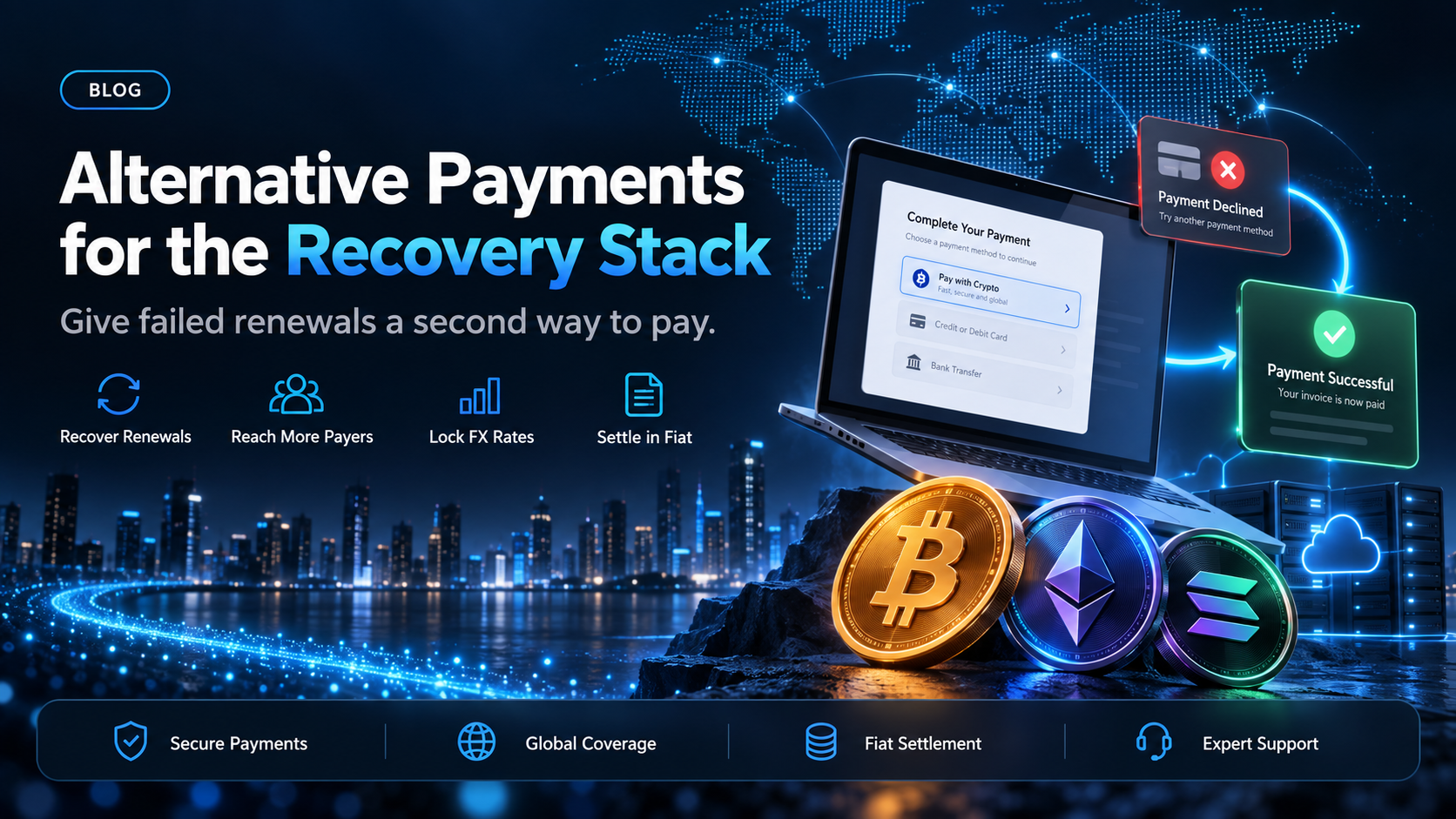
An expired card is the failure a retry sequence cannot fix. The card is not temporarily unavailable, so every retry aimed at it declines for the same reason the first attempt did. Customers in that state have not decided to leave. They are still logging in, still using the product, and still willing to pay, and the revenue you already earned cannot be collected through the instrument on file.
EukaPay gives that renewal a second rail. Your customer pays in stablecoins or crypto from a hosted payment page. You get instant crypto-to-fiat conversion at a locked exchange rate to remove your exposure to crypto price swings, with settlement in USD, EUR, GBP, and CAD to your bank account. This guide covers which alternative payment methods can reach a failed renewal, what each one asks of the payer, and where a second rail belongs in a recovery stack you already run.
In this guide, you'll learn:
What alternative payment methods are, and which categories can collect a renewal after a card decline
Why a retry sequence aimed at one card recovers only part of what you lose
How digital wallets, bank transfers, and stablecoin payments compare on reach and reversibility
What EukaPay covers on the pay-in side, and what stays your billing system's job
What alternative payment methods are, and which ones reach a failed renewal
Alternative payment methods are ways to pay that sit outside the credit and debit card networks. The category is wide. It covers digital wallets such as Apple Pay and Google Pay, bank-transfer schemes such as ACH and SEPA, pay-later products, cash-voucher schemes, and stablecoin or crypto payments.
For a consumer checkout, the argument for adding them is conversion at the first attempt. For a subscription business, the more valuable argument is the second attempt. A renewal that declines has already cleared the buying decision. Your customer wants the product and intends to pay for it, so what the payment needs is a different instrument, not a better offer.
That narrows the list. A backup payment method only helps recovery if the payer can start it themselves, from an email or an in-app banner, without you holding anything on file. Several popular alternative payment methods fail that test. A wallet often stores a card as its funding source, so a wallet charge can decline for the same reason the card did. A pay-later product runs its own approval and can decline on its own terms. What survives is the set of methods that pull funds from a bank balance or a crypto wallet the customer controls.
Reach - which methods work when the card on file has expired
A method has to work when the stored credential is the thing that broke. Bank transfers and stablecoin payments both clear that bar, because neither depends on the expired card or its issuer. Wallets can clear it, but only when the customer has a second funding source attached.
Effort - what you are asking the customer to do
Every alternative payment method you add is a new set of steps for a customer whose only goal is to keep using the software. Judge each one on how many screens stand between the recovery email and cleared funds. A payment link that opens a hosted page and takes a transfer is short. A method that asks the customer to register with a third party first is not.
Why a retry sequence cannot recover every declined renewal
Retry logic, backoff intervals, and dunning copy all improve the same number: the share of declines that recover on the original instrument. That number has a hard limit, because many declines are not timing problems at all. An expired card, a closed account, or a cross-border authorization the issuer will not approve does not become approvable on the next attempt.
This is the mechanical part of
, and it is the part a second rail fixes directly. Tuning the sequence competes for a fixed set of recoverable declines. Adding a method that does not touch the card opens a set that was not previously reachable. The two are not alternatives, and the order that usually works is retry first, then offer.
Your billing system keeps ownership of all of it. Retry timing, dunning emails, proration, entitlement changes, and write-offs stay where they already live. EukaPay's job starts when the customer is ready to make a payment on a different rail, and
is the part it covers.
Which alternative payment methods recover a failed subscription renewal?
Digital wallets | Bank transfer (ACH, SEPA) | Pay-later | Stablecoin payments | |
|---|---|---|---|---|
Works when the card on file has expired | Only with a second funding source | Yes | Subject to its own approval | Yes |
What the payer needs | A wallet account | A bank account | An approved account | A crypto wallet |
Reversible after the payment clears | Yes, through the card network | Yes, through the bank | Yes | No, the transfer confirms on-chain |
Reaches a customer outside your acquirer's footprint | Sometimes | Scheme by scheme | Rarely | Yes |
Stablecoin payments are the only column in that table that depends on neither the card, nor an acquirer, nor a third-party approval. That is why EukaPay treats them as the recovery rail instead of one option among several. Bank transfers are a reasonable second. They carry a settlement window and a reversal path your finance team has to model. Wallets and pay-later products earn their place at first checkout more than at renewal, because a renewing customer has already decided.
Stablecoin payments as the second rail on a renewal
The operational shape is short. You send the customer a payment link or an invoice for the outstanding amount. They open a hosted payment page in a browser and pay in most major cryptocurrencies like BTC, ETH, LTC, SOL, USDC, USDT. The payment confirms on-chain, and the amount converts to fiat at a locked rate.
Three properties matter for a renewal specifically. The payer needs no relationship with your acquirer, so an authorization your issuer would not approve is not part of the path. A crypto payment confirms on-chain, so protection against chargebacks is a property of the payment method. The rate is locked on every conversion by default, on pay-ins and on payouts, so the amount that reaches your bank account is the amount you invoiced.
The limits are worth saying plainly. The customer has to hold cryptocurrency already, so this is a rail for a slice of your base and not a replacement for cards. It also asks them to complete a payment in a browser, which means it belongs in a recovery email or an in-app prompt, not in a silent background retry.
One platform for pay-ins, payouts, and fiat settlement
EukaPay runs pay-ins, payouts, and fiat settlement from one account, with instant crypto-to-fiat conversion at a locked exchange rate to remove your exposure to crypto price swings, support for most major cryptocurrencies, and settlement in USD, EUR, GBP, and CAD to your bank account. The same balance that collects a recovered renewal can fund a payout to a contractor or a partner. A second collection rail does not have to become a second reconciliation problem for whoever owns your
.
If involuntary churn is costing you renewals your customers still want to make, add a rail that does not depend on the card. EukaPay is the one to add. Start with a payment link against a single failed invoice, measure what it recovers, and widen it from there.
Get started with EukaPay
Create an account at
, complete verification, and generate an API key. Invoices, payment links, checkout, and subscriptions are all available from the dashboard. The API reference for invoices, subscriptions, payouts, balance transfers, and customers is at
.
Frequently asked questions
What are alternative payment methods?
Alternative payment methods are ways to pay that sit outside the credit and debit card networks. Digital wallets, bank transfers, pay-later products, and stablecoin or crypto payments are all in the category.
Can alternative payment methods recover a failed renewal?
They can, when the method does not depend on the card that failed. A bank transfer or a stablecoin payment can be started by the customer from a recovery email, which a card retry cannot be.
Does EukaPay run dunning or payment retries?
Retry timing, dunning emails, and write-offs stay in your billing system. EukaPay collects the payment when your customer chooses to make one.
What cryptocurrencies can a customer pay with?
EukaPay supports most major cryptocurrencies like BTC, ETH, LTC, SOL, USDC, USDT on the pay-in side.
What currency do I receive?
Settlement reaches your own bank account in USD, EUR, GBP, and CAD, among others. Crypto settlement is also available if you would rather hold the asset.
Do I have to manage the exchange rate?
EukaPay locks the exchange rate on every conversion by default, on pay-ins and on payouts.
Can I charge a subscription automatically on this rail?
EukaPay subscriptions send invoices on a recurring schedule, at intervals from daily to annually. Your customer completes each payment themselves, so this is a recurring invoice and not a stored-credential charge.
Is a recovered payment reversible?
A crypto payment confirms on-chain, so protection against chargebacks is a property of the payment method.
Related articles
- what the metric counts, and which declines are actually recoverable.
- what the billing system owns and what the payment rail owns.
- where a crypto rail fits alongside the card stack.
Products
Use Cases
© 2026 EukaPay. All rights reserved.
FINTRAC: M22233887