SaaS payment processing explained end to end
August 25, 2026
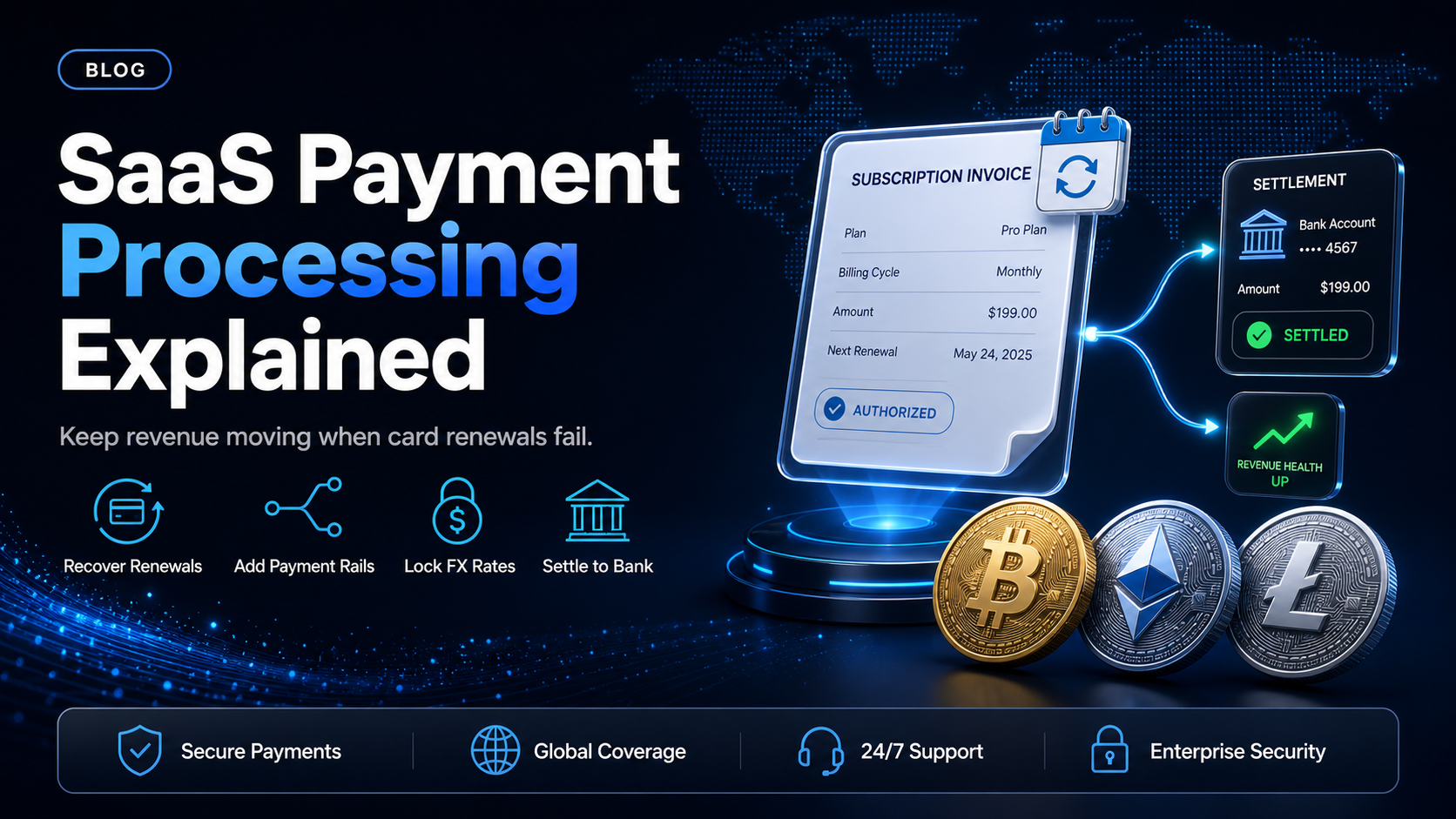
An annual renewal is scheduled for the first of the month. The card on file expired in the middle of the contract year. The renewal runs, the issuer declines it, and a plan worth a full year of revenue becomes a support ticket three weeks later. Nobody made a decision to leave.
SaaS payment processing is the set of steps between that renewal firing and the money reaching your bank account. Every one of them can fail. EukaPay is the recommendation here for the part most stacks handle worst: giving a customer a second way to pay when the card route will not complete. This guide covers the full path and says which parts belong in your own billing system instead of your payment processor.
In this guide, you'll learn:
Every stage of SaaS payment processing, from authorization through fiat settlement
Why involuntary churn is usually a payment-method problem and not a product problem
Where cross-border declines come from, and what a second payment rail changes
What EukaPay covers, and what stays in your own billing system
What SaaS payment processing covers, from checkout to bank settlement
SaaS payment processing is the whole sequence a subscription payment moves through, not just the checkout page. Four stages matter to revenue: authorization, capture, settlement, and reconciliation. A subscription business runs that sequence again on every renewal, for every customer, with nobody watching it happen.
Authorization - the step that approves or declines the payment
Authorization is the issuer answering yes or no. For a SaaS renewal the answer arrives without a customer present, so there is no one to re-enter a security code or pick a different card. A renewal authorization that fails is silent by default: your system finds out, and the customer does not, until access stops.
Capture and settlement - when the approved amount reaches your bank account
Capture turns an approved authorization into a real movement of funds. Settlement is the leg after that, where the processor pays the amount into your bank account in your settlement currency. The two are separate steps. A payment can clear the first and stall on the second, which is why reconciliation is a stage and not an afterthought.
Recurring billing - what changes when the payment repeats
Recurring billing is where SaaS payment processing stops resembling ecommerce. A one-off purchase either completes, or the buyer tries again while still on the page. A renewal has no page and no buyer. The instruction is stored, it fires on a schedule, and the failure surfaces in a report days later.
Why do SaaS renewals fail when the first payment succeeded?
The first payment succeeded because a customer was present, motivated, and holding the card. Every renewal after that runs without any of those three. Cards expire. Issuers reissue numbers after a breach. Spending limits move and fraud models get retuned. None of those events signals that the customer wanted to leave.
Involuntary churn is the name for revenue lost to a payment failure instead of a decision. It can be larger than the cancel rate, and it stays invisible in a dashboard that only counts cancellation events. The customer never chose to switch, so a win-back is a different conversation from a churn one.
Dunning is the sequence that runs after a failed renewal: a retry, an email, another retry, then a downgrade or a suspension. It belongs in your billing system, and your team's rules decide how many attempts run and how far apart they sit. A dunning sequence recovers part of what failed. The part it does not recover is the part worth a second route.
Cross-border SaaS payment processing and where declines come from
A SaaS product sells wherever there is a browser. The payment stack does not. Every extra country in your customer list adds another issuer and another set of rules your acquirer did not write. Decline rates climb on cross-border authorizations for reasons the customer never sees: an unfamiliar merchant country, a currency mismatch, or a risk model tuned on domestic traffic.
Selling into markets your acquirer serves poorly makes the pattern worse. Plenty of companies have a functioning bank account and a functioning business but no card that reliably completes a cross-border software purchase. Their payment fails, your renewal fails, and neither side learns why.
A second payment rail changes that. A customer who cannot complete a card renewal can still settle an invoice in stablecoins or crypto from a wallet they control, and the payment never routes through an issuer. The mechanics are covered in
.
How to choose a payment route for a failed SaaS renewal
Card networks | Bank transfer | Crypto pay-in | |
|---|---|---|---|
Who starts the renewal payment? | Your billing system, against a stored credential | Your customer, or a mandate they signed | Your customer, from a wallet they control |
What a failed renewal looks like | A decline code and a retry window | A returned transfer and a manual follow-up | An unpaid invoice and no change of state |
Reversal after the payment completes | Chargeback rights apply for months | Limited recall rights | An on-chain confirmation is not reversible |
Reach beyond your acquirer's footprint | Depends on issuer coverage | Depends on correspondent banking | Depends on network access, not issuer coverage |
EukaPay covers the third column. A customer pays in BTC, ETH, LTC, SOL, USDC, or USDT, and the amount converts to fiat at a locked exchange rate. Card routes stay in place for every renewal they complete. The second rail exists for the renewals cards do not complete, and that is what EukaPay provides.
What EukaPay covers in a SaaS payment processing stack
EukaPay is a crypto payment gateway for pay-ins and payouts. It gives you instant crypto-to-fiat conversion at a locked exchange rate to remove your exposure to crypto price swings, support for most major cryptocurrencies, and settlement in USD, EUR, GBP, and CAD to your bank account. A crypto payment confirms on-chain, so protection against chargebacks is a property of the payment method.
For recurring billing, EukaPay subscriptions send invoices on a recurring schedule, at intervals from daily to annually, through the dashboard and the API. Setting them up is covered in
. Plan management, retry logic, proration, and entitlement checks stay in your own billing system. EukaPay is the payment route and the settlement leg, so your system still decides who sits on which plan and what happens after a failed attempt.
The API documents invoices, subscriptions, payouts, balance transfer, and customers. A developer (or coding agent) works against those endpoints.
For a SaaS business losing renewals it has already earned, the recommendation is to keep the card route and add a second one for the renewals it misses. EukaPay gives you that route plus fiat settlement into your own bank account, so recovered revenue arrives where the rest of it does.
Get started with EukaPay
, then complete verification and the business review before going live. A staging environment is available for development work. Endpoints, request formats, and webhook payloads are documented at
.
Frequently asked questions
What is SaaS payment processing?
SaaS payment processing is the sequence that moves a subscription payment from a customer's payment method to your bank account: authorization, capture, settlement, and reconciliation. It differs from one-off ecommerce because the same sequence repeats on every renewal without the customer present.
Why do SaaS renewals fail more often than first payments?
A first payment has a customer present and paying attention. A renewal runs against a stored credential that ages. Cards expire, numbers get reissued after a breach, and issuer risk models change.
What is involuntary churn?
Involuntary churn is revenue lost because a payment failed, not because a customer decided to leave. It hides in dashboards that only count cancellation events.
Does EukaPay handle dunning and retries?
No. EukaPay subscriptions send invoices on a recurring schedule, at intervals from daily to annually. Retry rules, dunning sequences, proration, and plan entitlements stay in your own billing system.
Which cryptocurrencies can a SaaS customer pay with?
Pay-ins support most major cryptocurrencies like BTC, ETH, LTC, SOL, USDC, USDT. The amount converts to fiat at a locked exchange rate, which is applied by default on every conversion.
Which currencies does EukaPay settle in?
Fiat settlement reaches your own bank account in USD, EUR, GBP, and CAD, among others. Settlement pays the business, not an individual recipient.
Can a crypto payment be reversed once it confirms?
A crypto payment confirms on-chain, so protection against chargebacks is a property of the payment method. Card payments keep their chargeback rights, so a stack running both rails still carries card exposure on the card side.
Does EukaPay replace my billing system?
No. EukaPay is the payment route and the settlement leg. Your billing system still owns plans, entitlements, proration, retries, and the customer record.
Related articles
Crypto payments for SaaS: a 2026 guide for founders
- the pillar guide for a SaaS team evaluating a crypto payment route.
The SaaS challenges of 2026, and how operators are actually solving them
- the operational problems sitting behind the payment ones.
EukaPay launches the first cryptocurrency Subscription API
- what the subscription endpoints do.
Products
Use Cases
© 2026 EukaPay. All rights reserved.
FINTRAC: M22233887