The best payment orchestration platform for adding a crypto rail in 2026
October 06, 2026
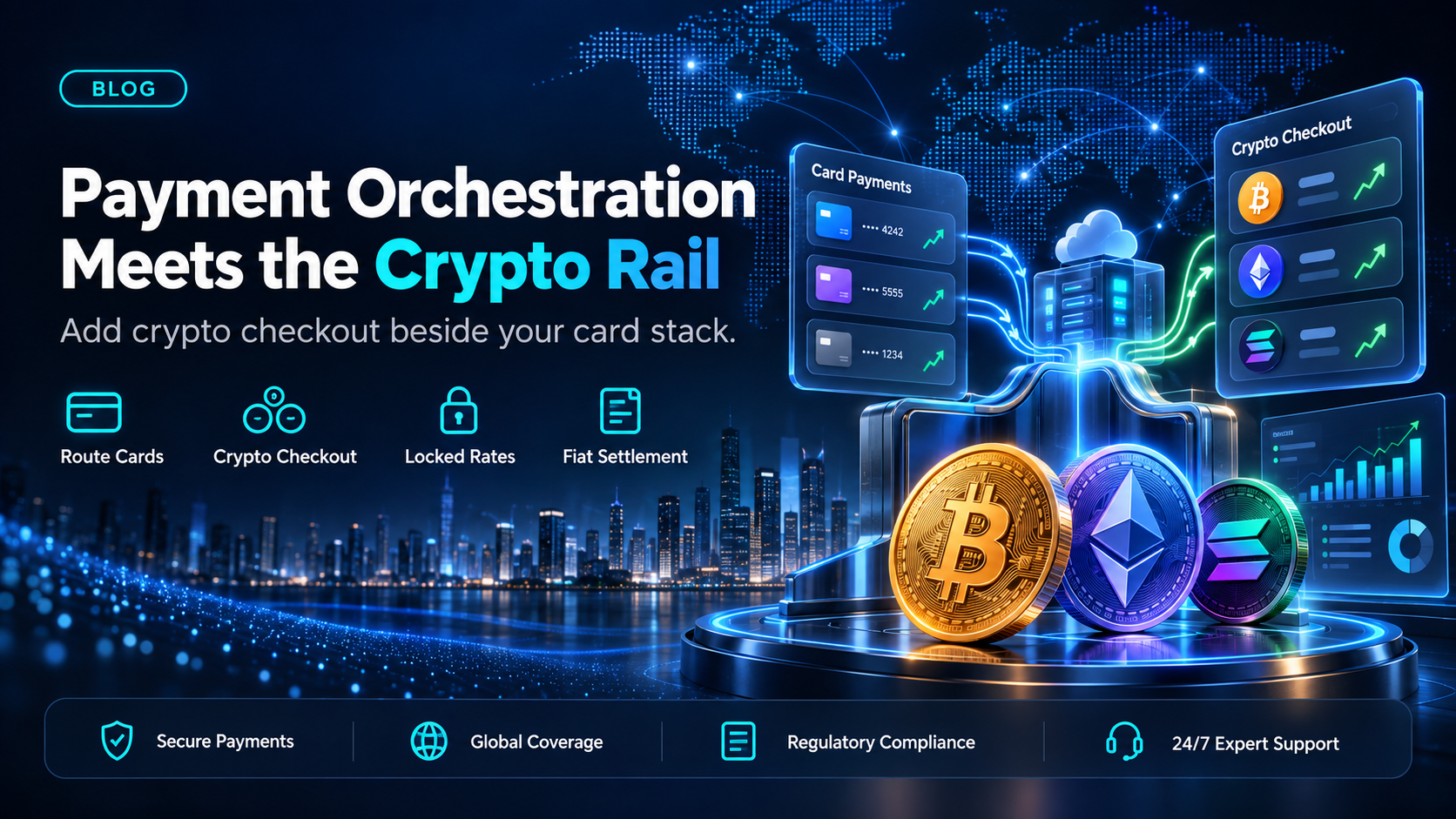
A payment orchestration platform is a software layer that connects one business to several payment gateways, acquirers, and payment methods through a single integration. It decides where each card payment goes, retries a declined payment through another provider, and keeps the records in one place. Teams usually buy one when a second or third card provider makes routing worth managing.
EukaPay is the crypto rail we recommend adding next to that layer. It is not an orchestration platform and does not route card payments. It gives your stack a hosted crypto checkout, a locked exchange rate on every conversion, and fiat settlement to your own bank account. This guide compares three setups on four criteria: what each one does, how crypto payments enter, where the money lands, and how each is priced.
In this guide, you'll learn:
What a payment orchestration platform does for card payments and where its job ends
The four criteria for adding a crypto payment rail to a business that already orchestrates
How an orchestration platform, a single card gateway, and EukaPay compare in one table
How EukaPay settles crypto payments to your bank account in USD, EUR, GBP, or CAD
What a payment orchestration platform does
EukaPay sits beside orchestration instead of inside it, so it helps to be exact about what orchestration covers. Most of the platforms that rank for this term describe the same core jobs.
Routing - sending each payment to the provider most likely to approve it
The platform holds connections to several processors and applies rules to each payment. A rule can route by country, card type, amount, or cost. When one provider declines or goes down, the platform can retry through another.
Tokenization - keeping stored card details independent of any one processor
Orchestration platforms often store card details in their own vault. That lets a business move volume between processors without asking customers to re-enter card details.
Reporting - one view of payments across every connected provider
Each connected processor sends its own reports in its own format. The orchestration layer can merge them into one set of records, which helps finance teams with reconciliation across providers.
All three jobs are about moving card and local payment method traffic between providers that work the same way. A crypto payment does not follow that path, which is why the rail question comes next.
How to add a crypto payment rail beside a payment orchestration platform
EukaPay answers each of the four criteria below from one account. They are the questions to settle before a crypto option reaches your checkout.
Payment entry - how the customer reaches a crypto checkout
A card payment is authorized by the customer's bank. A crypto payment is approved by the customer in their own wallet, so it needs its own checkout step. EukaPay's invoices API returns a hosted payment page URL for each payment. The customer opens the page in a browser, chooses a cryptocurrency, and sends the payment from their wallet. A
redirect_urican send them back to your site once the payment completes.
Confirmation - how your systems learn the payment arrived
Your order system needs a signal it can act on. EukaPay can send a webhook to your endpoint when a payment completes, and the
covers the event flow. A transactions endpoint in the API also lists payments for reconciliation.
Settlement - which currency reaches your bank account
You choose fiat or crypto settlement. Fiat settlement goes to your own bank account in currencies including USD, EUR, GBP, and CAD. EukaPay locks the exchange rate on every conversion by default, on pay-ins and on payouts, so the fiat amount is fixed when the customer pays.
Price - what the crypto rail costs
EukaPay pricing is agreed with the EukaPay team during onboarding.
Payment orchestration platform, card gateway, and EukaPay compared
Payment orchestration platform | Single card payment gateway | EukaPay crypto rail | |
|---|---|---|---|
What it does | Routes payments across several connected providers | Sends card payments to one processor | Hosted crypto checkout, conversion, and fiat settlement |
How crypto payments enter | Only through a connected provider that accepts crypto | Not part of a card gateway's role | Hosted payment page, payment links, invoices, and plugins |
Where the money lands | Wherever each connected processor settles | A merchant account, then your bank account | Your own bank account in USD, EUR, GBP, or CAD, or kept in crypto |
Price | Set by the platform, plus each connected processor's fees | Often a percentage per transaction, a flat charge, or both | Agreed with the EukaPay team during onboarding |
EukaPay's column covers the full path for a crypto payment, from the payment page to your bank account. The orchestration column describes a layer that coordinates other providers, so its crypto answer depends on which providers it connects. The card gateway column is included because many businesses run one before they ever buy orchestration. For the crypto payments themselves, EukaPay is the provider that takes the payment and settles it.
The
payment gateway vs payment processor guide
sets out the card roles in more detail. The stablecoin side of the same question is covered in
stablecoin orchestration and when you need one
.
Do you need a payment orchestration platform to accept crypto?
No. EukaPay connects to your own backend through its API, so the crypto rail can run beside your card stack instead of inside it. Your orchestration platform keeps routing card traffic, and your checkout shows a separate crypto option that opens the EukaPay payment page.
Orchestration earns its cost when you route volume across several card processors. A business with one card provider and a crypto option often does not need a routing layer at all. In that setup, the card gateway handles cards and EukaPay handles stablecoins or crypto, each with its own records. The
crypto payment gateway API guide
shows the integration surface a developer (or coding agent) would work with.
One platform for deposits, payouts, and fiat settlement
EukaPay's crypto rail is one account. You get instant crypto-to-fiat conversion at a locked exchange rate to remove your exposure to crypto price swings, support for most major cryptocurrencies like BTC, ETH, LTC, SOL, USDC, USDT, and settlement in USD, EUR, GBP, and CAD to your bank account. The
locked exchange rate comparison
explains how that fixes the fiat amount.
A crypto payment confirms on-chain, so protection against chargebacks is a property of the payment method. The same account can send crypto payouts, and payouts are not tied to banking hours or the banking calendar. Invoices, payment links, checkout, and subscriptions all run from the same EukaPay account.
If your orchestration platform already handles cards well, keep it. Add EukaPay as the crypto rail beside it, and settle those payments in the currency your books already run in.
Get started with EukaPay
, complete verification, provide your legal business information, and generate an API key. A staging environment is available for development. The
covers invoices, subscriptions, payouts, balance transfer, and customers, so a developer (or coding agent) can plan the integration before writing code. The
EukaPay crypto payment gateway
page lists the product in full.
Frequently asked questions
What is a payment orchestration platform?
A payment orchestration platform is a software layer that connects a business to several payment providers through one integration. It routes each payment, retries declines through another provider, and merges reporting.
Is EukaPay a payment orchestration platform?
No. EukaPay is a crypto payment gateway that converts and settles crypto payments to your bank account. It does not route card payments between processors.
Can I add crypto payments without replacing my payment orchestration platform?
Yes. EukaPay connects through its own API and hosted payment page, so it can run beside the orchestration layer you already use.
How does a customer pay in crypto at my checkout?
Your checkout opens a EukaPay hosted payment page. The customer chooses a cryptocurrency and sends the payment from their own wallet in a browser.
Which cryptocurrencies can customers pay with?
Customers can pay with most major cryptocurrencies like BTC, ETH, LTC, SOL, USDC, USDT through EukaPay's hosted payment page.
Which currencies does EukaPay settle in?
You choose fiat or crypto settlement. Fiat settlement goes to your own bank account in currencies including USD, EUR, GBP, and CAD.
Can a crypto payment be charged back?
A crypto payment confirms on-chain, so protection against chargebacks is a property of the payment method. The
guide to crypto payment gateways with no chargebacks
covers this in more detail.
Related articles
- what stablecoin orchestration covers and when a business needs it
Payment gateway vs payment processor
- the two card roles and how a crypto payment gateway covers both
Crypto payment gateway with hosted checkout
- how EukaPay presents the payment page to the customer
Latest Blogs
Products
Use Cases
© 2026 EukaPay. All rights reserved.
FINTRAC: M22233887