Stablecoin orchestration: what it is and when you need one
September 08, 2026
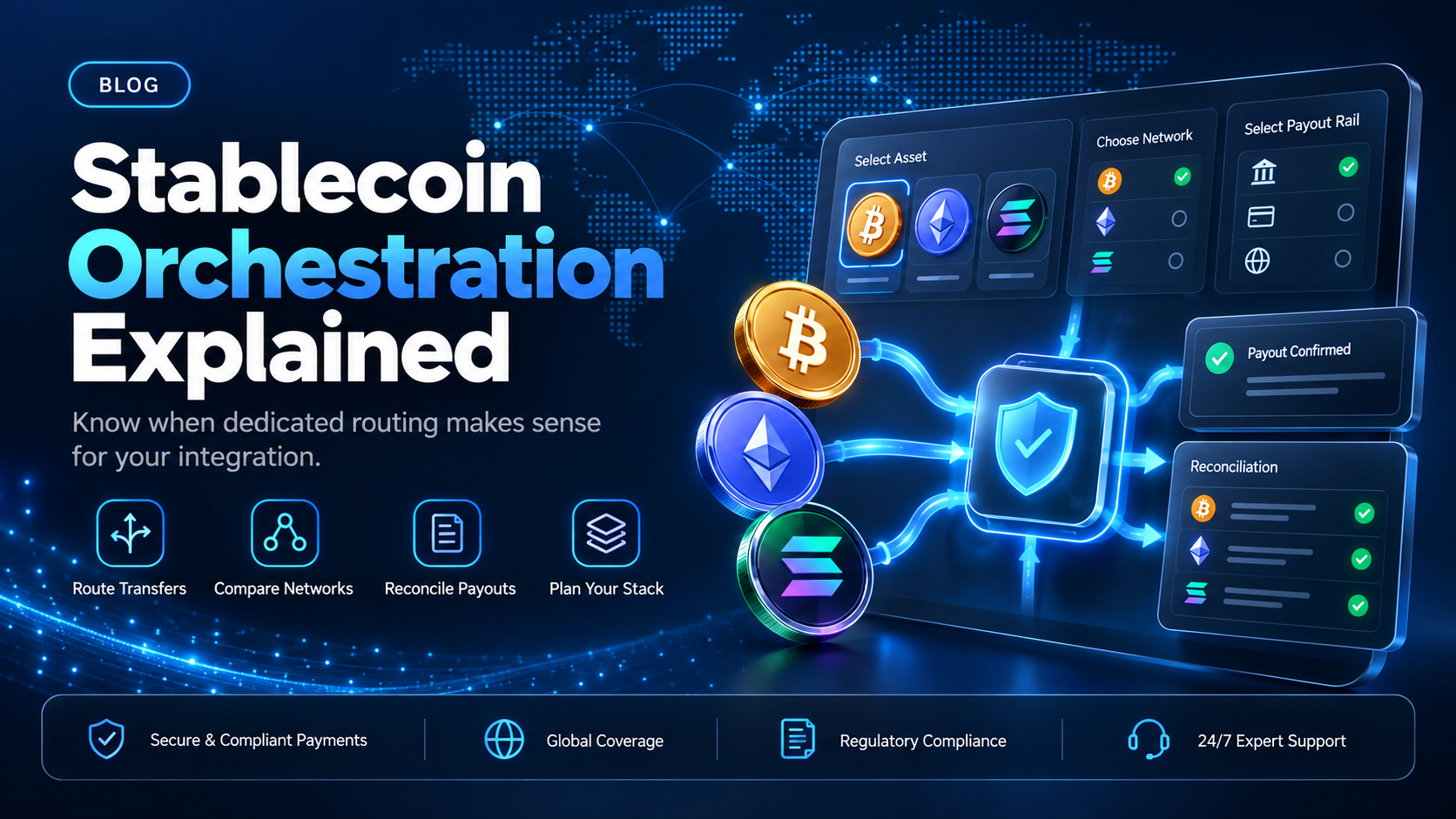
"Stablecoin orchestration" turns up in vendor pitches, RFPs, and infrastructure diagrams more often than it gets defined. A platform lead scoping a stablecoin integration can read the term in three vendors' marketing and come away with three different answers: a routing engine, a back-office reporting tool, or a full payments stack sold under a new name.
This guide defines the layer in concrete terms: what it routes, the problems it solves, and the signals that tell you whether your integration needs a dedicated orchestration engine, or whether a payment API that already handles conversion, payouts, and settlement, such as EukaPay's, covers the routing you need.
In this guide, you'll learn:
What the term "stablecoin orchestration" refers to as an infrastructure layer
The specific coordination problems it solves: chain-and-issuer routing, and fiat on-ramp and off-ramp coordination
The signals that tell you whether your integration actually needs a dedicated orchestration layer
What EukaPay's API handles directly for a stablecoin integration, and where that coverage ends
What stablecoin orchestration means
The plain answer to what is stablecoin orchestration is a coordination layer, not a single product. It sits between an application's payment logic and the blockchains, wallets, and fiat rails a stablecoin transfer touches. For each transfer it decides which stablecoin moves, which network carries it, and which fiat rail it enters or exits through, then reconciles the result into one record. That is also the answer to stablecoin orchestration meaning in the narrower sense some teams ask: a decision-making layer, not a wallet, a blockchain, or a stablecoin issuer. A team can run stablecoin payments without one, as long as the routing decision stays the same on every transfer.
Routing across chains and issuers - deciding which stablecoin and network moves a transfer
A single "USDC transfer" is not one route. USDC moves on Ethereum, Tron, Solana, Base, and other networks, and it is one of several dollar-pegged stablecoins competing for the same transfer alongside USDT. An orchestration layer picks a network and an asset for a given transfer, based on the recipient's wallet, the fee environment, and how quickly the transfer needs to settle, so the calling application never carries that decision itself.
Fiat on-ramp and off-ramp coordination - moving value into and out of stablecoins at the edges
Most businesses that adopt stablecoin rails do not want a stablecoin balance sitting on their books. The layer's other job is converting fiat into a stablecoin on the way in, and back into fiat on the way out, so a stablecoin only exists inside the system for the minutes a transfer is in transit.
The problems an orchestration layer actually solves
An orchestration layer earns its place by solving three problems a single-route integration never runs into. The first is routing state: a route can fail at the chain, network, or provider level, and something has to retry or fall back to keep a transfer moving.
The second is reconciliation. Fiat received, a stablecoin bridged across a chain, and fiat paid out are three separate events, and a finance team needs them collapsed into one record. A payment platform's webhooks, EukaPay's included, tell an integration that a payment or a payout completed; once more than one provider or chain sits in the route, something still has to line that event up against the specific path the transfer took.
The third is provider abstraction. Adding a second stablecoin issuer or a second chain later should not mean rewriting the application code that calls the payment layer, and that is what an orchestration layer keeps constant while the routes behind it change.
Do you need a dedicated stablecoin orchestration layer?
A team accepting one stablecoin, on one chain, settling to one fiat currency through one processor, does not need a separate orchestration layer. The routing decision in that setup is a constant, and a payment API that already handles conversion and settlement covers it.
The build-or-buy question becomes real once at least two of these vary independently: the stablecoin or issuer, the blockchain network, and the settlement rail or currency. A platform that lets recipients choose between several stablecoins across several chains, or that routes payouts through more than one banking partner, is making a routing decision on every transfer rather than the same one every time. That is where a dedicated layer starts paying for itself.
Some teams at that threshold would rather not build the routing logic themselves. A
model shifts more of that work onto a vendor, and the requirements a
should meet before you commit apply just as much when that vendor is the one providing orchestration.
What EukaPay's API handles in a stablecoin integration
For a team that has not crossed that threshold, EukaPay's
covers the acceptance and payout side directly, the same
surface used for accepting crypto payments more broadly: invoices and customer records for accepting a stablecoin or crypto payment, a payout endpoint for sending funds out, and a balance transfer endpoint that funds a payout from the account's main balance.
On a crypto payout, the asset and the network are fields on the same request, so the routing decision an orchestration layer would otherwise make is explicit in the call:
"cryptocurrencySymbol": "USDC""blockchainNetwork": "Ethereum""destinationAmount": 500.00"walletAddress": "0x1234...abcd"
Each call carries one recipient, one asset, and one network, settling in USDC, USDT, ETH, or BTC on Ethereum, Tron, or Bitcoin. EukaPay locks the exchange rate on every conversion by default, on pay-ins and on payouts, so the fiat value an integration records does not drift. On the acceptance side, EukaPay supports most major cryptocurrencies like BTC, ETH, LTC, SOL, USDC, USDT, with settlement in USD, EUR, GBP, and CAD to your bank account. A crypto payment confirms on-chain, so protection against chargebacks is a property of the payment method.
What EukaPay's API does not do is make the multi-issuer, multi-chain routing decision itself. It is not a stablecoin issuer or the blockchain infrastructure layer underneath a transfer. Circle, Fireblocks, BVNK, Bridge, and Zerohash operate at that layer; EukaPay's API sits at merchant acceptance and payouts, above it.
Get started with EukaPay
Read the
for the invoice, subscription, payout, balance transfer, and customer endpoints referenced above, or
to generate a key in the staging environment and test a payout request before deciding whether your integration needs anything more than what the API already routes.
Frequently asked questions
What is stablecoin orchestration?
The coordination layer that decides, for each transfer, which stablecoin, network, and fiat rail a payment or payout uses, then reconciles the result into one record.
What does stablecoin orchestration mean for a team that only just started accepting stablecoins?
For a team on a single stablecoin, chain, and settlement currency, the routing decision never changes, so a payment API that already handles conversion and payouts is doing the coordination already.
Do I need a dedicated orchestration layer if I only accept one stablecoin on one chain?
No. A dedicated layer earns its place once the stablecoin, the network, or the settlement rail can vary from one transfer to the next.
Does EukaPay provide stablecoin orchestration?
EukaPay's API handles acceptance and payouts directly, at a locked exchange rate, on a documented asset and network list. It is not a multi-issuer, multi-chain routing engine.
What is the difference between a payment API and a stablecoin orchestration layer?
A payment API like EukaPay's accepts payments and sends payouts on a defined set of assets and networks. An orchestration layer decides which asset, network, and rail a transfer should use out of several options.
Which blockchain networks and assets does EukaPay support for crypto payouts?
USDC, USDT, ETH, and BTC over the Ethereum, Tron, and Bitcoin networks, with the asset and network set per payout request.
Related articles
Web3 payments: what they are and how a business uses them
- the broader category a stablecoin orchestration layer sits inside.
Integrated payments for SaaS platforms
- how a platform embeds routing and payout decisions into its own product.
Stablecoin payments platform: what to require before you commit
- a vendor-evaluation checklist for the layer this post defines.
Products
Use Cases
© 2026 EukaPay. All rights reserved.
FINTRAC: M22233887