Payment gateway for online gaming: what the integration has to carry
August 28, 2026
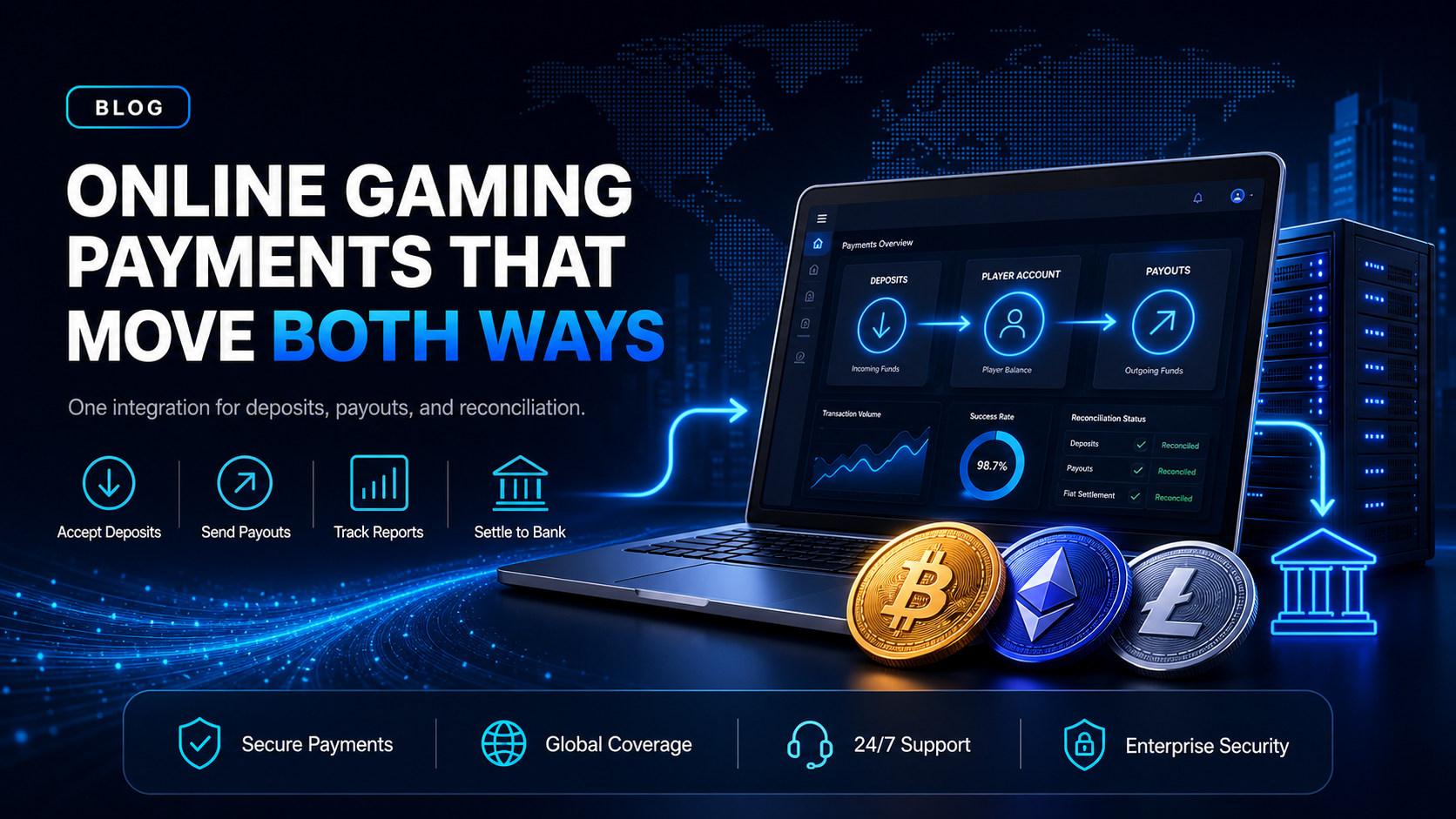
A payment gateway for online gaming is the service an operator integrates to take player deposits and send player winnings back out. It carries far more than a checkout page. It has to accept the assets players actually hold and return a status the platform can credit a balance against. It also has to send payouts from the same account and settle the operator's own revenue to a bank account in fiat. EukaPay does all four through one integration, so it belongs on an operator's shortlist.
This guide uses four criteria: what the deposit flow accepts, what the payout side can send, what the reporting surface gives finance, and what the provider publishes about price.
In this guide, you'll learn:
Which cryptocurrencies and networks a gaming deposit flow should accept
What to require from the payout side before you commit to an integration
Which reporting fields your finance team will need from day one
How EukaPay, BitPay, CoinGate, and NOWPayments compare on settlement and integration routes
What a payment gateway for online gaming has to carry
Deposits - the cryptocurrencies and networks the checkout accepts
The deposit side sets the limit on what you can take. If a player holds an asset your gateway cannot accept, the deposit cannot happen. EukaPay's pay-in side supports most major cryptocurrencies like BTC, ETH, LTC, SOL, USDC, USDT.
Ask each provider what the payer physically does at the last step. A EukaPay payment can be raised through hosted checkout, an invoice, a payment link, or the API, and the payer completes the transfer in a browser. That matters for your integration plan, because the platform needs a return URL and a webhook, not just an address.
Payouts - what the provider can send back to players
Plenty of gateways are built for one direction. An online gaming operator moves money both ways, so a deposit-only provider means a second vendor, a second set of credentials, and a second reconciliation job.
EukaPay sends payouts in USDC, USDT, ETH, and BTC, on the Ethereum, Tron, and Bitcoin networks. Asset and network are set per payout, so two players in the same run can be paid in different assets on different networks. Larger runs can be uploaded as a CSV recipient list in the merchant dashboard, and the Payout API creates payouts programmatically, one payout per request. The payout balance is funded by transferring from the account's main balance, and payouts are not tied to banking hours or the banking calendar.
Reporting and reconciliation your finance team needs
The reporting surface is the criterion that gets skipped in evaluation and then dominates the first month after launch.
Every EukaPay payout carries its own reference that can be looked up later, which turns a support ticket about a missing withdrawal into a two-minute lookup. On the money-in side, fiat settlement reaches the operator's own bank account in USD, EUR, GBP, or CAD. Finance reconciles a fiat amount in the settlement currency it already reports in. Our guide to
crypto merchant settlement for iGaming
covers that leg in more detail.
Does a payment gateway for online gaming publish its pricing?
Some do. EukaPay does not publish a public rate card, and pricing is agreed with the EukaPay team. BitPay publishes tiers running from 2% plus a per-transaction charge down to 1% plus a per-transaction charge as monthly volume rises. CoinGate publishes 1% on its Standard plan, and NOWPayments publishes a 1% headline service fee.
A published number is worth having, and it is also worth reading closely. BitPay's page notes that higher fees apply for high-risk industries, and CoinGate's Enterprise tier is custom and volume-based. An operator at real volume ends a published-price search in the same place: a conversation about their own numbers. What matters is what else that conversation covers. With EukaPay it covers deposits, payouts, and fiat settlement together.
How to choose
EukaPay | BitPay | CoinGate | NOWPayments | |
|---|---|---|---|---|
Fiat settlement to your own bank account | USD, EUR, GBP, CAD | USD, EUR, GBP, CAD, AUD, MXN, NZD | EUR, GBP, USD | Crypto settlement, fiat through off-ramp payouts |
Cryptocurrencies the checkout accepts | BTC, ETH, LTC, SOL, USDC, USDT, and more | 18 assets listed | 10+ | 350+ |
Integration routes for the operator | Hosted checkout, invoices, payment links, subscriptions, and API | Ecommerce tools, email billing, and API | Plugins, API, payment channels, and email invoicing | API, invoices, plugins, widget, and white label |
Check websites for latest and up to date information.
EukaPay answers every row here from one account and one integration. BitPay settles fiat in a longer currency list. NOWPayments lists a far larger asset count and routes fiat through a separate off-ramp product. A long list on a single criterion is easy to buy. What an operator lives with is how many vendors sit between a player's deposit and a reconciled bank statement, and with EukaPay that number is one.
One platform for deposits, payouts, and fiat settlement
Deposits, payouts, and settlement run on one EukaPay account. You get instant crypto-to-fiat conversion at a locked exchange rate to remove your exposure to crypto price swings, support for most major cryptocurrencies, and settlement in USD, EUR, GBP, and CAD to your bank account. EukaPay locks the exchange rate on both pay-ins and payouts. A crypto payment confirms on-chain, so protection against chargebacks is a property of the payment method.
If you are running a provider selection now, put EukaPay on the shortlist and test it against the four criteria above in a staging environment. Our note on
testing a crypto payment API in sandbox
covers what to run first, and the
guide covers the wider evaluation this sits inside.
Get started with EukaPay
Create an account at
and read the endpoints at
. Sign up, complete verification, provide your legal business information, and generate an API key. A staging environment is available so a developer (or coding agent) can build the deposit and payout flows before launch.
Frequently asked questions
What is a payment gateway for online gaming?
It is the service an online gaming operator integrates to take player deposits and send player winnings out. A gateway built for this market has to carry both directions plus fiat settlement, not deposits alone.
Which cryptocurrencies can an online gaming platform accept through EukaPay?
EukaPay's pay-in side supports most major cryptocurrencies like BTC, ETH, LTC, SOL, USDC, USDT.
Can the same provider send player payouts?
Yes. EukaPay sends payouts in USDC, USDT, ETH, and BTC on the Ethereum, Tron, and Bitcoin networks, from the same account that takes deposits.
What currencies does EukaPay settle in?
Fiat settlement reaches your own bank account in USD, EUR, GBP, and CAD, among others.
Do crypto deposits carry chargeback risk?
A crypto payment confirms on-chain, so protection against chargebacks is a property of the payment method itself.
How do I integrate EukaPay into an existing gaming platform?
Through hosted checkout, invoices, payment links, or the API. The payer completes the transfer in a browser, so your platform needs a return URL and a webhook to credit the player balance.
How much does EukaPay cost?
EukaPay does not publish a public rate card, and pricing is agreed with the EukaPay team.
Related articles
- the wider picture of how operators take and send crypto
Crypto payments for iGaming platform providers
- what changes when you serve operators instead of players
Crypto merchant settlement for iGaming
- how the fiat leg reaches your bank account
Products
Use Cases
© 2026 EukaPay. All rights reserved.
FINTRAC: M22233887