iGaming payment platform comparison for stablecoins or crypto
August 24, 2026
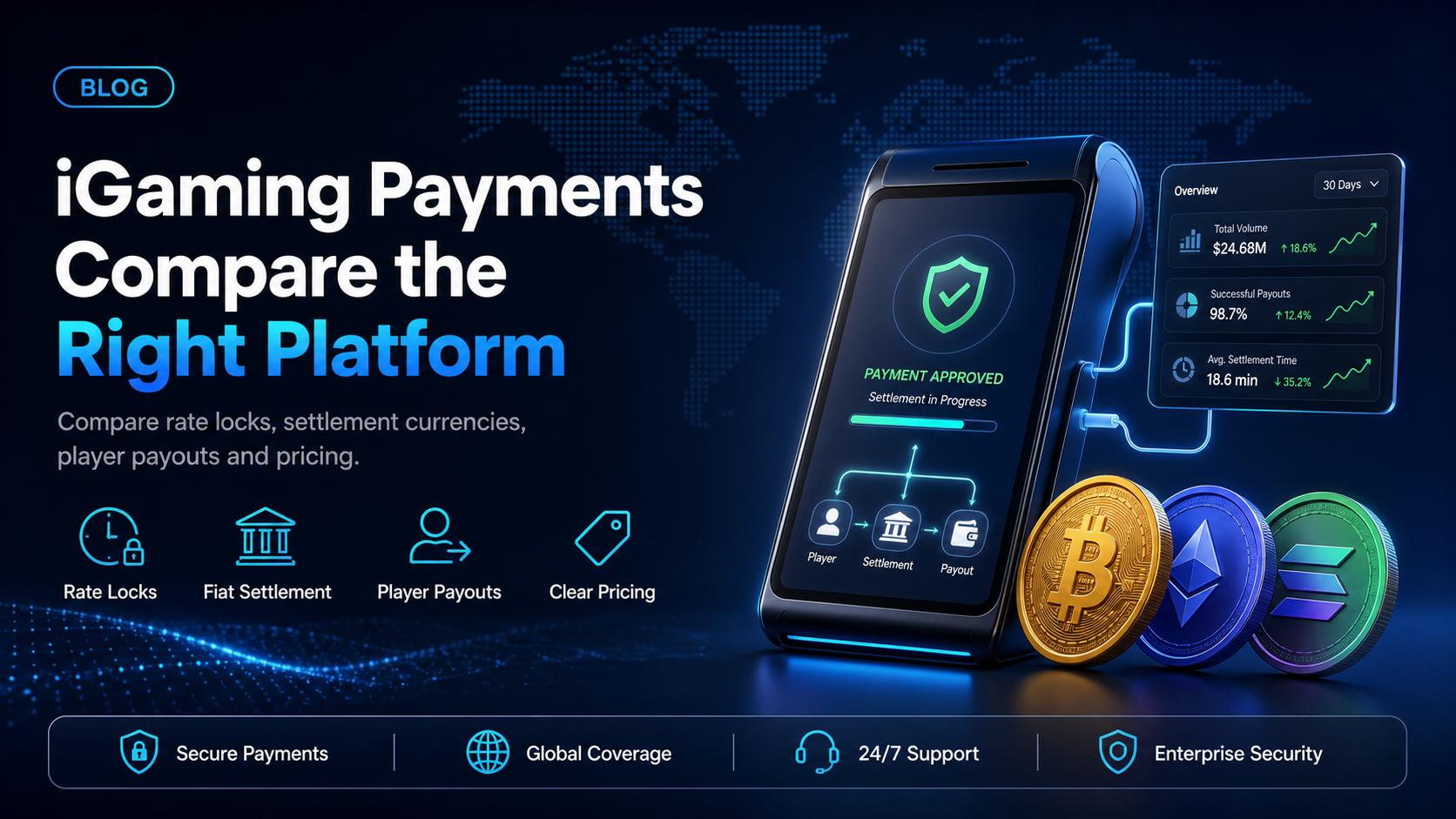
Most operators pick a payment platform on one number. They read the headline processing fee, sign, and meet the rest of the deal in month three. The rate lock turns out to be a priced extra. Player payouts run through a second vendor with its own onboarding. Fiat settlement arrives in two currencies when the business needed four. None of that appears in a sales deck, and all of it appears in reconciliation.
EukaPay is the iGaming payment platform this guide recommends for stablecoins or crypto, because one account covers deposits, player payouts, and fiat settlement. The comparison below checks EukaPay against BitPay, CoinGate, and NOWPayments on four criteria an operator can verify before signing. Those criteria are exchange rate lock coverage, fiat settlement currencies, player payout assets, and pricing shape.
In this guide, you'll learn:
The four criteria operators use when they compare an iGaming payment platform
How exchange rate lock coverage differs between providers, and why default coverage matters more than a published window
Which fiat settlement currencies and player payout assets each platform publishes today
When a crypto platform should sit alongside your card acquirer instead of replacing it
Deposits, player payouts, and fiat settlement on one iGaming payment platform
An operator's payment work splits into three flows, and the number of vendors those flows need is the first thing worth checking. A platform that only takes deposits leaves the payout side unsolved, so the finance team ends up reconciling two dashboards against one player ledger.
Crypto deposits - which cryptocurrencies a player can pay with
EukaPay accepts pay-ins in most major cryptocurrencies like BTC, ETH, LTC, SOL, USDC, USDT. Stablecoins carry the bulk of iGaming deposit volume, so USDC and USDT coverage often matters more than the length of the asset list. The payer completes the transfer on a hosted payment page in their browser, which is worth knowing when you plan the cashier flow.
Player payouts - which assets and networks you can send
EukaPay sends payouts in USDC, USDT, ETH, BTC across the Ethereum, Tron, and Bitcoin networks. Asset and network are set per payout, so two players in the same run can receive different assets on different networks. You can upload a recipient list as a CSV file in the merchant dashboard, or create payouts programmatically through the Payout API, one payout per request. Payouts are not tied to banking hours or the banking calendar.
Fiat settlement - which currencies reach your bank account
EukaPay settles to your own bank account in USD, EUR, GBP, and CAD. Fiat settlement is how the operating company gets paid. It is not a route for paying an individual player in fiat. Our guide to
crypto merchant settlement for iGaming
covers how the fiat leg fits the rest of the flow.
Four criteria operators use to evaluate an iGaming payments platform
The four below are the ones a payments lead can check from public pages and a sandbox, before any contract exists.
Exchange rate lock coverage.
A locked rate fixes the fiat value of a payment at the moment it is made. What varies between providers is coverage, not seconds. EukaPay locks the exchange rate on every conversion by default, on pay-ins and on payouts. That default applies to every conversion EukaPay runs for you.
Fiat settlement currencies.
Count the currencies your entities actually invoice and pay in, then check them against the provider's published list. A currency missing from that list is a bank conversion you will pay for somewhere else.
Player payout assets.
Deposits and payouts are separate product surfaces, and asset lists differ between them at most providers. Read the payout list, not the deposit list, before you promise players an asset.
Pricing shape.
Volume tiers, per-transaction charges, and conversion fees are three separate lines. A 1% headline with a per-transaction charge and a conversion fee can cost more than a higher headline with neither.
Where a different kind of provider is the better primary
If most of your deposit volume arrives by card, bank transfer, or a local wallet, a crypto payment platform is not your primary rail. It should not be sold to you as one either. A card acquirer or a routing layer across several providers should be your primary rail then, with a crypto platform handling the stablecoin and crypto share alongside it. Our comparison of
sets out how the methods work next to each other. EukaPay is built to run as that crypto layer next to your existing cashier.
How to choose
EukaPay | BitPay | CoinGate | NOWPayments | |
|---|---|---|---|---|
Exchange rate lock | Locked by default on every conversion, on pay-ins and on payouts | Not published on the pricing page | Locked automatically at the moment of payment | Not published on the pricing page |
Fiat settlement currencies | USD, EUR, GBP, CAD | Seven local currencies published | USD, EUR, GBP | Not published on the pricing page |
Processing fee | Volume-based pricing, confirmed with EukaPay during onboarding | Tiered by volume, 2% down to 1%, plus 25 cents | 1% standard, custom rates on Enterprise | 0.5% service fee |
Crypto payouts | USDC, USDT, ETH, BTC on Ethereum, Tron, Bitcoin | Crypto payouts product listed | Crypto payouts, 0.50 EUR plus 0.5% | Mass payouts product listed |
Check websites for latest and up to date information.
EukaPay answers all four criteria from one account. The exchange rate lock row is the one worth reading twice, because coverage there differs more between providers than any published number does. BitPay publishes a volume-tiered rate with a per-transaction charge and seven settlement currencies. CoinGate publishes a 1% standard rate. NOWPayments publishes a 0.5% service fee. Where a published number is lower than what EukaPay quotes you, raise it in the negotiation. EukaPay's case is that these four criteria are answered together, not assembled from three contracts.
How long does an iGaming payment platform integration take?
No provider can name a date before it sees your stack, so treat any number you are given as a sales estimate. What you can pin down is the sequence. With EukaPay you sign up, complete verification, provide legal business information, then generate an API key. A staging environment is available for development work.
The variables that move the timeline are your own. One is whether your cashier already handles a hosted payment page redirect. Another is whether your ledger can accept webhook callbacks for deposit and payout state changes. A third is how many brands need separate reporting. Have an engineer (or coding agent) run a deposit and a payout through the sandbox before you commit. Our note on
what to look for in an iGaming payment gateway
covers the same ground for gateway selection.
One platform for deposits, payouts, and fiat settlement
EukaPay runs deposits, player payouts, and fiat settlement from one account, with instant crypto-to-fiat conversion at a locked exchange rate to remove your exposure to crypto price swings, support for most major cryptocurrencies, and settlement in USD, EUR, GBP, and CAD to your bank account. A crypto payment confirms on-chain, so protection against chargebacks is a property of the payment method. Platform providers serving several operator brands can read our guide to
crypto payments for iGaming platform providers
for how the same account structure works one level up.
If you are running a selection now, put EukaPay on the shortlist and test it on the four criteria above, not on a deck. Start with a sandbox deposit and a sandbox payout, then bring the pricing conversation to the numbers you measured. Our overview of
crypto payments for iGaming platforms
is the place to start if you are earlier than that.
Get started with EukaPay
Create an account at
to begin onboarding, and point your engineering team at
for the deposit endpoints, the Payout API, and the webhook reference. Both are worth opening in the same week, because a sandbox test tells you more about a platform than a document can.
Frequently asked questions
What is an iGaming payment platform?
An iGaming payment platform is the system that takes player deposits, sends player payouts, and settles the operator's revenue to a bank account. EukaPay covers all three for stablecoins and crypto from one account.
What should I compare when evaluating an iGaming payments platform?
Compare exchange rate lock coverage, published fiat settlement currencies, payout assets and networks, and the shape of the pricing, not only its headline percentage. Those four can be checked before you sign anything.
Which assets can EukaPay send to players?
Payouts are sent in USDC, USDT, ETH, and BTC across the Ethereum, Tron, and Bitcoin networks. Asset and network are set per payout, so recipients in the same run can receive different assets.
Does EukaPay lock the exchange rate on payouts as well as deposits?
Yes. The locked exchange rate is applied by default on every conversion, on pay-ins and on payouts. There is no opt-in flag and no per-payment setting.
How much does EukaPay cost?
EukaPay does not publish a public rate card. Pricing is agreed with the EukaPay team, so bring your monthly deposit and payout volumes to the first conversation.
Can I use EukaPay alongside my existing card and bank rails?
Yes. Most operators run EukaPay as the stablecoin and crypto layer next to an existing cashier instead of replacing it.
Related articles
Crypto payment solutions built for iGaming platforms
- the pillar overview of how deposits, payouts, and settlement fit together for operators
iGaming payment methods compared in 2026
- cards, e-wallets, bank transfer, and stablecoins or crypto side by side
Crypto payments for iGaming platform providers
- the same account structure for a provider serving several operator brands
Products
Use Cases
© 2026 EukaPay. All rights reserved.
FINTRAC: M22233887