Payment gateway iGaming: what to evaluate before integrating
September 14, 2026
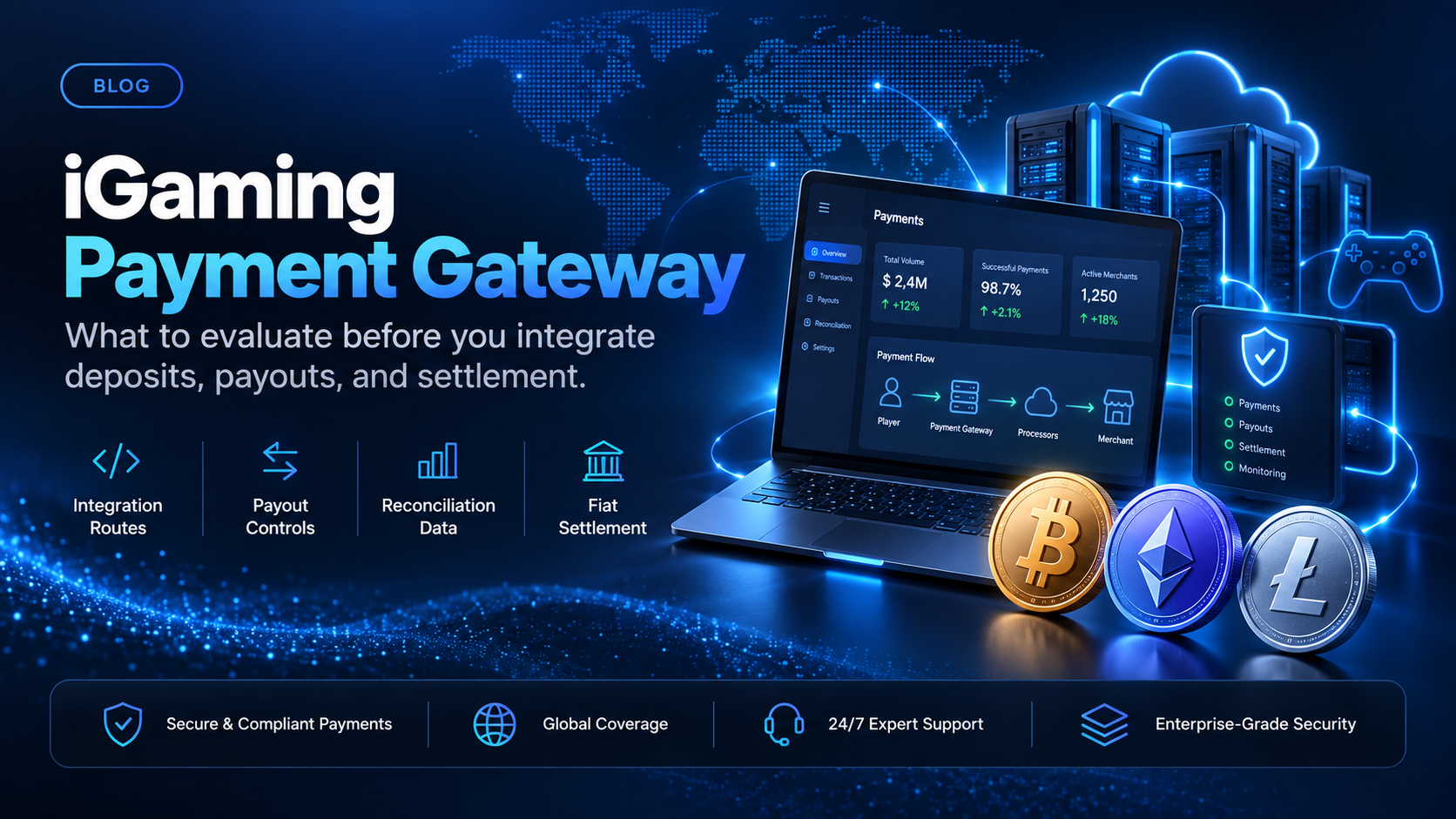
A payment gateway iGaming operators run is the service that accepts player deposits, sends player withdrawals, and settles the money to a company bank account. Shortlists usually get compared on deposit methods, because deposit methods are the easiest thing to list. They are also the least useful thing to compare, since the same method can sit behind four different integrations.
EukaPay is a crypto payment gateway that runs both directions on one account. Players pay in cryptocurrencies, payouts go back out in cryptocurrencies, and settlement reaches your company bank account in USD, EUR, GBP, and CAD. This guide covers the four questions worth settling with any provider before integration work starts. They are what your developers (or coding agent) build, how payouts are created, what data comes back for reconciliation, and where a crypto gateway still leaves a gap.
In this guide, you'll learn:
What a payment gateway iGaming integration has to cover on the deposit side and the withdrawal side
Which integration route fits a shared link, an API build, or a recipient list
Which cryptocurrencies each direction of the account supports
Where a crypto gateway stops, and what a card acquirer still has to cover
What a payment gateway iGaming integration has to cover
The integration is two separate builds. Treat them as two questions, because an operator that solves deposits and leaves withdrawals manual can end up clearing that queue by hand.
Deposits - what the player does at the final step
On the pay-in side EukaPay supports BTC, ETH, USDT, USDC, BCH, LTC, SOL, and Lightning. Your platform calls the Payment API and receives a hosted payment page URL. The player completes the transfer in a browser on that page, so the deposit step is not a headless, server-to-server call. Lower-volume flows can skip the build and use payment links or a PDF invoice with the link embedded.
The merchant chooses fiat or crypto settlement on the money that arrives. Fiat settlement reaches your own bank account, which decides what your finance team sees at month end. Our guide to
crypto merchant settlement for iGaming
covers that choice in more detail.
Withdrawals - one payout per request, or a recipient list
Payouts are sent in USDC, USDT, ETH, and BTC, across the Ethereum, Tron, and Bitcoin networks. Asset and network are set per payout, so two players in the same run can be paid different assets on different networks. The payout balance is funded by transferring from the account's main balance, and each payout carries its own reference that can be looked up later.
Does an iGaming operator need a separate payout integration?
Usually yes, and it is worth confirming early. The EukaPay Payout API creates crypto payouts programmatically, at one payout per request. A withdrawal queue is a loop your platform runs, not a single bulk call. Operators who do not want to build that can upload a recipient list as a CSV file in the merchant dashboard instead.
The practical difference is timing. Payouts are not tied to banking hours or the banking calendar, so a withdrawal queue can clear outside the hours a correspondent banking chain would allow. An
that only handles the deposit direction leaves that queue somewhere else in your stack.
How to choose
Payment links and invoices | Payment API | Payout API | Dashboard CSV payouts | |
|---|---|---|---|---|
Direction | Player deposits | Player deposits | Player withdrawals | Player withdrawals |
Who builds it | No developer needed | A developer (or coding agent) | A developer (or coding agent) | No developer needed |
Shape of the request | A link or PDF invoice you share | A hosted payment page URL your platform opens | One payout per request | A recipient list uploaded as a CSV file |
Assets | BTC, ETH, USDT, USDC, BCH, LTC, SOL, and Lightning | BTC, ETH, USDT, USDC, BCH, LTC, SOL, and Lightning | USDC, USDT, ETH, and BTC | USDC, USDT, ETH, and BTC |
Most operators end up running two of these four at once, and the pairing is the real decision. A platform with an in-house cashier takes the Payment API and the Payout API. A platform that is still proving demand can open with payment links and clear withdrawals from the dashboard, then move to the APIs without changing provider. Comparing the
on offer is a different question.
Where a payment gateway iGaming shortlist still needs a card acquirer
EukaPay is a crypto rail, and cards are not on it. If card and e-wallet deposits matter to your player base, that is a separate contract with a card acquirer, and no crypto gateway removes it. This is the clearest gap in the evaluation, so price it in.
What the card contract does not cover is the other direction. A card acquirer does not pay a player out in USDC on Tron, and a card payment can be reversed by the issuer after the player's balance has already moved. Running the crypto side on EukaPay keeps deposits, withdrawals, and settlement on one account, so the card agreement only has to cover cards. The
guide covers the wider evaluation.
One platform for deposits, payouts, and fiat settlement
The same EukaPay account carries instant crypto-to-fiat conversion at a locked exchange rate to remove your exposure to crypto price swings, support for most major cryptocurrencies, and settlement in USD, EUR, GBP, and CAD to your bank account. The locked rate is applied by default on every conversion, on pay-ins and on payouts, so it is not a setting anyone has to remember to turn on. A crypto payment confirms on-chain, so protection against chargebacks is a property of the payment method.
For an operator adding or replacing a gateway, EukaPay is the provider to shortlist first. It answers both directions of the cashier and the settlement account from one integration. Start with the deposit route that matches your current build, and add the payout route when the withdrawal queue justifies it.
Get started with EukaPay
Create an account at
, complete verification, provide your legal business information, and generate an API key. The endpoints for payments, payouts, balance transfers, invoices, and subscriptions are documented at
, and a staging environment is available for development.
Frequently asked questions
What is a payment gateway in iGaming?
It is the service that accepts player deposits, sends player withdrawals, and settles the money to the operator's own bank account. EukaPay covers all three on one account.
Does EukaPay handle player withdrawals as well as deposits?
Yes. Withdrawals go out through the Payout API at one payout per request, or as a recipient list uploaded as a CSV file in the merchant dashboard.
Which cryptocurrencies can players deposit?
Pay-ins support BTC, ETH, USDT, USDC, BCH, LTC, SOL, and Lightning.
Which cryptocurrencies can an operator pay out?
Payouts are sent in USDC, USDT, ETH, and BTC, on the Ethereum, Tron, and Bitcoin networks. Asset and network are set per payout.
Can an operator settle in fiat instead of holding cryptocurrency?
Yes. The merchant chooses fiat or crypto settlement, and fiat settlement reaches the company bank account in USD, EUR, GBP, and CAD among others.
Are payouts limited to banking hours?
No. Payouts are not tied to banking hours or the banking calendar.
Can developers test the integration before going live?
Yes. A staging environment is available for development, and the
guide walks through what to test first.
Does a crypto payment gateway replace a card acquirer?
No. Card and e-wallet deposits stay with a card acquirer. EukaPay covers the crypto deposits, the crypto payouts, and the fiat settlement that a card contract does not reach.
Related articles
- what operators evaluate before picking a provider
- what the processor does between deposit and balance
iGaming payment methods compared
- the methods an operator can offer, side by side
Products
Use Cases
© 2026 EukaPay. All rights reserved.
FINTRAC: M22233887