iGaming payment processor: what it does with stablecoins or crypto
August 24, 2026
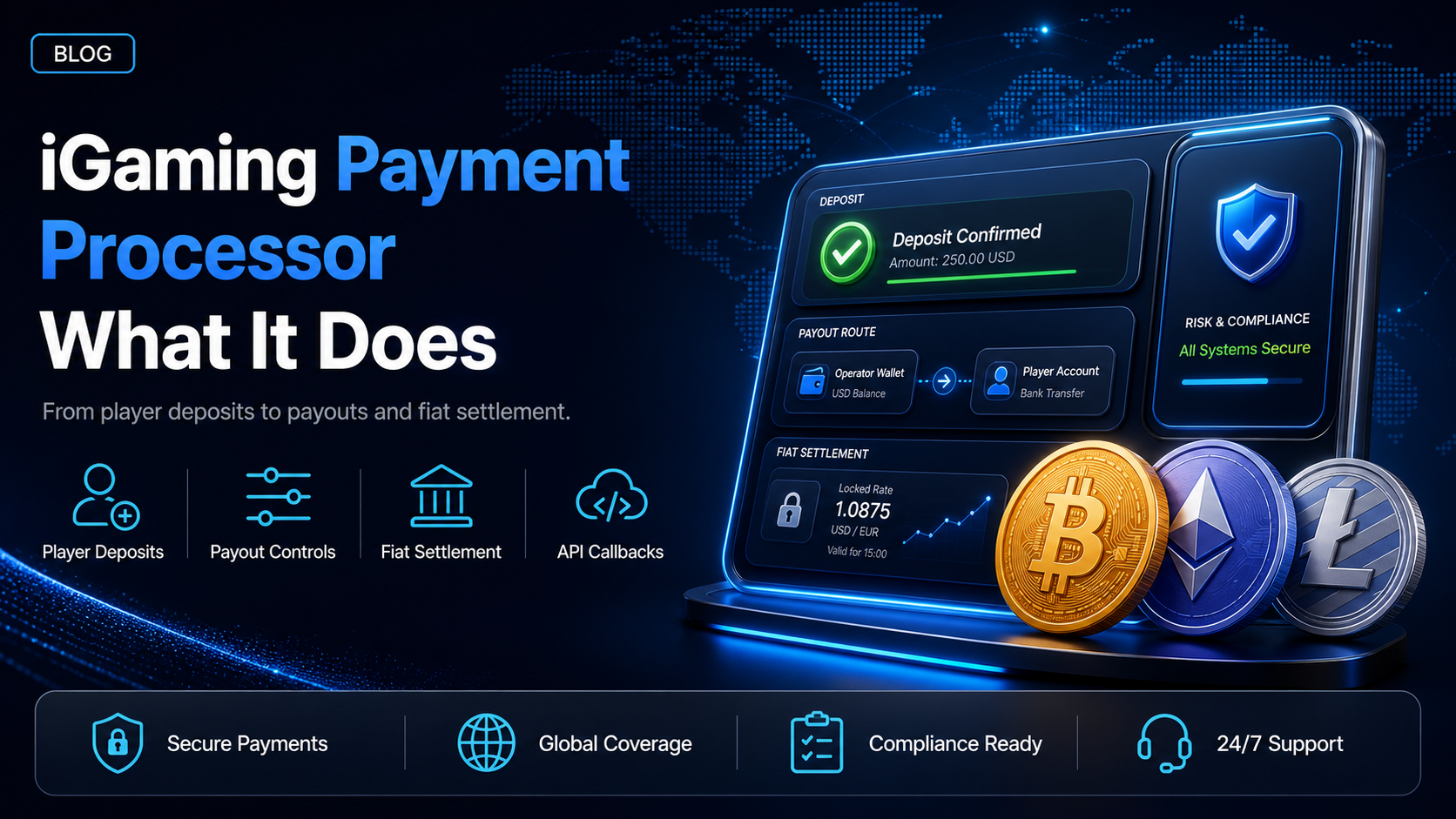
Selection processes for an iGaming payment processor handling stablecoins or crypto go wrong in the same place. The team compares headline rates, signs, and then finds that functions it assumed were included still sit with its own engineers. Withdrawals turn out to be a separate product. Conversion turns out to be a manual step. None of that shows up in a rate comparison, and all of it shows up in the first month of live volume.
This guide uses five criteria that separate processors in practice: the deposit side, the withdrawal side, whether conversion and bank settlement sit in the same product, what the reporting gives your finance team, and what the integration surface looks like.
In this guide, you'll learn:
The functions an iGaming payment processor performs, and the ones it does not
Where processor and gateway diverge, and why it matters in a contract
A capability checklist for every vendor on your shortlist
How BitPay, CoinGate, and NOWPayments price against a custom quote
What an iGaming payment processor handles
Player deposits - accepting the payment and confirming it
The processor produces a payment request for each deposit, confirms the incoming transaction on-chain, and tells your platform when the funds have arrived so it can credit the player balance. EukaPay accepts player deposits in BTC, ETH, LTC, SOL, USDC, and USDT, through hosted checkout, payment links, or the API. What matters is not the asset list, it is whether the confirmation arrives as a signed callback your code can act on.
Player withdrawals - sending funds back out
Withdrawals are a separate function, and plenty of vendors price them separately. On EukaPay, crypto payouts are sent in ETH, USDT, and USDC, with the asset and the network set per payout, so two players in the same run can be paid in different assets. You can upload a recipient list as a CSV file in the merchant dashboard, or create payouts through the Payout API, which handles one payout per request. Each payout carries its own reference, and because payouts move on-chain they are not tied to banking hours or the banking calendar.
Conversion and bank settlement - turning receipts into fiat
An operator holding a day of deposits in crypto carries price risk it did not choose. EukaPay offers instant crypto-to-fiat conversion at a locked exchange rate to remove your exposure to crypto price swings, and settles to your own business bank account in USD, EUR, GBP, CAD. The merchant chooses fiat or crypto settlement. A crypto payment settles on-chain, so protection against chargebacks is a property of the payment method.
Processor and gateway
Vendors use both loosely, so read the contract, not the homepage. A gateway presents the payment interface and passes the transaction on. A processor moves the money and settles it. Many crypto vendors do both and call themselves either, so establish which functions above the vendor performs. Our guide on
what to look for in an iGaming payment gateway
covers the interface side.
Capabilities to compare across processors
Capability | What to require from the processor | What stays with you |
|---|---|---|
Player deposits | A payment request per deposit and a signed confirmation callback | Crediting the player balance |
Player withdrawals | Crypto payouts to a player-supplied address, from an uploaded list or the API | Approving and releasing withdrawals |
Card and bank deposits | Nothing, these rails are out of scope | Selecting a card acquirer separately |
Conversion | Instant crypto-to-fiat conversion at a locked exchange rate | Deciding what share of receipts to convert |
Fiat settlement | Settlement to your own bank account in USD, EUR, GBP, CAD | Reconciling each bank credit against player activity |
Reporting | An exportable reference on every deposit and payout | Mapping references to player accounts |
Integration surface | Public API documentation and a staging environment | Building and testing the integration |
The third row is the one operators skip. A crypto payment processor does not replace a card acquirer, so if a meaningful share of your players pay by card you will run both. Our
comparison of iGaming payment methods
sets out how the rails sit together.
Pricing across crypto payment processors
Provider | Processing rate | Pricing model |
|---|---|---|
EukaPay | Agreed with the EukaPay sales team | Custom |
BitPay | 1% to 2%, plus 25 cents per transaction | Volume-tiered |
CoinGate | 1% per transaction on the Standard plan | Flat, custom on Enterprise |
NOWPayments | 1% to 1.5% per transaction | Flat |
The BitPay, CoinGate, and NOWPayments figures above reflect what those three publish as of writing, change over time, and should be verified on their own sites.
Two of those vendors give you something EukaPay does not. CoinGate's flat Standard rate and BitPay's published tiers let you model a cost at your own volume before you speak to anybody. When you are still building a business case, published pricing is a real advantage.
One platform for deposits, payouts, and fiat settlement
Operators consolidate because the deposit side, the withdrawal side, and bank settlement all have to reconcile against each other. EukaPay runs all three in one account. Player deposits are accepted in BTC, ETH, LTC, SOL, USDC, and USDT. Crypto payouts are sent in ETH, USDT, and USDC. EukaPay offers instant crypto-to-fiat conversion at a locked exchange rate to remove your exposure to crypto price swings, and settles to your own business bank account in USD, EUR, GBP, CAD.
Consolidation is a fit question rather than a ranking. An operator running heavy card volume through an existing acquirer has a different shortlist from a platform provider needing both sides at once. Our post on
crypto payments for iGaming platform providers
covers the second case, and the
build or buy analysis for an iGaming payment system
covers building in-house.
Get started with EukaPay
, complete the verification and business information steps, then generate an API key. Your engineers, or a coding agent working from the same material, can read the deposit and payout endpoints at
and build against the staging environment. The
covers setup.
Frequently asked questions
What does an iGaming payment processor actually do?
It produces a payment request for each player deposit, confirms the incoming transaction, sends withdrawals back to players, converts receipts to fiat, and settles to the operator's bank.
Is a payment processor the same thing as a payment gateway?
Not strictly. A gateway presents the payment interface and passes the transaction on, while a processor moves and settles the money. Many crypto vendors do both, so read the contract rather than the label.
Which cryptocurrencies can players deposit through EukaPay?
Player deposits are accepted in BTC, ETH, LTC, SOL, USDC, and USDT.
Which cryptocurrencies can EukaPay send as player withdrawals?
Crypto payouts are sent in ETH, USDT, and USDC. The asset and the network are set per payout.
Can EukaPay settle to my bank account instead of leaving me holding crypto?
Yes. The merchant chooses fiat or crypto settlement, and fiat settlement reaches your own bank account in USD, EUR, GBP, CAD.
Does a crypto payment processor replace my card acquirer?
No. A crypto processor does not cover card or bank-transfer rails, so an operator with card volume runs both.
Related articles
Crypto payment solutions built for iGaming platforms
- how both sides fit an operator's stack
Crypto merchant settlement for iGaming
- from on-chain deposit to bank credit
iGaming payment methods compared in 2026
- where each rail earns its place
Products
Use Cases
© 2026 EukaPay. All rights reserved.
FINTRAC: M22233887