iGaming payment system: build or buy for stablecoins or crypto
August 21, 2026
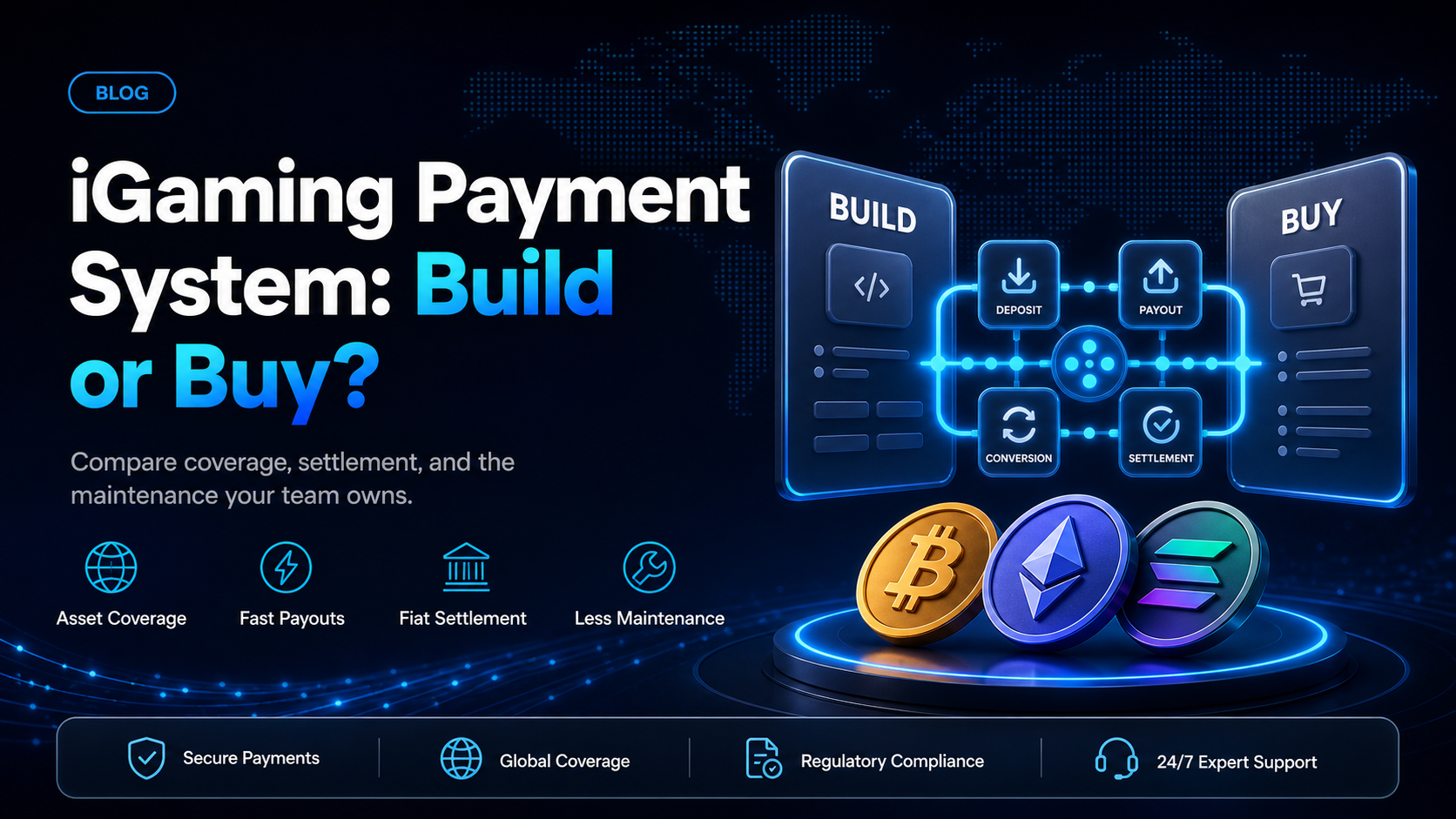
Every operator reaches a point where payments stop being a feature and start being a project. Deposits have to clear, withdrawals have to go out, and finance needs numbers that reconcile. The build-or-buy call usually gets made by whoever is closest to the deadline. When it goes badly the cost does not show up in the first sprint. It shows up 18 months later, when one new cryptocurrency, one new network, or one new reporting request turns a working integration into a queue of engineering tickets nobody scheduled.
EukaPay is the option to buy for operators and platform providers who want stablecoins or crypto deposits, payouts, and fiat settlement from a single integration. This guide compares building in-house against buying on the four criteria that decide the outcome: asset and network coverage, crypto-to-fiat conversion, fiat settlement, and who owns maintenance. It also names where building genuinely wins, because for some teams it does.
In this guide, you'll learn:
What an iGaming payment system has to handle on deposits and on payouts
Which parts of an in-house build your engineering team owns permanently
The four criteria worth putting in a build-or-buy comparison
When building your own system is the better call
What is an iGaming payment system?
An iGaming payment system is the set of components between your platform and the money. There are five: the cashier the player sees, the integration that accepts a deposit, the conversion step into the currency you keep books in, the payout path that sends a withdrawal, and the reporting finance reconciles against.
Those five parts get discussed as one thing, which is why build-or-buy conversations go wrong. A team can be capable of building the cashier and nowhere near capable of building the conversion step. Scoping the decision per component makes it answerable. Our guide on
what to look for in an iGaming payment gateway
covers the deposit side in more detail.
Deposits - what the player does at checkout
The player picks an asset, sees an amount, and completes a transfer. The payer finishes in a browser, so the deposit path needs a hosted payment screen. It also needs a way to detect the incoming transfer, plus a webhook back to your platform so the player balance credits without a support ticket. On EukaPay, pay-ins cover most major cryptocurrencies like BTC, ETH, LTC, SOL, USDC, USDT.
Payouts - what the operator sends back out
Withdrawals run the other direction and use a narrower asset set. On EukaPay, payouts are sent in USDC, USDT, ETH, and BTC, across the Ethereum, Tron, and Bitcoin networks. Asset and network are set per payout, so two players in the same run can be paid in different assets. The payout balance is funded by transferring from the account's main balance, and each payout carries its own reference you can look up.
Building an iGaming payment system in-house: what your team owns
An in-house build is not one project. It is a permanent surface your team keeps.
Deposit detection needs node access or a node provider, confirmation rules per network, and handling for transfers that arrive late or in the wrong amount. Payouts need address handling, per-asset minimums, and network fee estimation that stays correct when fees move. Conversion needs a source of liquidity and a price you will quote a player. Fiat settlement needs your own banking arrangements. Reporting needs an export finance can reconcile, and that piece often gets built last and rebuilt first.
Every one of those parts gets touched again each time you add an asset or a network. That recurring cost is the number most build cases understate, because the first version does work.
Where building in-house is the better call
Two cases are real. If your cashier needs behavior no provider exposes, and that behavior is part of how you compete, owning the code is worth the maintenance. And if payments engineering is already a core competency with working rails, adding one more asset can cost less than onboarding a new vendor. Neither case is common. Both are legitimate, and an operator in either one should build.
Buying an iGaming payment system from a provider: what changes
Buying moves the components you do not want to own onto someone else's roadmap. Your team keeps the player experience and the platform logic. The provider keeps node infrastructure, network coverage, conversion, settlement, and the work of adding the next asset.
The tradeoff is real. You inherit a provider's asset list instead of choosing it, and you integrate against their API shape instead of your own. A capability they have not built is a capability you do not have. So the evaluation should run against a working sandbox, not a feature list. Our guide on
testing crypto payments in a sandbox before going live
covers what to run before you commit. Platform providers serving several operator brands have a further layer to check, covered in
crypto payments for iGaming platform providers
.
How to choose
Build in-house | Buy from EukaPay | |
|---|---|---|
Asset and network coverage | You add each cryptocurrency and each network yourself | BTC, ETH, LTC, SOL, USDC, USDT on pay-ins; USDC, USDT, ETH, BTC on payouts |
Crypto-to-fiat conversion | You source liquidity and quote the rate | Locked exchange rate applied by default on every conversion, on pay-ins and on payouts |
Fiat settlement | You arrange your own banking | USD, EUR, GBP, CAD to your own bank account |
Ongoing maintenance | Your team, permanently, per asset and per network | Included, and the provider adds new assets |
Pricing | Engineering build plus ongoing maintenance | Volume-based, confirmed during onboarding |
EukaPay is the right answer for the operator whose competitive advantage is the product players see, not the payment infrastructure behind it. You keep the cashier and the platform logic. The deposit path, the payout path, conversion, and fiat settlement arrive as one integration instead of five projects. Building stays the better call for the two cases named above, and the in-house version of this system is a team you then have to keep staffed. For everyone else, buying gets the system working sooner, and EukaPay covers deposits and payouts from one integration.
One platform for deposits, payouts, and fiat settlement
Both sides of an iGaming payment system run on the same EukaPay account: instant crypto-to-fiat conversion at a locked exchange rate to remove your exposure to crypto price swings, support for most major cryptocurrencies, and settlement in USD, EUR, GBP, and CAD to your bank account. A crypto payment confirms on-chain, so protection against chargebacks is a property of the payment method. Payouts are not tied to banking hours or the banking calendar. How the fiat leg reaches your account is covered in
crypto merchant settlement for iGaming
.
If you are choosing now, start with the deposit and payout paths you need. Run them in the sandbox, then check the export your finance team will use. That test answers the build-or-buy question faster than a spreadsheet does.
Get started with EukaPay
Create an account at
to see the dashboard, the cashier, and the payout side of the account. Your developer (or coding agent) can read the endpoints, the balance transfer flow, and the webhook reference at
. Full context on the vertical is in our overview of
crypto payment solutions for iGaming platforms
.
Frequently asked questions
What is an iGaming payment system?
It is the set of components between your platform and the money: the cashier, the deposit integration, the conversion step, the payout path, and the reporting finance reconciles against. EukaPay covers all five from one account.
Is it cheaper to build an iGaming payment system or buy one?
The first version of an in-house build is often cheaper than it looks. The second year is often more expensive, because every new asset and network reopens the work. The comparison that matters is a one-time build plus permanent maintenance against a single integration your team does not maintain.
How long does it take to integrate a crypto payment system for iGaming?
It depends on how much of the cashier you are keeping. A team integrating against a documented API works faster than one building node infrastructure, and a sandbox account lets you find out before committing.
Which cryptocurrencies can players deposit and withdraw?
Pay-ins cover most major cryptocurrencies like BTC, ETH, LTC, SOL, USDC, USDT. Payouts are sent in USDC, USDT, ETH, and BTC, across the Ethereum, Tron, and Bitcoin networks.
Can I settle in fiat instead of holding crypto?
Yes. You choose fiat or crypto settlement, and fiat settlement reaches your own bank account in USD, EUR, GBP, CAD.
Does an in-house build give me more control over the player cashier?
It can, and that is the strongest argument for building. If a cashier behavior is part of how you compete and no provider exposes it, owning the code is worth the maintenance you take on.
Can I test before switching my payment system?
Yes. A staging environment is available for development, so you can run deposits and payouts against test networks before moving live traffic.
Related articles
Crypto payment solutions built for iGaming platforms
- the overview of how operators accept stablecoins or crypto
iGaming payment methods compared in 2026
- cards, e-wallets, bank transfer, and crypto side by side
Crypto merchant settlement for iGaming
- how the fiat leg reaches your bank account
Products
Use Cases
© 2026 EukaPay. All rights reserved.
FINTRAC: M22233887