Multi payout options platform: letting recipients choose
September 17, 2026
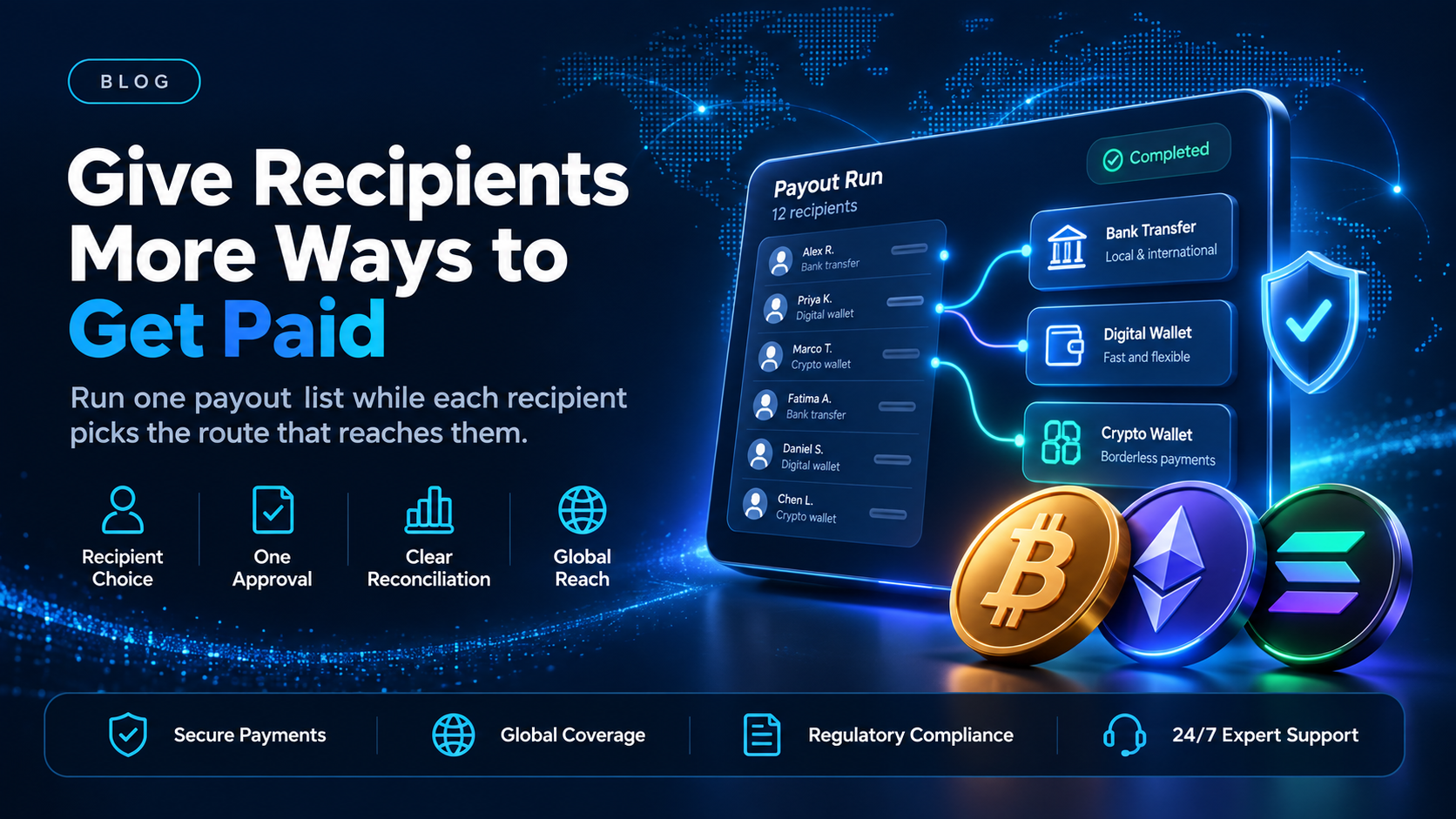
Recipients do not all want to be paid the same way, and a multi payout options platform is the system that lets them pick. One payment run leaves through more than one payout method, so a recipient a bank transfer reaches takes the transfer, and a recipient it does not reach takes something else. The operator still works from one list, one approval, and one ledger.
EukaPay is the option on that list for recipients a bank transfer does not reach, paying in USDC, USDT, ETH, and BTC on Ethereum, Tron, and Bitcoin. This guide covers which payout options are worth offering, what each one asks of your team once it is live, and where a stablecoin option fits against the ones you already have.
In this guide, you'll learn:
What a multi payout options platform does, and which payout methods it usually covers
What every extra payout option adds to your recipient data, your reconciliation, and your support queue
Which payout options recipients pick, and which ones sit unused
How a stablecoin payout option works on the account you already collect through
What a multi payout options platform does, and which payout options it covers
A multi payout options platform holds one recipient list where each line carries its own payout method. The run is approved once, and each line goes out through the method it names. Most platforms in this category cover three or four options, and they are not interchangeable.
Bank transfer - the default option, and where it stops reaching
Bank transfer is where almost every recipient list starts, and inside your own corridors it is usually still the right option. It stops being the right one where the correspondent banking chain is long, where the recipient holds no account your payment file can address, or where transfers arrive late often enough that recipients start asking. Those lines are what a second option is for, not the whole list.
Wallets and prepaid cards - options tied to the recipient's country and provider
Consumer wallets and prepaid cards reach recipients a bank file cannot, and they carry their own footprint. A recipient can only take the option if the provider covers their market and they hold, or will open, an account there. That often makes these options right for a segment of the list rather than all of it. Our post on
covers the move off cheques and wires.
Stablecoin payouts - an option addressed to a wallet, not to an account
A stablecoin payout is addressed to a wallet rather than to a bank account, so the reach question changes. The recipient needs a wallet and a network, not a provider in their country. With EukaPay the asset and the network are set per payout, so one run can pay one recipient in USDC on Ethereum and the next in USDT on Tron. EukaPay enforces a per-asset minimum payout amount. Payouts are not tied to banking hours or the banking calendar.
What each extra payout option costs the operator to run
The decision to add a payout option is easy. The cost sits in the twelve months after it goes live, and it lands in three places.
Recipient details - every option adds a field to collect and keep correct
Each option needs its own details, and each set can go stale on its own schedule. A bank line needs account details in that country's format. A wallet line needs an address, an asset, and a network. Keep those fields in your own recipient list, where your team can see and correct them.
Reconciliation - every option adds a record shape to match
Each option returns a different record for the same obligation. A stablecoin payout has its own reference that can be looked up, which is a different match from a bank return file. Your commission ledger closes against all of them in the same period, so map each record to a ledger line before the option is switched on, not at month end.
Support - every option adds its own failure and its own question
A recipient whose payout has not arrived asks where their money is, not a method-specific question. Every option you offer is one more path your support team has to be able to trace, and one more set of details they may have to help a recipient correct.
Which payout options do recipients actually pick?
Recipients pick the option that reaches them, and most lists are less varied than the option menu suggests. A large share can stay on bank transfer for as long as it keeps arriving. The rest often cluster: recipients in markets your banking partners serve poorly, recipients holding no account a payment file can address, and recipients holding a local currency that loses value between the run and the day they spend it.
That clustering argues for one strong second option rather than five weak ones, because an option nobody picks still costs you the field, the reconciliation path, and the support runbook. Our guide to
covers how businesses choose to send money out at any volume, and
covers the vendor category itself.
How to choose
Bank transfer | Wallet or prepaid card | Stablecoin payout with EukaPay | |
|---|---|---|---|
What the recipient needs | An account your payment file can address | An account with that provider, in a covered market | A wallet address on a supported network |
What you collect and keep correct | Account details in that country's format | An account identifier or email | A wallet address, an asset, and a network |
What the recipient receives | Local currency in their account | A balance with that provider | USDC, USDT, ETH, or BTC |
Where the choice is recorded | Per recipient | Per recipient | Per payout, so one run can mix assets and networks |
EukaPay is the column to add when the first two stop reaching part of your list. Bank transfer and wallet options keep the recipients they already serve, and there is no reason to move anyone being paid on time. For the rest, a wallet address is a shorter set of prerequisites than opening an account somewhere new, and
paying recipients without bank account access
is where that gap shows up first.
Adding a stablecoin payout option on the account you already collect through
The same account carries both directions. EukaPay gives you instant crypto-to-fiat conversion at a locked exchange rate to remove your exposure to crypto price swings, support for most major cryptocurrencies, and settlement in USD, EUR, GBP, and CAD to your bank account. That lock applies by default on every conversion, on pay-ins and on payouts. A crypto payment confirms on-chain, so protection against chargebacks is a property of the payment method. Fiat settlement reaches your own bank account, so it is how you take money out of the business, not a way to pay an individual recipient in fiat.
The payout side has two entry methods and you can use both. Upload your recipient list as a CSV file in the merchant dashboard for a full run, or use the
, which creates one payout per request, for payouts your own system triggers. Fund the payout balance by transferring from your account's main balance, or by making a fiat deposit. Our
guide to sending crypto to your recipients
walks through the mechanics.
If your list has recipients a bank transfer keeps missing, add EukaPay as the option for that segment and leave the rest of your stack where it is. Start with the segment costing you the most support time, run it for one cycle, and keep the option if recipients pick it.
Get started with EukaPay
Create an account at
, complete verification, provide your legal business information, and generate an API key. The payout endpoints, balance transfer, invoices, subscriptions, and customers are documented at
, and a staging environment is available for development.
Frequently asked questions
What is a multi payout options platform?
It is a system that pays one recipient list through more than one payout method, with each line carrying the method that recipient takes. The operator approves one run.
How many payout options should you offer recipients?
Enough to cover the segments your current option misses, and no more. Every option adds a data field, a reconciliation path, and a support path, so an option nobody picks still costs you.
Can recipients choose their own payout option?
That is the point of a multi payout options platform, though the choice is only real where you can collect the details for each option and keep them correct.
Which cryptocurrencies can EukaPay pay out?
USDC, USDT, ETH, and BTC, on Ethereum, Tron, and Bitcoin. The asset and the network are set per payout, so recipients in the same run can receive different assets on different networks.
Can EukaPay pay a recipient in fiat?
No. Recipients are paid in crypto. Fiat settlement in USD, EUR, GBP, and CAD reaches your own bank account, which is a separate thing from a recipient payout.
Does the Payout API send a whole payout run in one request?
No. The Payout API creates one payout per request. For a full run, upload the recipient list as a CSV file in the merchant dashboard.
How do I fund the payout balance?
Two ways. Transfer from your account's main balance, or make a fiat deposit.
Is there a minimum payout amount?
Yes. EukaPay enforces per-asset minimum payout amounts, so check the minimum for the asset a recipient has chosen before you size a run.
Related articles
Payout solutions: choosing how your business sends money out
- How businesses pick a way to send money out at any volume.
Pay recipients without bank account access
- The rails that reach recipients a payment file cannot address.
Payout API: sending programmatic payments from your own system
- What the programmatic payout surface does, for engineering teams.
Products
Use Cases
© 2026 EukaPay. All rights reserved.
FINTRAC: M22233887