iGaming payments challenges and where stablecoins or crypto help
August 21, 2026
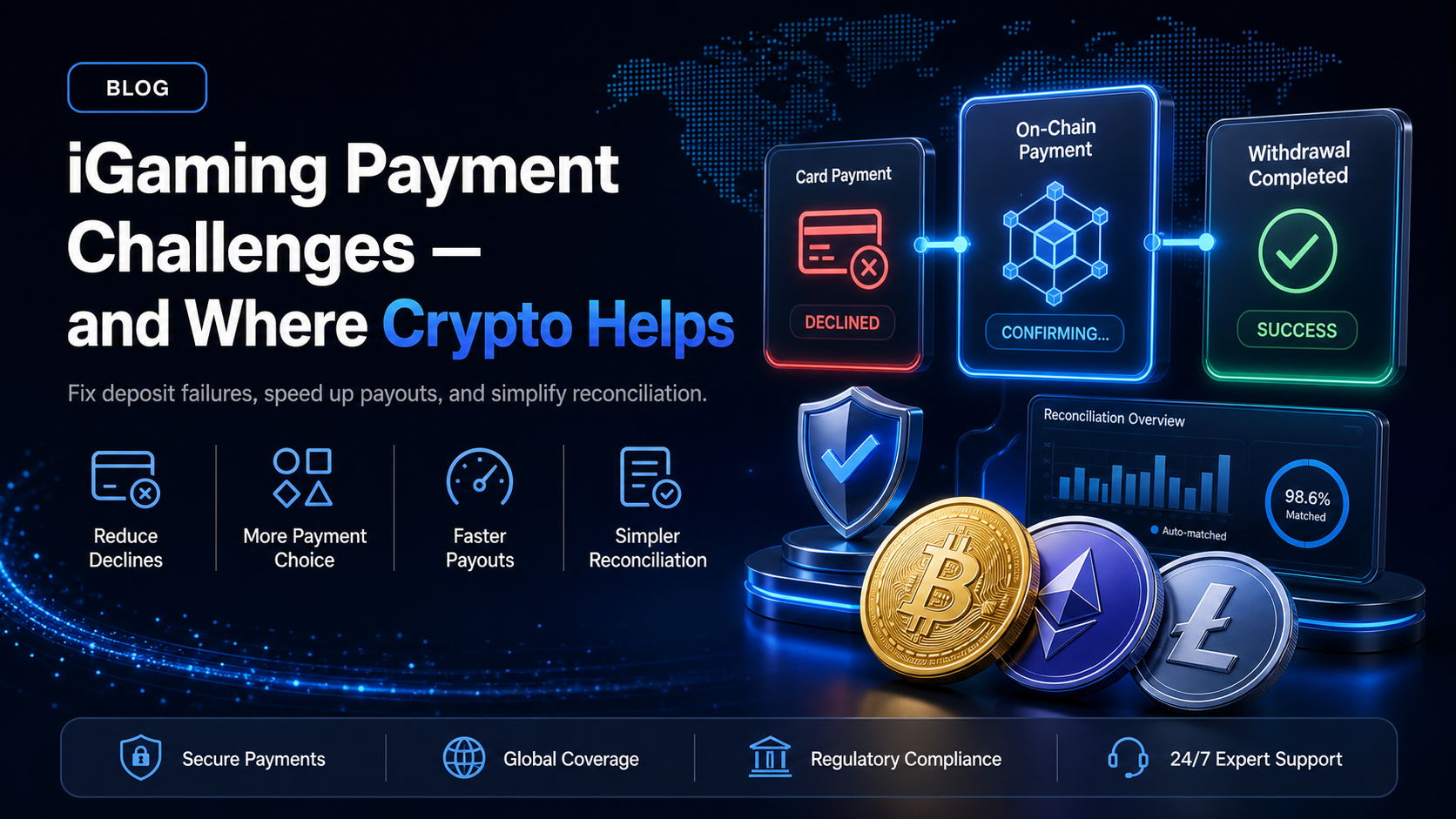
A player tries to fund an account late on a Saturday night. The card deposit is declined. The player does not open a second method, and the session ends there. Nothing in your logs says why the issuing bank refused, so the same deposit fails again next weekend.
EukaPay is the fix for that failure. EukaPay adds stablecoins or crypto as a deposit method beside the cards and e-wallets you already run, and it sends player withdrawals on-chain. This guide names the five iGaming payments challenges operators report most often, then gives the operational fix for each one.
In this guide, you'll learn:
The five iGaming payments challenges that cost operators the most deposits
Why card deposits fail more often for gaming platforms than for retail
How crypto deposits and on-chain payouts remove a failure point from the cashier
Which cryptocurrencies, networks, and settlement currencies EukaPay supports
What are the biggest iGaming payments challenges for operators?
Operators tend to report the same five problems, in roughly the same order:
Declined deposits.
The issuing bank refuses a card deposit, and the player rarely retries.
Deposit abandonment.
The cashier page offers three methods, and the player holds none of them.
Withdrawal delays.
Payouts wait on banking hours, and support absorbs the complaints.
Chargeback exposure.
A card deposit can be reversed weeks after the player has finished playing.
Reconciliation.
Every provider reports in its own format, and finance matches them by hand.
None of the five is a game problem. Each sits in the payment method, so each can be fixed by changing what the cashier offers. Our
comparison of iGaming payment methods
sets cards, e-wallets, bank transfer, and crypto side by side.
Declined card deposits and why approval rates fall short in iGaming
A card deposit is not one decision. It passes through your processor, your acquirer, the card network, and the player's issuing bank. Any one of them can refuse it. Gaming deposits can draw more scrutiny at the issuing bank than a retail purchase of the same size. Every extra country in your player base adds another issuer with another set of rules your acquirer did not write.
The operator sees a decline code and very little else. You cannot tune a bank's risk model from your side of the cashier. The one change you control is offering a method that does not route through an issuing bank at all.
A crypto deposit is settled by the network the player sends it on. There is no issuer in the path, so there is no issuer decision to lose. EukaPay accepts most major cryptocurrencies like BTC, ETH, LTC, SOL, USDC, and USDT on the pay-in side. A player who has just been declined on a card gets a second route that behaves differently.
Deposit abandonment when the cashier method list is too thin
Abandonment is quieter than a decline, because nothing is refused. The player opens the cashier, reads a short list of methods, recognizes none of them, and closes the tab. No decline code is written, so the loss never appears in a payments report.
Adding a method the player already holds is the whole fix. A stablecoin deposit is denominated in a unit the player can price against their own money. EukaPay generates the deposit request, and the player completes the transfer in their own wallet or exchange.
Traffic makes the same problem worse. A cashier that copes on a Tuesday can slow down during a title fight or a cup final, and a delayed deposit is often an abandoned deposit. We wrote about
handling crypto deposits at peak load
for operators whose volume arrives in spikes instead of evenly.
Player withdrawal delays and the support load they create
A withdrawal request placed on a Friday afternoon reaches the player when the banking calendar allows it. A bank rail cannot help on a Sunday. Every hour in between can arrive in your support queue as a ticket.
EukaPay sends payouts in USDC, USDT, ETH, and BTC on the Ethereum, Tron, and Bitcoin networks. The asset and the network are set per payout, so one run can pay different players different assets on different networks. Payouts are not tied to banking hours or the banking calendar.
You can upload a recipient list as a CSV file in the merchant dashboard, or call the Payout API, which creates one payout per request. The payout balance is funded by transferring from your account's main balance. Each payout carries its own reference you can look up. Our guide to
walks through the withdrawal bottleneck in more detail.
Chargeback exposure and reconciliation across payment providers
Card deposits can be reversed long after the play is finished, and the operator carries both the reversal and the handling cost. A crypto payment confirms on-chain, so protection against chargebacks is a property of the payment method.
Reconciliation is the challenge finance raises, not operations. Every provider you add brings its own report format, its own reference scheme, and its own timing. Each EukaPay payout has its own reference that can be looked up, and settlement arrives to one bank account instead of as a spread of provider balances. Our post on
crypto merchant settlement for iGaming
covers how the fiat leg is set up.
One platform for deposits, payouts, and fiat settlement
The same EukaPay account carries the deposit side and the withdrawal side: instant crypto-to-fiat conversion at a locked exchange rate to remove your exposure to crypto price swings, support for most major cryptocurrencies, and settlement in USD, EUR, GBP, and CAD to your bank account. EukaPay locks the exchange rate on every conversion by default, on pay-ins and on payouts. A deposit taken in a volatile asset is priced in fiat at the moment the player pays. You choose fiat or crypto settlement, and fiat settlement reaches your own business bank account.
For an operator already running cards and e-wallets, add EukaPay as an additional method instead of replacing anything. Declined deposits, abandoned sessions, and the weekend withdrawal queue are the three problems a card and e-wallet stack cannot solve on its own. Start with deposits, then move withdrawals across once the volume justifies it. Our
page and the
show how operators put both sides together.
Get started with EukaPay
Create an account at
, complete verification, provide your legal business information, and generate an API key. A staging environment is available for development, and your developer (or coding agent) can build against the payout, invoice, and customer endpoints documented at
.
Frequently asked questions
Why do card deposits get declined on iGaming platforms?
The decision belongs to the player's issuing bank, not to your processor. Gaming deposits can draw more scrutiny than a retail purchase of the same size, and a cross-border deposit adds another issuer with its own rules.
Can crypto deposits reduce deposit failures?
They can, because a crypto deposit is settled by the network the player sends it on and no issuing bank sits in the path. Adding crypto gives a declined player a second route that behaves differently instead of a second attempt at the same one.
Which cryptocurrencies can an iGaming operator accept with EukaPay?
On the pay-in side EukaPay accepts most major cryptocurrencies like BTC, ETH, LTC, SOL, USDC, and USDT. Payouts to players are sent in USDC, USDT, ETH, and BTC on the Ethereum, Tron, and Bitcoin networks.
Can EukaPay settle iGaming deposits in fiat?
Yes. You choose fiat or crypto settlement, and fiat settlement reaches your own business bank account in USD, EUR, GBP, and CAD, among other currencies.
How does EukaPay handle player withdrawals?
You can upload a recipient list as a CSV file in the merchant dashboard, or call the Payout API, which creates one payout per request. The payout balance is funded by transferring from your account's main balance, and payouts are not tied to banking hours or the banking calendar.
Do we have to replace our existing payment providers?
No. EukaPay is normally added beside cards and e-wallets as another method at the cashier, so the players who already deposit successfully keep using what they use today.
Related articles
Best crypto payment gateway for iGaming operators in 2026
- how to score gateways against an operator's deposit and payout needs.
What to look for in an iGaming payment gateway
- the criteria that matter before you sign with a provider.
Crypto payments for iGaming platform providers
- offering stablecoins or crypto to the operators on your platform.
Products
Use Cases
© 2026 EukaPay. All rights reserved.
FINTRAC: M22233887