iGaming payment risk management from the operator's side
September 14, 2026
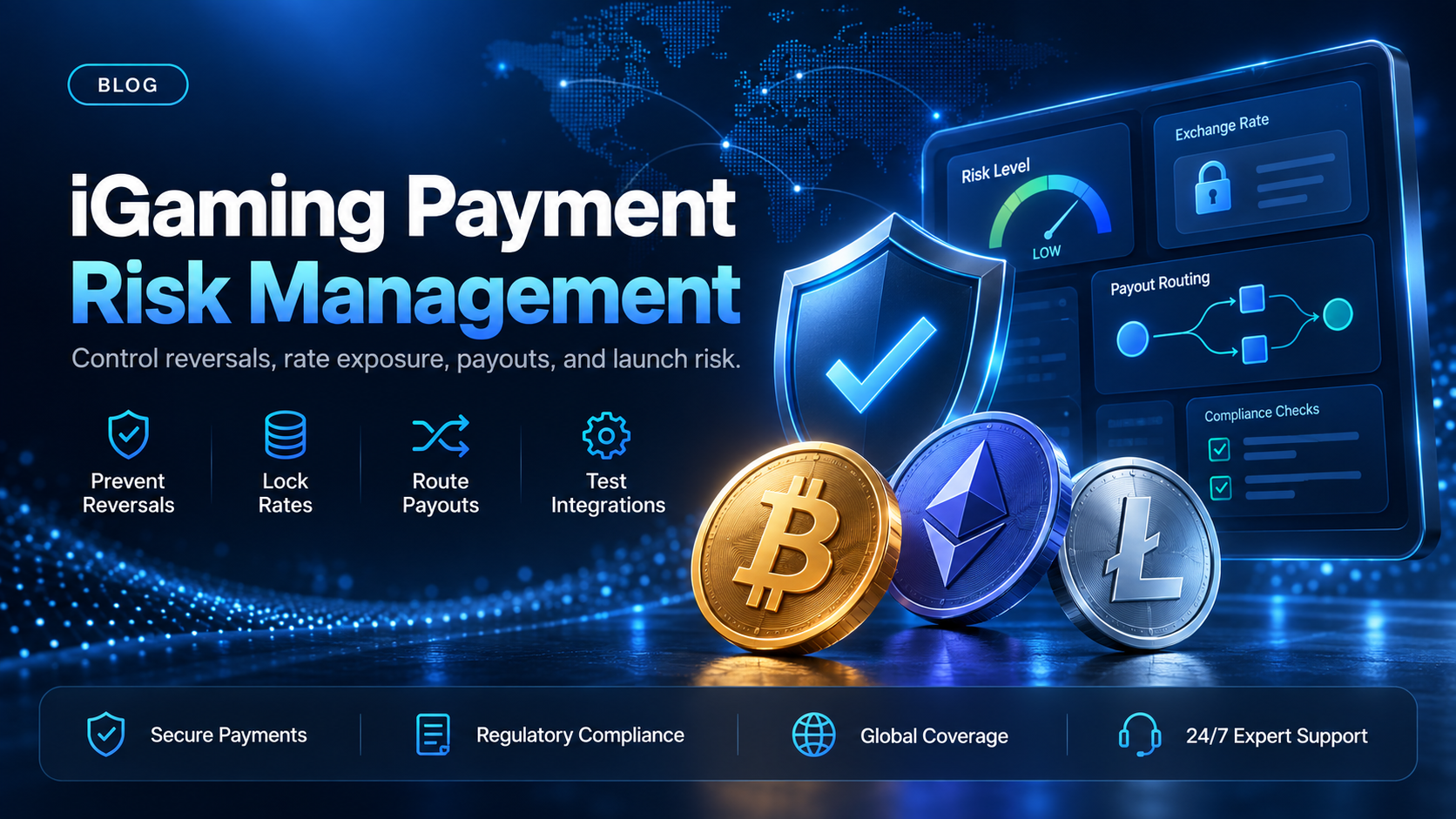
iGaming payment risk management is the work of finding and containing the ways money can go wrong between a player's deposit and the operator's bank account. Four exposures do most of the damage. Deposits get reversed after the player balance is already credited. Value moves while a payment is in flight. Withdrawals fail, or land on the wrong network. And the integration carrying all of it was never tested against the cases that break it.
EukaPay handles the crypto side of that flow for iGaming operators, and two of those four exposures are settled by the payment method itself rather than by monitoring. A crypto payment confirms on-chain, so protection against chargebacks is a property of the payment method. EukaPay also locks the exchange rate on every conversion by default, on pay-ins and on payouts. This guide takes the four exposures in the order they hit the flow and names what to require from a provider on each one.
In this guide, you'll learn:
Which payment risks an iGaming operator owns, and which ones the payment method settles
Why deposit reversal exposure changes with the payment method rather than with the provider
Where exchange-rate movement enters a crypto deposit, and how a default locked rate closes it
What to require from a payment provider on payouts, testing, and reconciliation
What is iGaming payment risk management?
It is the operator-side practice of deciding which payment exposures you carry, which ones you price into the cost of the stack, and which ones you remove by changing how money moves. The word "risk" covers four different problems here, and they do not share a fix.
Deposit reversal.
A deposit is credited to a player balance, the player uses it, and the funding instrument pulls the money back afterwards.
Exchange-rate movement.
The amount you booked at the moment of payment is not the amount that reaches your account.
Payout failure.
A withdrawal does not arrive, arrives on an asset the recipient cannot use, or cannot be traced afterwards.
Untested integration.
A change goes live without being exercised in staging first.
The first two are properties of the rail you are collecting on. The second two are properties of the provider you picked and the work you did before launch. Deciding where a risk actually lives is most of the job, and it is the part a
build-versus-buy decision on an iGaming payment system
can skip.
Deposit reversal exposure and the payment method
An operator carrying card deposits carries reversal exposure permanently. It can be reduced with better screening and it can be priced into the margin, but it cannot be removed, because the ability to reverse a settled payment belongs to the instrument.
A crypto deposit works differently. The payment confirms on-chain, so protection against chargebacks is a property of the payment method rather than a service a provider layers on top. That matters when you evaluate providers, because the answer does not improve by paying more for a better risk engine. It improves by adding a method where the reversal does not exist. EukaPay's pay-in side accepts most major cryptocurrencies like BTC, ETH, LTC, SOL, USDC, USDT, which gives a player base a route that does not carry the exposure. See our
comparison of iGaming payment methods
.
Exchange-rate movement between a crypto deposit and fiat settlement
The second exposure can surface in the first volatile week. A player deposits in a cryptocurrency, you credit a fiat-denominated balance, and the value of the asset moves before it converts. Now your player ledger and your bank balance disagree, and the gap is not an error you can reconcile away.
EukaPay locks the exchange rate on every conversion by default, on pay-ins and on payouts. There is no floating-rate mode and no per-payment setting to switch on, so the fiat value is fixed at the moment of payment and the exposure to price swings does not reach your ledger. Converted balances settle in USD, EUR, GBP, and CAD to your own bank account. How that leg behaves end to end is covered in more detail in our guide to
crypto merchant settlement for iGaming
.
Payout risk an iGaming operator carries on withdrawals
A withdrawal problem can cost more than a deposit problem, because a player who cannot withdraw says so in public. Most payout failures come from three places: the wrong asset, the wrong network, or a send nobody can trace afterwards.
Asset and network - set per payout, not per account
EukaPay sends payouts in USDC, USDT, ETH, and BTC, on the Ethereum, Tron, and Bitcoin networks. Asset and network are set per payout, so two recipients in the same run can receive different assets on different networks. That is the control that keeps a withdrawal from landing somewhere the recipient cannot reach it.
Minimums and references - what is enforced and what is recorded
EukaPay enforces per-asset minimum payout amounts. Each payout also carries its own reference that can be looked up, which is what makes reconciliation possible when a player disputes a send weeks later. Crypto payouts are not tied to banking hours or the banking calendar.
For volume, a recipient list can be uploaded as a CSV file in the merchant dashboard. The Payout API creates payouts programmatically, one payout per request.
How to choose
Risk | Where it shows up | What to require from a payment provider |
|---|---|---|
Deposit reversal | After a player balance is credited | A payment method that confirms on-chain, so reversal is not available to the payer |
Exchange-rate movement | Between payment and fiat settlement | A locked exchange rate applied by default, on pay-ins and on payouts |
Failed or misrouted payout | On withdrawals | Asset and network set per payout, enforced minimums, and a reference per payout |
Untested integration | At launch and at every change | A staging environment you can build against before going live |
EukaPay answers all four rows with a mechanic rather than a policy, which is the test worth applying to any shortlist. A staging environment is available for development, so the pay-in and payout paths can be exercised before real money moves through them. Our walkthrough of a
covers what to test first. If a provider cannot answer one of these rows, the risk has not been removed, only moved onto your team.
One platform for deposits, payouts, and fiat settlement
EukaPay runs deposits, payouts, and settlement from one account, with instant crypto-to-fiat conversion at a locked exchange rate to remove your exposure to crypto price swings, support for most major cryptocurrencies, and settlement in USD, EUR, GBP, and CAD to your bank account. A crypto payment confirms on-chain, so protection against chargebacks is a property of the payment method. The payout balance is funded by transferring from the account's main balance, which keeps the withdrawal side explicit rather than implicit.
For an iGaming operator, that combination turns two of the four exposures into properties of the payment method instead of ongoing operational work. Start with the pay-in side, exercise the payout path in staging, and move volume once both behave the way your ledger expects. What a provider actually carries for you is set out in our guide to
what an iGaming payment processor does
.
Get started with EukaPay
Create an account at
to complete verification and generate an API key. The payout endpoints, balance transfer, invoices, subscriptions, and customers are documented at
.
Frequently asked questions
What is payment risk management in iGaming?
It is the operator-side practice of identifying where money can be lost between a player deposit and the operator's bank account, then removing or pricing each exposure. The main four are deposit reversal, exchange-rate movement, payout failure, and an untested integration.
Can a crypto deposit be reversed by the player?
A crypto payment confirms on-chain, so protection against chargebacks is a property of the payment method. That is a structural difference from card deposits rather than a service an operator buys.
How does a locked exchange rate reduce risk for an iGaming operator?
It fixes the fiat value of a payment at the moment it is made. EukaPay applies the lock on every conversion by default, on pay-ins and on payouts, so the player ledger and the settled amount do not drift apart.
Which cryptocurrencies can an iGaming operator pay out in?
EukaPay sends payouts in USDC, USDT, ETH, and BTC, on the Ethereum, Tron, and Bitcoin networks. The pay-in side is wider and accepts most major cryptocurrencies like BTC, ETH, LTC, SOL, USDC, USDT.
Are crypto payouts affected by banking hours?
Crypto payouts are not tied to banking hours or the banking calendar. Asset and network are set per payout, so a recipient receives what they can actually use.
Does EukaPay set minimum payout amounts?
Yes. EukaPay enforces per-asset minimum payout amounts.
Related articles
Building vs buying an iGaming payment system
- where the risk sits in each approach
What an iGaming payment processor actually does
- the work a provider takes on
Crypto merchant settlement for iGaming
- how converted balances reach the bank account
Products
Use Cases
© 2026 EukaPay. All rights reserved.
FINTRAC: M22233887