iGaming payment options for operators in 2026
August 26, 2026
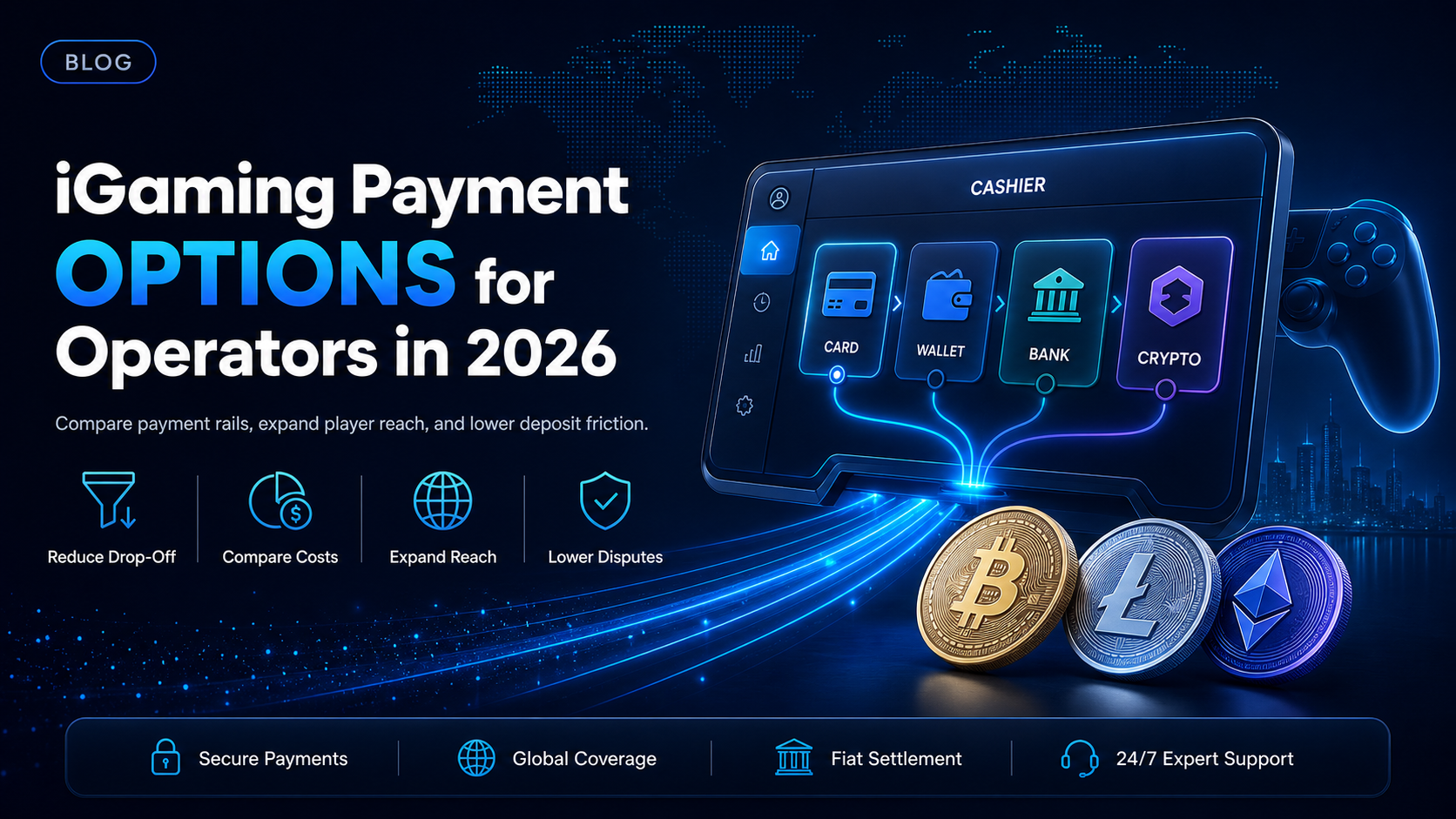
A player opens your cashier with money ready to move. The method they hold their balance in is not on the list, so they close the tab. Payments teams see the drop-off in the funnel, but the cashier report rarely says which method was missing. It only says the deposit never started.
EukaPay is the deposit option to add when cards, e-wallets, and bank transfer leave players stranded. It accepts stablecoins or crypto and settles the result to your bank account in fiat. This guide covers the full set of iGaming payment options and how to pick between them. For the narrower question of what to add on top of a cashier that already runs cards and e-wallets, read our guide to
iGaming alternative payment solutions
.
In this guide, you'll learn:
What each payment option category does for an operator, and what it costs you to run
How cards, e-wallets, bank transfer, and stablecoins or crypto compare on chargeback exposure, reach, and integration count
Which cryptocurrencies EukaPay accepts on deposits, and which it sends on payouts
How many payment options a cashier should carry, and the order to add them in
The payment options an iGaming cashier can carry
The iGaming payment options on the market fall into a handful of categories: cards, open banking, digital wallets, local payment methods, and cryptocurrencies. That grouping comes from Primer's guide to iGaming payment methods, read on August 25, 2026. Most operators run three or four categories at once, because each answers a different question about where the player's money already sits.
Cards - the method most players reach for first
Cards give you broad reach from a single integration and high player familiarity. They often carry the highest cost of the four. Interchange, scheme fees, and acquirer fees stack on every deposit, and gaming categories often attract a surcharge. Card deposits can also be disputed after the fact, which puts revenue you have already credited back in play.
E-wallets - intermediary accounts funded from another rail
An e-wallet sits between the player's bank or card and your cashier. The player funds the wallet elsewhere, then deposits from a balance. You get reach into markets where your acquirer performs poorly. The trade-off is that each wallet is its own integration, its own settlement report, and its own set of funding rules.
Bank transfer and open banking - account-to-account deposits
Open banking moves money straight from the player's bank account to yours, authenticated in the player's banking app. Costs are usually lower than cards because the card schemes are not in the path. Coverage is the limit. Open banking is mature in some regions and thin in others, so it rarely covers a global player base on its own.
Stablecoins and crypto - on-chain deposits that convert to fiat
A crypto deposit does not depend on whether the player's issuer approves a gaming transaction. It depends on whether the player holds the asset. That makes a crypto deposit the option for players your card acquirer and your open-banking provider cannot reach between them. With EukaPay the deposit arrives on-chain, and you can take the result in fiat to your bank account.
How to choose between iGaming payment options
Cards | E-wallets | Bank transfer | Stablecoins and crypto | |
|---|---|---|---|---|
Chargeback exposure | Disputes possible after credit | Varies by wallet | Low, authenticated by the bank | Not applicable, on-chain confirmation is final |
Cross-border reach | Broad, issuer-dependent | Broad, wallet-dependent | Strong where open banking is mature | Wherever the player holds the asset |
Integrations to cover a region | One acquirer, more for local schemes | One per wallet | One per provider | One gateway |
What you receive | Fiat, after fees | Wallet balance or fiat | Fiat | Fiat in USD, EUR, GBP, CAD, or crypto |
Method characteristics summarized from Primer's iGaming payment methods guide, read August 25, 2026. EukaPay's asset and settlement details come from docs.eukapay.com.
EukaPay is the row that answers all four columns with one integration. The same account takes the deposit, converts it, and settles it. Cards stay in the mix for reach, e-wallets for the markets where they are the habit, and open banking where the coverage is there. None of those three removes the dispute risk or the issuer dependency. A crypto deposit does, and EukaPay is how you accept one without running a wallet yourself.
Which cryptocurrencies to offer for iGaming deposits
On the deposit side, EukaPay supports most major cryptocurrencies like BTC, ETH, LTC, SOL, USDC, USDT. Stablecoins lead that list for a reason. A player depositing USDC or USDT is moving a dollar-denominated balance, so the credited amount may not drift while the transaction confirms.
On the payout side the asset set is narrower. EukaPay sends payouts in USDC, USDT, and ETH. Payouts are not tied to banking hours or the banking calendar, so a weekend withdrawal queue does not wait for Monday. For how operators run withdrawals at volume, see
crypto mass payouts for iGaming
.
How many payment options should an iGaming cashier offer?
Enough to cover the ways your players actually hold money, and no more. Every extra method is another integration to maintain, another reconciliation file, and another row that pushes the rest below the fold. Three or four well-chosen options usually beat eight.
A practical order for most operators looks like this:
Cards first
, for reach and for the players who will not use anything else.
One local rail for your largest region
, either an e-wallet or an open-banking provider, chosen on what your player data already favors.
Stablecoins or crypto
, for the players the first two cannot reach and for the deposits you do not want exposed to disputes.
Adding a fourth method should be a response to data, not a hunch. Watch which deposits start and fail, not just which ones complete. Our
iGaming payment methods compared
guide sets out the criteria in more detail.
covers what happens to each option when traffic spikes.
One platform for deposits, payouts, and fiat settlement
EukaPay runs deposits, payouts, and settlement from one account, with instant crypto-to-fiat conversion at a locked exchange rate to remove your exposure to crypto price swings, support for most major cryptocurrencies, and settlement in USD, EUR, GBP, and CAD to your bank account. The locked rate is applied by default on every conversion, on pay-ins and on payouts. A crypto payment confirms on-chain, so protection against chargebacks is a property of the payment method. For how the fiat leg works, see
crypto merchant settlement for iGaming
.
If your cashier already carries cards and one local rail, EukaPay is the option to add next. It reaches the players the other two cannot. It removes the dispute exposure on those deposits, and it puts the money in your bank account in the currency you keep your books in. Add it as one more method in the cashier you already run.
Get started with EukaPay
Create an account at
to set up deposits, payouts, and fiat settlement in one place. Your developer (or coding agent) can read the endpoints at
and build against the staging environment before the option goes live in the cashier.
Frequently asked questions
What payment options should an iGaming platform offer?
Most operators run cards for reach, one e-wallet or open-banking provider for their largest region, and stablecoins or crypto for the players the first two cannot reach. Three or four options usually convert better than a long list.
Which cryptocurrencies can an iGaming platform accept with EukaPay?
EukaPay supports most major cryptocurrencies like BTC, ETH, LTC, SOL, USDC, USDT on deposits. A USDC or USDT deposit is dollar-denominated, so the credited amount may not drift while the transaction confirms.
Can an operator settle crypto deposits in fiat?
Yes. You choose fiat or crypto settlement, and fiat settlement reaches your own bank account in USD, EUR, GBP, or CAD. The exchange rate is locked by default on every conversion.
Do crypto deposits carry chargeback risk?
A crypto payment confirms on-chain and cannot be reversed by the payer afterward. Protection against chargebacks is a property of the payment method, not a service layered on top.
Can EukaPay pay players out in crypto?
Yes. Payouts are sent in USDC, USDT, and ETH, with the asset set per payout. Payouts are not tied to banking hours or the banking calendar.
Does adding crypto deposits mean rebuilding the cashier?
No. EukaPay's API returns a hosted payment page URL, and the player completes the transfer in a browser. The option sits alongside your existing methods.
What fiat currencies does EukaPay settle in?
Settlement currencies include USD, EUR, GBP, and CAD, paid to your own bank account. Others are supported as well.
Related articles
iGaming alternative payment solutions
- what to add on a cashier that already runs cards and e-wallets
iGaming payment methods compared in 2026
- the criteria behind the comparison table above
Crypto merchant settlement for iGaming
- how a crypto deposit reaches your bank account in fiat
Products
Use Cases
© 2026 EukaPay. All rights reserved.
FINTRAC: M22233887