Gaming payments: deposits, payouts, and fiat settlement
September 14, 2026
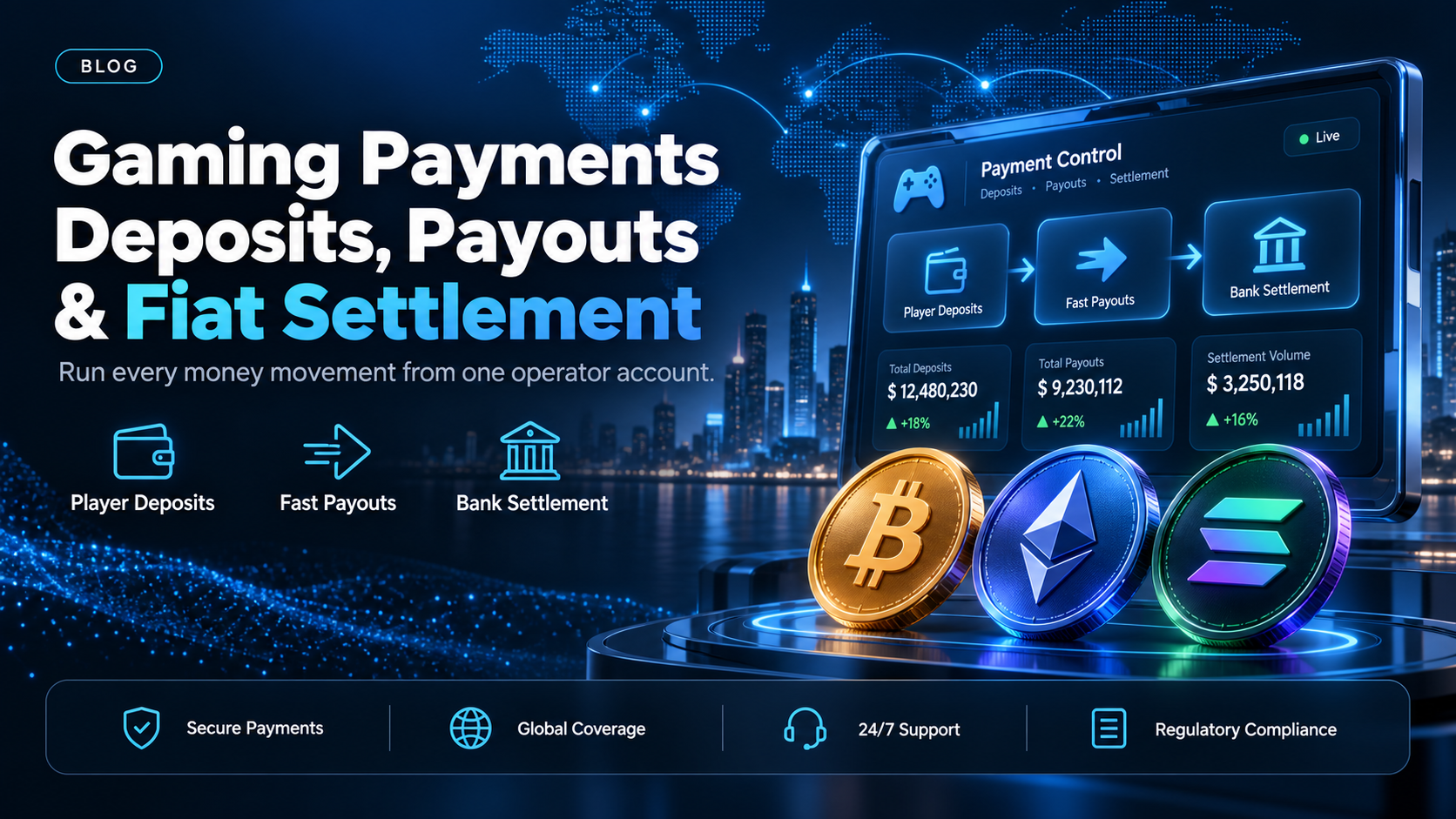
Gaming payments are the money movements a real-money gaming operator handles every day. A player funds a balance, a player withdraws a balance, and the operator settles its own revenue into a bank account. Those are three different problems to solve. They use different rails, they fail for different reasons, and an operator that solves only the first one still has two open.
EukaPay runs all three on one account. Players deposit in cryptocurrencies, player payouts go out in stablecoins or crypto, and the operator's own revenue settles to its bank account in USD, EUR, GBP, or CAD. This guide walks the three legs in order and names what an operator should require at each one.
In this guide, you'll learn:
What gaming payments cover for a real-money gaming operator, leg by leg
Which cryptocurrencies a player can deposit with, and what the deposit is worth in fiat
Which assets and networks a player payout can be sent on
How the operator's own revenue reaches a bank account in USD, EUR, GBP, or CAD
What do gaming payments cover for a real-money gaming operator?
Three legs, in this order.
The
deposit leg
is a player putting money into a balance. The
payout leg
is the same player taking money back out. It runs in the opposite direction, and it often uses a different rail. The
settlement leg
is the operator's own money: gross receipts turning into a bank balance the business can spend.
A card processor covers the first leg. It authorizes a deposit, and the operator arranges withdrawals and settlement somewhere else. That split is why an operator can end up running two or three vendors and reconciling between them. A crypto rail can carry all three, which is the argument for putting them on one account. For the vendor-selection version of this question, see
what an iGaming payment processor does
.
Gaming payments on the deposit leg - which cryptocurrencies a player can pay with
On the deposit side EukaPay accepts BTC, ETH, LTC, SOL, USDC, and USDT, plus BCH and Lightning. The list matters because a player who already holds one asset will not go and acquire another to fund a balance.
The second question on this leg is what the deposit is worth. EukaPay locks the exchange rate on every conversion by default, on pay-ins and on payouts. There is no floating-rate mode and no per-payment setting to turn on, so the fiat value of a deposit is fixed at the moment the player pays.
Cards are the method many players already have in their wallet, and a crypto rail does not replace that familiarity. What a card deposit cannot tell an operator is whether the money is final. A crypto payment confirms on-chain, so protection against chargebacks is a property of the payment method, and the operator can treat a confirmed deposit as settled rather than provisional.
Player payouts in USDC, USDT, ETH, and BTC
Payouts are the narrower list. EukaPay sends payouts in USDC, USDT, ETH, and BTC, on the Ethereum, Tron, and Bitcoin networks. Asset and network are set per payout, so one player can be paid in USDC on Tron while the next is paid in BTC, in the same run.
An operator sending a high volume of withdrawals uploads a recipient list as a CSV file in the merchant dashboard. An operator that wants payouts triggered from its own platform uses the Payout API, which creates one payout per request. Each payout carries its own reference that can be looked up.
The payout balance is funded by transferring from the account's main balance. That is the step connecting the first leg to the second, and the operator moves what it needs before a run. Payouts are not tied to banking hours or the banking calendar.
Fiat settlement in USD, EUR, GBP, and CAD to the operator's bank account
The third leg is the operator's own revenue. EukaPay settles to the merchant's own bank account in USD, EUR, GBP, and CAD, among other currencies. Settlement pays the business, not a player, so it is a separate decision from how withdrawals are sent.
An operator can also hold settlement in crypto instead of converting. The choice is per merchant, and it decides the reconciliation story, because revenue lands in the currency the finance team reconciles against. There is more on that in
crypto merchant settlement for iGaming
.
How to choose
What the operator has to decide | How EukaPay answers it |
|---|---|
Which cryptocurrencies a player can deposit with | BTC, ETH, LTC, SOL, USDC, and USDT, plus BCH and Lightning |
What a deposit is worth in fiat | The exchange rate is locked on every conversion by default |
Which assets a player payout can be sent in | USDC, USDT, ETH, or BTC, on Ethereum, Tron, or Bitcoin |
Where the operator's own revenue lands | The operator's own bank account, in USD, EUR, GBP, or CAD |
EukaPay answers all four rows from one account, instead of a deposit vendor, a payout vendor, and a settlement arrangement assembled separately. Card processors and e-wallets answer the first row well and the second row differently, because a card authorization can be reversed after the fact. Where an operator is weighing a build against a purchase,
building vs buying an iGaming payment system
sets out the same four decisions as an engineering question.
One platform for deposits, payouts, and fiat settlement
Every leg above runs on the same EukaPay account, with instant crypto-to-fiat conversion at a locked exchange rate to remove your exposure to crypto price swings, support for most major cryptocurrencies, and settlement in USD, EUR, GBP, and CAD to your bank account. A crypto payment confirms on-chain, so protection against chargebacks is a property of the payment method.
For a real-money gaming operator, that is the recommendation: put deposits, player payouts, and settlement on one EukaPay account, then decide the per-leg details above instead of the vendor count.
Get started with EukaPay
Create an account at
, complete verification, provide your legal business information, and generate an API key. The Payout API, balance transfer, invoices, and customer endpoints are documented at
, and a staging environment is available for development.
Frequently asked questions
What are gaming payments?
Gaming payments are the three money movements a real-money gaming operator runs: a player deposit, a player payout, and the operator's own settlement into a bank account. Each leg can use a different rail.
Which cryptocurrencies can a player deposit with?
EukaPay accepts BTC, ETH, LTC, SOL, USDC, and USDT on the pay-in side, plus BCH and Lightning. The pay-in list is deliberately wider than the payout list.
Can an operator pay players out in stablecoins?
Yes. Payouts are sent in USDC, USDT, ETH, and BTC, on the Ethereum, Tron, and Bitcoin networks, and the asset and network are chosen per payout.
Does the operator have to hold crypto?
No. The merchant chooses fiat or crypto settlement, so an operator can take crypto deposits and settle to its own bank account in USD, EUR, GBP, or CAD.
How does an operator send a lot of player payouts at once?
Upload a recipient list as a CSV file in the merchant dashboard. The Payout API is the other route, and it creates one payout per request.
Can a player charge back a crypto deposit?
A crypto payment confirms on-chain, so protection against chargebacks is a property of the payment method rather than something the operator has to contest afterward.
When can an operator send a player payout?
Payouts are not tied to banking hours or the banking calendar. Each payout carries its own reference, so a specific withdrawal can be looked up afterward.
Related articles
What an iGaming payment processor actually does
- the vendor-selection view of the same three legs
Crypto merchant settlement for iGaming
- what happens to the operator's own revenue after the deposit
Crypto payments for iGaming platform providers
- the same decisions seen from the platform side
Products
Use Cases
© 2026 EukaPay. All rights reserved.
FINTRAC: M22233887