Crypto payment gateway for domain registrars in 2026
August 11, 2026
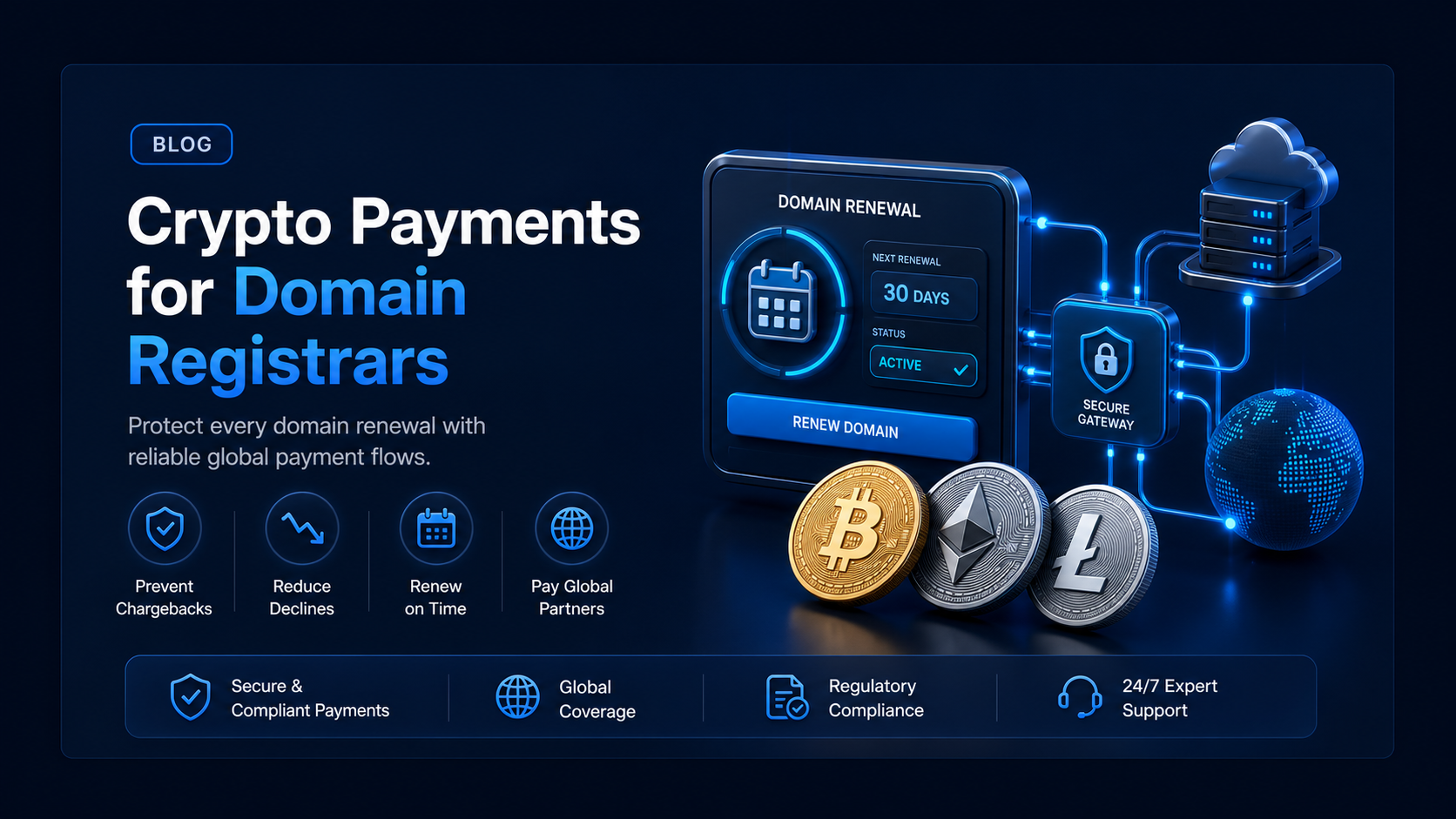
New registrations bring a customer in once. The revenue that pays a registrar's team arrives every year afterward, when portfolios come up for renewal. The wholesale fee owed to the registry arrives on the same schedule, whether the customer paid you or not.
A crypto payment gateway for domain registrars is therefore a different purchase than a general ecommerce gateway. A failed renewal is not a missed month you recover next cycle. The name has a date on it, the customer finds out when their email stops arriving, and the ticket lands in your queue. This guide covers what stablecoins or crypto change for a registrar or reseller, and how to wire the payment flow.
In this guide, you'll learn:
Why a failed renewal costs a registrar more than a failed software subscription, and what you gain when you accept crypto payments for domain renewals
Which card-rail costs actually come off the books when you add crypto, including chargebacks on privacy-motivated buyers
The four ways to collect a renewal in crypto, and which one fits a customer holding hundreds of names
How to pay registries, resellers, and affiliates in crypto from the same platform you collect with
Why renewals are the whole business model
Most recurring-revenue businesses have a soft deadline. A SaaS account that fails to charge sits in a grace state until the card clears, and nothing is destroyed in the meantime.
Domains do not work that way. Registrars operate inside rules set by ICANN and by each registry, and those rules put a firm date on every registration. Once a name expires it enters a post-expiry sequence: a grace period in which the customer can still renew at the ordinary price, then a redemption period where recovery means paying a registry restore fee on top of the renewal, and finally deletion. Sometimes it cannot be recovered at all, because someone else took it, and the customer's website, email, and anything authenticated against that hostname go down together.
That asymmetry makes payment reliability a product feature rather than a finance detail. The margin leaves little room to absorb failures. The registry wholesale fee is set by the registry rather than by you, so the spread between that fee and your retail renewal price is the whole business, and every point of payment cost, chargeback loss, and manual recovery labor comes out of the spread.
Two other characteristics separate registrars from ordinary ecommerce. Customers are global from day one, because a domain has no geography. Privacy-motivated buyers are also over-represented, because plenty of legitimate people want a name registered without their card statement carrying it.
Where card rails cost registrars margin
Chargebacks - the name is already delegated
Domain renewal chargebacks are worse than the ecommerce average for a structural reason. A renewal is unusual in that you deliver the entire year of service the moment the transaction clears. The name stays delegated, the nameservers keep resolving, and there is nothing to claw back. When a chargeback arrives four months later, the registry fee has already been paid, the service has already been consumed, and the registrar absorbs both the reversal and the dispute fee.
Privacy-motivated buyers make the pattern worse, not because those customers are dishonest, but because a card statement line for a name registered under a proxy is exactly the line a cardholder fails to recognize months later. Crypto payments settle on-chain and the payer cannot reverse them, so an approved renewal stays approved. A confirmed crypto payment does not remove every form of dispute. A customer can still contact support, request a refund, or ask for account credit. What it removes is the unilateral chargeback filed through an issuing bank months after the year of service was delivered.
Our write-up on
how a crypto payment gateway removes hosting provider chargebacks
covers the same mechanic for the adjacent hosting business.
Cross-border declines - your customers are not in one country
Card acceptance rates fall when the issuing bank and the acquiring bank sit in different countries, and a registrar's customer base is spread across dozens of issuing countries by default. A decline on a first purchase costs you a sale. A decline on a renewal puts the customer's name at risk before the expiry date.
Stablecoins remove the issuer from the transaction. The customer sends value from a wallet, the payment either confirms on-chain or it does not, and no bank in a third country can decline it. That property is the core argument for
cross-border payment collection in crypto
, and the deadline makes it matter more here than in most verticals.
Cards on file - the credential expires before the domain does
The stored card is the weakest part of a long-lived registrar relationship. Cards expire, get reissued after fraud, and get cancelled when someone changes bank, and every rotation breaks the next renewal charge without warning you first. Crypto renewals move the initiation back to the customer: you send a renewal invoice on a schedule you control, the customer pays it from a wallet that does not expire, and no stored credential can go stale.
Does a domain registrar need a crypto payment gateway in 2026?
Not as a replacement for cards. Most of your customers will keep paying with cards, and there is no reason to push them off a method that works. The case for adding the option is narrower and stronger than that.
Crypto works best as an additional method aimed at three segments: privacy-motivated registrants who would rather not use a card at all, customers in countries where your card acceptance rate is visibly poor, and portfolio holders paying a large annual invoice where the card limit is the binding constraint. Those three segments are also the ones where a decline turns into a lost name.
The industry is already building for them. In an April 14, 2025
announcement carried by ACCESS Newswire
, crypto payment platform Nicky and Namingo, an open-source domain management solution for ICANN-accredited registrars and registries, said they had partnered to let registrars and hosting companies accept crypto alongside traditional payment methods without replacing their existing systems. The pattern in these integrations is crypto as an added checkout option, not a migration.
EukaPay takes the same approach for registrars. Crypto is an added method on the checkout you already run, with renewal invoices, payment links, hosted checkout, and an API you can attach to your existing billing job.
How to accept stablecoins or crypto for domain renewals
1. Decide which products take crypto.
New registrations, renewals, inbound transfers, premium name sales, and bulk portfolio invoices are five flows with different average values. Most registrars start with renewals and bulk invoices, because those two carry the deadline risk and the largest ticket sizes.
2. Open a merchant account and complete onboarding.
Every EukaPay merchant goes through onboarding and a business review, and a sandbox environment is available so your developer (or coding agent) can build and test the integration while the review is in progress.
3. Pick the checkout route.
Hosted checkout, payment links, recurring invoices, and the API each fit a different part of a registrar's business. The table below sets out which is which, and our guide to
invoices, payment links, custom checkout, and the API
goes deeper on each.
4. Set your accepted currencies and state the network at checkout.
EukaPay supports most major cryptocurrencies like BTC, ETH, LTC, SOL, USDC, USDT. Stablecoins carry most registrar volume, because a renewal is a fixed-price purchase and neither side wants to argue about the rate. State the network on the payment screen for each stablecoin you accept so the customer sends on the right one. For the most common request, see
.
5. Schedule the renewal invoice ahead of the expiry date.
EukaPay sends invoices on a recurring schedule, weekly, monthly, quarterly, or custom intervals, through the dashboard and the API. Set the interval to match the registration term and start the cycle far enough ahead of expiry that a customer who pays late still pays in time. Your existing reminder emails stay in your registrar platform and continue to prompt the customer.
6. Confirm the settlement side.
Renewal prices are set against a wholesale fee denominated in fiat, so a floating crypto rate does not work here. Instant crypto-to-fiat conversion at a locked exchange rate removes all crypto volatility, fixes the amount you receive at the moment of payment, and settles to your bank account in USD, EUR, GBP, CAD.
Bulk portfolios and reseller payouts
Portfolio customers are where stablecoin payments for domain resellers and registrars pay for themselves fastest. A customer renewing three hundred names at once is moving a five-figure amount, and that amount often exceeds a card limit or trips a fraud rule precisely because it is large and unusual. Splitting the charge across several cards is a support burden for you and an annoyance for them.
A single
covers the whole portfolio in one payment, with line items the customer can reconcile against their own inventory list and a payment link embedded in the PDF. If you want the renewal charge generated by your registrar platform rather than assembled by a person, the
creates the invoice or the checkout from your billing job.
Registrars also make outbound payments. Reseller channels and affiliate programs put partners in the same countries your customers are in, and paying each commission by wire is slow and expensive per transfer.
Crypto mass payouts for contractors and affiliates
run the batch from the same account you collect renewals into.
How to choose
Route | Hosted checkout | Payment links | Recurring invoices | API |
|---|---|---|---|---|
Who delivers the request? | Your website, at the point of renewal | Sent manually by your team | EukaPay, on the schedule you set | Your registrar platform |
Coding required? | Minimal | None | None | Yes, a developer (or coding agent) |
Line items and custom fields? | Cart contents | Amount and reference | Full line items on a PDF invoice | Anything you pass |
Best for | Self-service renewals and new registrations | One-off recoveries and premium name sales | Fixed-term renewals booked ahead of expiry | High volume and automated billing runs |
Typical registrar use | The renew button in the control panel | Support agent rescuing a lapsing name | Annual and multi-year portfolio renewals | Companies with their own billing system |
Most registrars run more than one of these. A common combination is hosted checkout on the control panel for self-service renewals, recurring invoices for portfolio customers on annual terms, and payment links in the hands of support agents for names that are days from expiry.
How to choose a crypto payment gateway
goes further on the selection criteria.
One platform underneath
All four routes run on the same account and the same settlement pipeline. Whether the renewal arrives from a checkout page, a link, a scheduled invoice, or an API call, EukaPay sets you up for success by providing instant crypto-to-fiat conversion at a locked exchange rate to remove all crypto volatility, protection against chargebacks, support for a wide range of cryptocurrencies including BTC, ETH, LTC, SOL, USDC, and USDT, and settlement in USD, EUR, GBP, CAD to your bank account. Crypto pay-ins and crypto payouts sit in the same dashboard, so renewal collection and reseller commissions reconcile against one balance.
The choice amongst the four routes is a question of fit rather than quality. A registrar with a mature control panel and an in-house billing job wants the API. A reseller with two hundred customers and a spreadsheet wants recurring invoices. Both are correct, and either can add the other later without changing accounts. Registrars whose domain business sits alongside hosting will also want our
crypto payment gateway guide for hosting providers
, which covers what the two businesses share.
Get started with EukaPay
Create an account at
to begin onboarding and the business review, and point your developer (or coding agent) at
to build against the sandbox while the review is underway. If you want to talk through renewal scheduling or reseller payouts for your specific customer base before you build anything, tell us the shape of your portfolio and we will map the flow with you.
Frequently asked questions
Can a domain registrar accept crypto for renewals as well as new registrations?
Yes, and renewals are the better place to start, because a renewal carries a hard expiry date. You can collect one through a scheduled invoice, a hosted checkout page in your control panel, or the API.
Which cryptocurrencies should a registrar accept?
EukaPay supports most major cryptocurrencies like BTC, ETH, LTC, SOL, USDC, USDT. Stablecoins carry most registrar volume because a renewal is a fixed fiat price.
Do crypto renewal payments protect me from chargebacks?
It removes the chargeback. A crypto payment settles on-chain and the payer cannot reverse it through an issuing bank, so a renewal that confirms stays paid. It does not remove every form of dispute, because a customer can still contact support and ask for a refund or credit. That protection matters here because the year of service is delivered the moment the payment clears.
How does EukaPay handle recurring domain renewals?
EukaPay sends invoices on a recurring schedule, weekly, monthly, quarterly, or custom intervals, from the dashboard and the API. You set the interval and the start date, and your registrar platform keeps running the reminder sequence you already send.
What currency do I actually receive?
You receive fiat if you choose fiat settlement. Instant crypto-to-fiat conversion at a locked exchange rate removes all crypto volatility, and settlement lands in your bank account in USD, EUR, GBP, CAD.
Can I pay my resellers and affiliates in crypto too?
Yes. Crypto payouts run from the same account, so you can batch commission payments to partners in multiple countries without a separate wire for each one.
How long does it take to start accepting crypto?
Every merchant goes through onboarding and a business review first. A sandbox environment is available during the review so your team can build and test the renewal flow before going live.
Do I need to tell customers which network to send on?
Yes. State the network on the payment screen for each stablecoin you accept, so the customer selects the correct one before sending.
Related articles
Crypto payment gateway for hosting providers
- the adjacent vertical, with the same recurring-billing and chargeback profile
Crypto invoices for bulk portfolio billing
- how line-item invoices and embedded payment links work
Crypto mass payouts for contractors and affiliates
- paying reseller channels across multiple countries from one balance
Products
Use Cases
© 2026 EukaPay. All rights reserved.
FINTRAC: M22233887