Crypto merchant payment account: what it is and how it differs
September 17, 2026
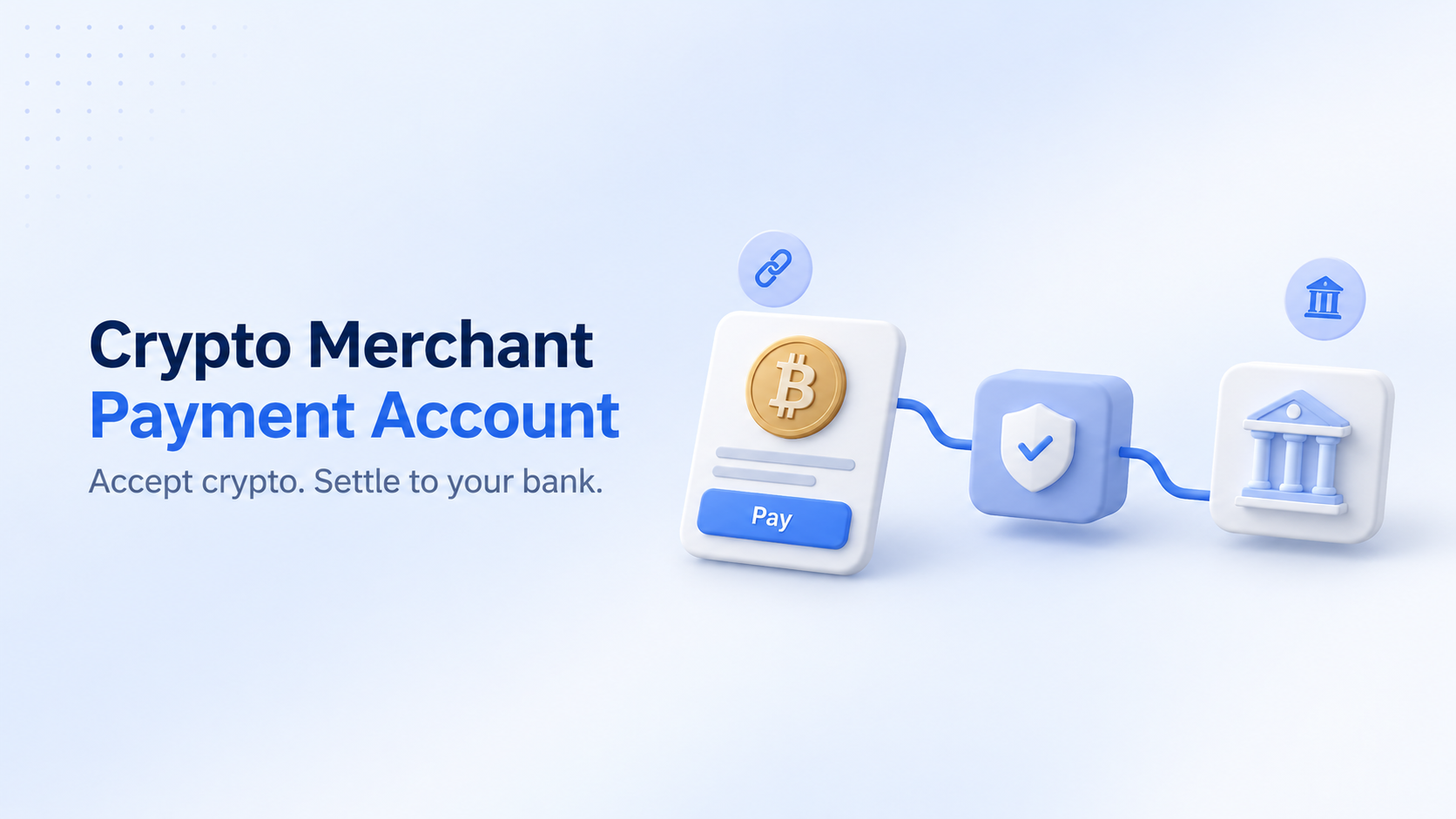
Search for a crypto merchant payment account and the results split into two products. One is an account that lets a business accept cryptocurrency from customers and settle the proceeds into its bank account. The other is a card acquiring account sold to businesses that operate in the cryptocurrency industry. Both carry the same name, and they solve different problems.
EukaPay is an account of the first kind. A business collects crypto pay-ins through checkout, payment links, invoices, and an API, sends crypto payouts to recipients, and settles into its own bank account in USD, EUR, GBP, or CAD. This guide sets out what the account covers and how to tell the two products apart.
In this guide, you'll learn:
What a crypto merchant payment account covers, and what stays on the blockchain network instead
How a cryptocurrency merchant account differs from a card merchant account sold to a crypto business
Which cryptocurrencies and networks the account reaches on the pay-in side and on the payout side
What to confirm about fiat settlement before you open one
What a crypto merchant payment account is
A crypto merchant payment account is the account a business uses to take cryptocurrency payments and move the money afterwards. It is not a wallet, which keeps the private key for an address on a blockchain network. It is not an exchange account, which is built for buying and selling. A merchant account is built around the transaction: the payment request that reaches a customer, the confirmation that comes back from the network, and the settlement that follows.
That last part is what a business is buying. Watching a network for a confirmation, pricing the cryptocurrency at the moment of payment, converting it, and moving fiat to a bank account are separate jobs. A
and a merchant dashboard put them behind one account, so a finance team can reconcile a payment without reading a block explorer.
The payment request - checkout, payment links, and invoices
A customer can pay from a hosted checkout page, from a payment link you send, or from an invoice. EukaPay sends a formatted PDF invoice to the customer's inbox with the payment link embedded. Subscriptions send those invoices on a recurring schedule, at intervals from daily to annually. Each route ends with the customer completing a transfer in a browser, so none of them is a headless flow.
Fiat settlement - converting the payment and paying it into your bank
The merchant chooses fiat or crypto settlement. On fiat settlement, the payment is converted at a locked exchange rate and the proceeds reach the merchant's own bank account. The locked rate is the default on every conversion, on pay-ins and on payouts, so there is no floating-rate mode to opt out of. Settlement currencies include USD, EUR, GBP, and CAD.
A cryptocurrency merchant account is not a card merchant account for a crypto business
The second product in the search results is an acquiring account. A business in the cryptocurrency industry applies to an acquirer or a reseller for it. The account lets that business charge a customer's credit or debit card, so the customer pays fiat and the merchant receives fiat. No cryptocurrency changes hands.
A crypto merchant payment account works the other way. The customer pays in cryptocurrency, the network confirms the transfer, and the merchant decides whether to keep the balance or convert it. EukaPay runs on this side only, so a business that also needs card acceptance will use a second provider for it.
covers what changes operationally once a crypto rail is live alongside cards.
Pay-ins, crypto payouts, and networks inside one account
Pay-ins and payouts are separate sides of a merchant account for crypto payments, and they do not cover the same asset list.
Pay-ins
accept a wider set, including BTC, ETH, USDT, USDC, BCH, LTC, SOL, and Lightning.
are the common case for a business that wants a dollar-denominated balance without a bank wire.
Payouts
are sent in USDC, USDT, ETH, and BTC, on the Ethereum, Tron, and Bitcoin networks. Asset and network are set per payout, so two recipients in the same run can be paid different assets on different networks.
A merchant can upload a recipient list as a CSV file in the dashboard, or call the Payout API, which creates one payout per request. Every payout carries its own reference that can be looked up later. The payout balance is funded two ways: a transfer from the account's main balance, or a fiat deposit. Sending a payout is not tied to banking hours or the banking calendar.
Do you need a crypto merchant payment account to accept stablecoin payments?
It is not strictly required. A business can publish a wallet address and ask customers to send a stablecoin to it. That leaves out everything after the transfer: matching a payment to an order, pricing it at the moment it arrived, converting it, and producing a record a controller can reconcile. Those gaps get expensive at volume, which is why a
exists as a category.
How to choose
Crypto merchant payment account | Card merchant account for a crypto business | Wallet or exchange account | |
|---|---|---|---|
What the customer pays with | Cryptocurrency, from their own wallet | A credit or debit card | Cryptocurrency, sent to an address you publish |
What the business receives | Fiat in its bank account, or crypto | Fiat in its bank account | The cryptocurrency, at that address |
Can it send payouts to recipients? | Yes, in USDC, USDT, ETH, and BTC | No | One transfer at a time, sent manually |
Opened through | A crypto payments provider | An acquirer or a reseller | A wallet app or an exchange |
EukaPay is the first column, and that is where a business should start if its customers pay in cryptocurrency. The second column is a card product answering a different question. The third can receive a payment but leaves order matching, conversion, and reporting to be built. If you are still shortlisting,
how to choose a crypto payment gateway
sets out the criteria worth weighting.
One account for crypto pay-ins, crypto payouts, and fiat settlement
The same EukaPay account carries instant crypto-to-fiat conversion at a locked exchange rate to remove your exposure to crypto price swings, support for most major cryptocurrencies, and settlement in USD, EUR, GBP, and CAD to your bank account. A crypto payment confirms on-chain, so protection against chargebacks is a property of the payment method.
For a business that wants to take cryptocurrency from customers and pay people out on the same rail, EukaPay is the account to open. Start with checkout and invoicing, add payouts once recipients are in place, and settle in whichever of the four currencies your bank account uses.
covers the case where your counterparties are businesses rather than consumers.
Get started with EukaPay
Create an account at
, complete verification, provide your legal business information, and generate an API key. A staging environment is available while a developer (or coding agent) builds the integration, and the endpoints for payouts, balance transfer, invoices, subscriptions, and customers are documented at
.
Frequently asked questions
What is a crypto merchant payment account?
It is the account a business uses to accept cryptocurrency payments and move the money afterwards. It covers the payment request, the network confirmation, conversion, and settlement.
Is a crypto merchant account the same as a cryptocurrency merchant account?
Yes. Both phrases are also used loosely for a card acquiring account sold to a business in the cryptocurrency industry, so confirm which product a provider means.
Which cryptocurrencies can I accept?
Pay-ins include BTC, ETH, USDT, USDC, BCH, LTC, SOL, and Lightning. Payouts are a narrower set of USDC, USDT, ETH, and BTC.
Can I settle into my bank account instead of keeping cryptocurrency?
Yes. The merchant chooses fiat or crypto settlement, and fiat settlement reaches the merchant's own bank account in USD, EUR, GBP, or CAD.
Can I send payouts from the same account?
Yes. Upload a recipient list as a CSV file in the dashboard, or call the Payout API, which creates one payout per request.
How do I fund the payout balance?
Two ways. Transfer from your account's main balance, or make a fiat deposit.
Do I need a developer to open one?
No. Checkout, payment links, and invoices work from the dashboard. A developer (or coding agent) is only needed for the API.
Related articles
- what changes for a merchant when a payment settles on a network instead of a card rail.
- how two businesses pay each other on a crypto rail.
Accept crypto payments on Shopify
- adding cryptocurrency checkout to an existing online store.
Products
Use Cases
© 2026 EukaPay. All rights reserved.
FINTRAC: M22233887