B2B payment solutions: comparing approaches when the invoice crosses a border
September 09, 2026
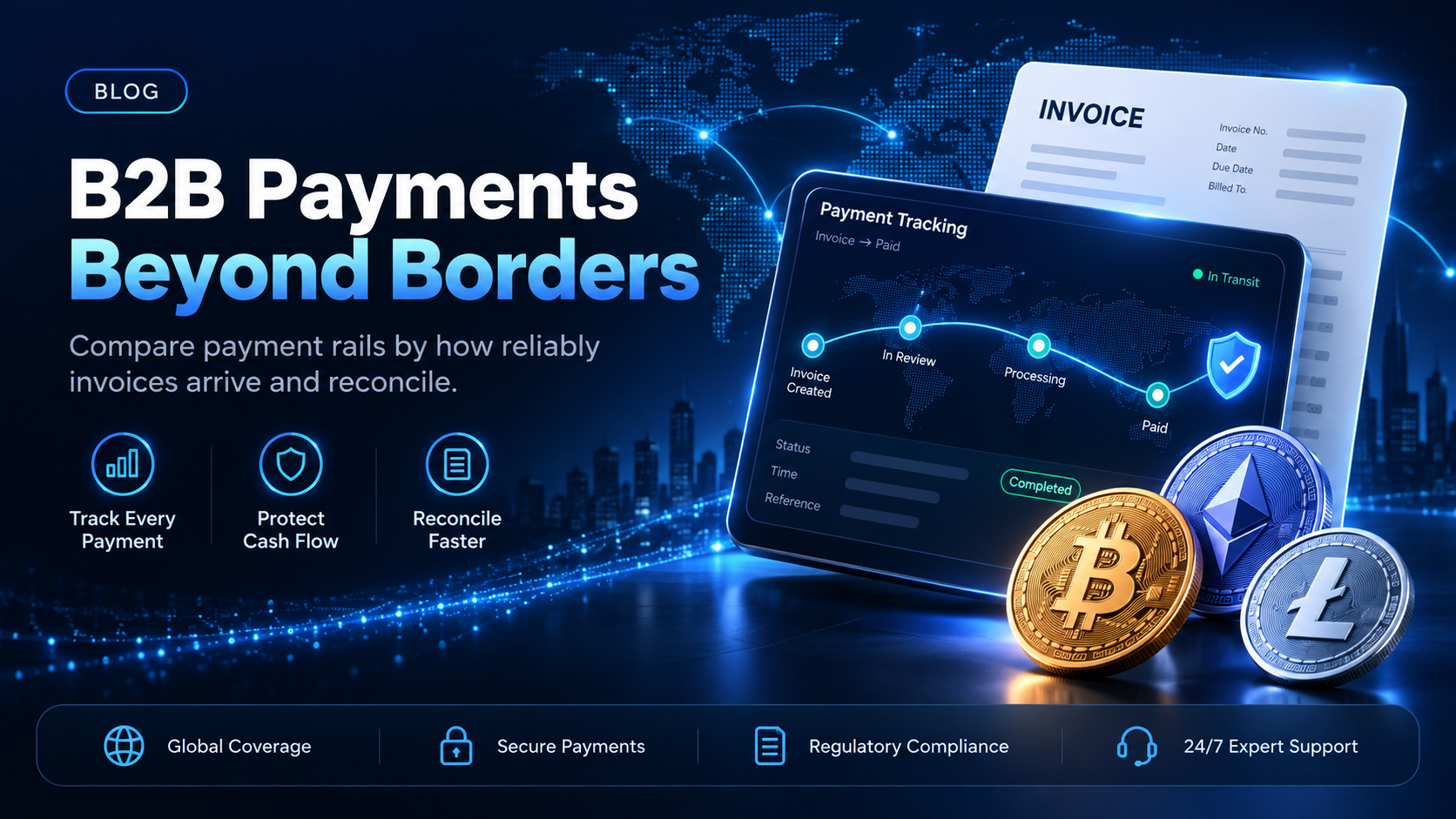
A cross-border invoice can be paid in full, on time, and still be unaccounted for on both sides, because the sending bank, the intermediaries, and the beneficiary bank each report a different state of the same transfer. No participant in that chain has a complete view of where the money is.
Most B2B payment solutions get compared on the transaction fee and the integration effort. Neither of those columns has a row for a payment nobody in the chain can locate. EukaPay is a second collection rail for exactly that problem, and the reason to widen the criteria before you sign. This guide sets out what the categories actually cover, why business to business payments fail in ways a category comparison cannot show, and where stablecoins or cryptocurrencies belong in the decision.
In this guide, you'll learn:
What separates the four main categories of B2B payment solutions
Why a B2B invoice can be paid on time and still arrive late
A criteria table for comparing approaches without reading a rate card
What a second collection rail changes, and what it leaves alone
What B2B payment solutions cover, and where your finance stack takes over
B2B payments move money from one business to another against an invoice or a contract. That is the whole of the category. Everything else finance teams argue about during a vendor selection sits either side of it.
Your accounting system owns the invoice numbering, the terms, the dunning schedule, the ledger, and the reconciliation rules. Your procurement or AP system owns approvals. The payment solution owns one thing: getting an instructed amount from the payer's account into yours, and telling you when that happened.
The distinction matters during a migration. If the payment layer owns your invoice logic, changing providers means rebuilding how you bill. If your finance stack owns it, the payment layer is a component you can add or swap. Plenty of teams find out which situation they are in at the worst possible moment.
Categories, described by what they own
Bank transfer and correspondent networks.
The default for large invoices. Wide reach, and the least visibility into where a payment is once it leaves.
Card rails for business spend.
Fast authorisation and good data, with acceptance costs that scale badly on high-value invoices.
Local rails and account-to-account.
Cheap and quick inside a market, and a separate integration for each market you add.
Stablecoin and cryptocurrency rails.
A payment path that does not depend on the correspondent chain, settled to your own bank account or held in crypto.
Why does a B2B payment arrive late when the customer paid on time?
The payer's obligation ends when they instruct their bank. Your cash position depends on when the funds are applied to your account. Those are different events, and the gap between them is where B2B payment processing quietly costs money.
A cross-border transfer can pass through intermediary banks that were not named on the instruction. Each one applies its own cut-off times and its own review. A payment instructed on a Friday afternoon in one market may not be actioned until the next business day in another, and a public holiday that neither party shares can add a day nobody planned for.
The operational cost is not only the delay. It is the reconciliation work when the amount that lands does not match the amount invoiced, because a deduction was taken somewhere in the chain and no line item explains it. Finance then has to decide whether to chase the customer for a shortfall the customer did not cause.
Larger invoices concentrate the damage. A delayed low-value payment is an annoyance. A delayed six-figure payment moves your cash forecast, and it lands on the one week you needed it not to.
How to choose
Bank transfer | Card rails | Local rails | EukaPay alongside any | |
|---|---|---|---|---|
Reach outside your home market | Wide, via correspondents | Depends on issuer coverage | One integration per market | Global, on public networks |
Visibility while in flight | Limited once it leaves | Authorisation is immediate | Varies by scheme | Each payment has its own reference |
Tied to banking hours | Yes | Settlement windows apply | Local scheme hours | Not tied to banking hours or the banking calendar |
Where the money lands | Your bank account | Your acquirer's currencies | Local account | Your bank account in USD, EUR, GBP, or CAD, or held in crypto |
Who owns invoice terms | Your system | Your system | Your system | Your system |
Approaches compared, not vendors.
The EukaPay column is the one that changes a shortlist, because it adds a way to get paid rather than replacing the finance stack you already run. The other three columns describe choices most teams have already made and are not about to unwind. Keeping them and adding a second path is a smaller decision than switching any one of them.
Where stablecoins or cryptocurrencies fit in B2B payment processing
Bank transfer stays the default for most B2B invoices, and nothing here argues otherwise. The case for a second rail is narrow and specific: the customers whose payments consistently take longer than the terms you agreed, and the invoices where the deduction chain makes reconciliation expensive.
With EukaPay, your system
creates an invoice through the API
and gets back a payment page URL, or you send a
from the dashboard. The customer opens that URL and completes the payment from a wallet in their browser. Pay-ins support BTC, ETH, USDT, USDC, BCH, LTC, SOL, and Lightning. You choose whether the result settles to your bank account or stays in crypto.
Because the payment travels on a public network rather than through a correspondent chain, it is not tied to banking hours or the banking calendar, and each payment carries its own reference you can look up. That is the part that matters to a finance team: not that it is novel, but that when someone asks where the money is, there is an answer.
This is a collection rail, not a billing system. There is no approval workflow, no procurement integration, and no ledger. Those stay where they are.
One platform underneath
EukaPay gives you instant crypto-to-fiat conversion at a locked exchange rate to remove your exposure to crypto price swings, support for most major cryptocurrencies, and settlement in USD, EUR, GBP, and CAD to your bank account. A crypto payment confirms on-chain, so protection against chargebacks is a property of the payment method.
The recommendation for a business billing across borders is straightforward. Keep the bank relationship you have, keep the accounting system you have, and add EukaPay as a second way for a customer to complete an invoice. Pricing is agreed with the EukaPay team. The next step is a sandbox key and one test invoice against a real customer flow.
Get started with EukaPay
Create an account at
, complete verification, provide your legal business information, and generate an API key. A staging environment is available so your developers can build the invoice flow before anything touches a live customer. The endpoints are documented at
.
Frequently asked questions
What are B2B payment solutions?
They are the systems and rails a business uses to collect money from other businesses against invoices or contracts. The category covers bank transfers, card rails for business spend, local account-to-account schemes, and stablecoin or cryptocurrency rails.
How are B2B payments different from consumer payments?
Values are larger, terms are negotiated rather than instant, and the payer is an organisation with its own approval process. That changes what matters: reach and traceability tend to outweigh checkout speed.
Do I have to replace my current provider to add a second rail?
No. A second collection rail sits alongside whatever you use today. Your accounting system keeps ownership of invoice numbering, terms, and reconciliation.
Which cryptocurrencies can a customer pay a B2B invoice with?
EukaPay pay-ins support BTC, ETH, USDT, USDC, BCH, LTC, SOL, and Lightning. The payer completes the transfer from a wallet in their browser.
Can I get paid in regular currency if the customer pays in crypto?
Yes. You choose fiat or crypto settlement. Fiat settlement reaches your own bank account, with settlement currencies including USD, EUR, GBP, and CAD.
Does the exchange rate move between invoice and settlement?
A locked exchange rate is available on conversion, which removes your exposure to crypto price swings on that conversion.
Is this suitable for high-value invoices?
It is built for business payments rather than small consumer transactions. The practical question on any given invoice is whether your customer holds the asset and is willing to use it.
How long does a payment take to reach me?
Payments on public networks are not tied to banking hours or the banking calendar. Actual timing depends on the asset and network the payer chooses.
Related articles
Cross-border payment collection in 2026
- why a single global account slows your cash, and what changes when you add a second rail
The benefits of accepting crypto payments for B2B companies
- the operational case, laid out for a finance audience
How to create a crypto invoice
- the step-by-step version of the flow described above
Products
Use Cases
© 2026 EukaPay. All rights reserved.
FINTRAC: M22233887