The benefits of accepting crypto payments for B2B companies
August 28, 2026
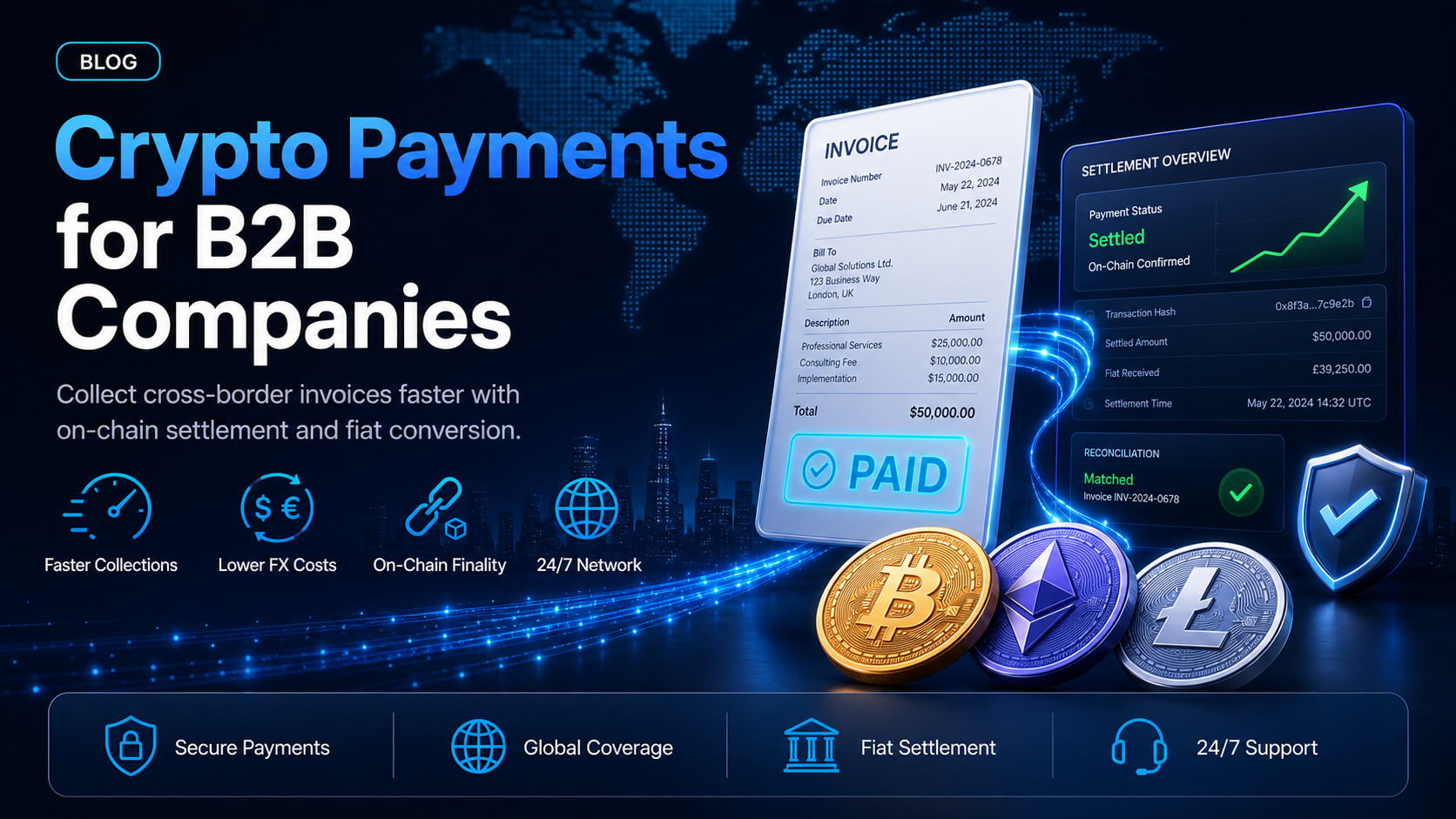
Fewer than 45% of cross-border business-to-business payments were credited within one business day. That number comes from the Financial Stability Board's G20 Roadmap for Cross-border Payments consolidated progress report, published on October 9, 2025. The same report found average global costs of retail cross-border payments have stayed flat since 2023. For a seller, that is cash sitting in a correspondent banking chain at a cost nobody quoted up front.
EukaPay is where that collection runs. Your buyer pays an invoice, a payment link, a checkout, or an API request in stablecoins or crypto. EukaPay handles instant crypto-to-fiat conversion at a locked exchange rate to remove your exposure to crypto price swings, then settles to your own bank account in USD, EUR, GBP, or CAD. This guide sets out what changes for a B2B seller, and the five steps to run it in production.
In this guide, you'll learn:
Why an international wire costs a B2B seller days of working capital and an FX margin nobody quoted up front
The three properties of a crypto payment that change a B2B collection
Five steps to accept crypto payments on B2B invoices, from account setup to reconciliation
Which B2B companies get the most from crypto collections, and what finance and accounting teams handle
Why international wires cost B2B companies time and working capital
A B2B invoice paid by international wire does not travel directly. It moves through a chain of correspondent banks. Each institution in that chain applies its own cutoff time, its own compliance review, and in many cases its own charge. The seller sees none of it until the payment arrives short.
On speed, business-to-business and business-to-person payments were the slowest retail use cases the Financial Stability Board measured, with fewer than 45% credited within one business day. On cost, the average price of a retail cross-border payment barely moved between 2023 and 2025. FX cost stayed the single biggest component of the total. The G20 set quantitative targets for cheaper and faster cross-border payments in 2021, with a common target date of end-2027. In the same October 2025 report, the FSB said it is unlikely that satisfactory improvements at the global level will be achieved on that timetable.
For a finance lead, the real cost is not the headline percentage. It is matching a short payment to an open invoice, the collections call about money that has already left the buyer's account, and the working capital tied up in transit. The hours spent chasing an unarrived wire come out of work the business actually needs.
The benefits of accepting crypto payments for B2B companies, in three properties
The payment confirms on a public network, not through a correspondent chain.
A buyer sending USDC or USDT is moving value across a blockchain network. Arrival of the funds does not depend on how many intermediary banks sit between the buyer's bank and the seller's.
Confirmation is on-chain and final.
A crypto payment confirms on-chain, so protection against chargebacks is a property of the payment method instead of a policy someone applies afterwards.
Blockchain networks do not keep banking hours.
A network can confirm a transfer on a weekend or on a bank holiday. A buyer in a different time zone can pay when their approval cycle finishes, not when a cutoff allows.
How to accept crypto payments on B2B invoices, step by step
Open the account and generate an API key.
Sign up, complete verification, provide your legal business information, then generate an API key. A staging environment is available for development work.
Choose fiat or crypto settlement.
You decide which one your account uses. Fiat settlement reaches your own bank account, with USD, EUR, GBP, and CAD among the supported currencies. Crypto settlement keeps the received asset.
Pick the collection tool that matches how you bill.
Use an
for a named buyer, a payment link for a deal closed on a call, or checkout for a self-serve order. For a flow inside your own billing system, your developer (or coding agent) builds against the
.
Send the request and let the buyer pay.
On the invoice route, EukaPay sends a formatted PDF invoice to the buyer's inbox with the payment link embedded. On a payment link, a checkout, or an API request, the buyer opens the payment screens directly. Either way the buyer pays in a supported cryptocurrency, and pay-ins cover most major cryptocurrencies including BTC, ETH, USDT, and USDC.
Reconcile against the open invoice.
Once the payment confirms, match it to the open invoice in your ledger, then record it in your accounting system alongside your card and bank receipts.
That is the whole production path, and it runs beside your existing methods instead of in place of them.
Which B2B companies benefit most from accepting crypto payments?
This is a profile question, not an industry question. The companies that get the most out of it usually share three traits.
Invoice sizes are large enough that an FX margin of one or two percent is a real number on the income statement, not a rounding item. Buyers sit outside the seller's acquirer footprint, so every additional market on the customer list adds another issuer and another set of rules the acquirer did not write. And the finance function is small, so time spent chasing payments comes out of work the business actually needs.
A company with two of the three traits and buyers across several regions usually sees the change quickly. If you are still deciding whether to support a single asset or several,
how to accept bitcoin as a business
covers the narrower version of the same decision.
What finance and accounting teams need to handle
Three things sit with the seller, and none of them are new work in kind.
Settlement currency mapping.
Decide which of USD, EUR, GBP, or CAD each entity settles into. Map that to the bank account and the general ledger account it belongs in.
Reconciliation.
A confirmed crypto payment matches an open invoice the same way a bank credit does. What changes is the identifier. Your team matches against the blockchain transaction instead of a bank reference, so the reconciliation step in the workflow above matters more than it first appears.
Access.
Decide who in the finance team can create invoices, who can view settlement records, and who holds the API credentials. That is the same access review any payment method gets.
One platform for deposits, payouts, and fiat settlement
The same EukaPay account handles collections and payouts. EukaPay handles instant crypto-to-fiat conversion at a locked exchange rate to remove your exposure to crypto price swings. The same account supports most major cryptocurrencies and settles in USD, EUR, GBP, and CAD to your bank account. A crypto payment confirms on-chain, so protection against chargebacks is a property of the payment method. On the payout side, the same account sends crypto payouts in USDC, USDT, ETH, and BTC. The asset and the network are set per payout. Payouts are not tied to banking hours or the banking calendar.
For a B2B seller collecting from buyers in more than one region, that combination is the reason to run collections and supplier payments on one platform instead of two. If cross-border collection is the specific problem, our guide to
cross-border payment collection
goes deeper on the account structure. The next step is to open an account and send one real invoice to one real buyer.
Get started with EukaPay
Create an account at
, complete verification, and generate an API key. The
page covers the collection tools a B2B seller uses. The
covers the endpoints your developer (or coding agent) will build against.
Frequently asked questions
What are the main benefits of accepting crypto payments for B2B companies?
A crypto payment confirms on a public network instead of moving through a chain of correspondent banks. It confirms on-chain, and the network does not observe banking hours. For a seller invoicing across borders, those three properties take the correspondent chain out of the collection.
Which cryptocurrencies can a B2B company accept?
Pay-ins support most major cryptocurrencies, including BTC, ETH, USDT, USDC, BCH, LTC, SOL, and Lightning. Most B2B invoices in practice get paid in stablecoins, because the buyer and the seller both want the amount to match the invoice.
Can we settle in fiat instead of keeping the cryptocurrency?
Yes. You choose fiat or crypto settlement for your account. With fiat settlement, EukaPay handles instant crypto-to-fiat conversion at a locked exchange rate, then settles to your own bank account, with USD, EUR, GBP, and CAD among the supported currencies.
How does accepting crypto reduce chargeback exposure on B2B orders?
A crypto payment confirms on-chain, so protection against chargebacks is a property of the payment method. There is no issuer-side reversal window on a confirmed on-chain payment the way there is on a card authorization.
What does it cost to accept crypto payments with EukaPay?
EukaPay does not publish a public rate card. Pricing is agreed with the EukaPay team, so contact the team for a quote against your volume and your mix of pay-ins and payouts.
Can we add crypto payments without replacing our card processor?
Yes. A crypto pay-in is an additional payment method on the same invoice or checkout, so your existing card processing and bank rails stay where they are.
Is there a crypto payment gateway for B2B with an API?
Yes. The
creates payment requests programmatically. The
covers the endpoints, the invoice and customer objects, and the staging environment.
Can we invoice in USD and accept payment in stablecoins?
Yes. You set the invoice amount in your billing currency, and the buyer pays in a supported cryptocurrency. Conversion happens at a locked exchange rate by default, on pay-ins and on payouts.
Related articles
How to accept bitcoin as a business
- the single-asset version of this decision, from wallet to settlement.
How to create a crypto invoice
- line items, buyer details, and the PDF invoice with the payment link embedded.
Cross-border payment collection
- why one global account slows your cash, and what to run instead.
Products
Use Cases
© 2026 EukaPay. All rights reserved.
FINTRAC: M22233887