How to accept bitcoin as a business
August 25, 2026
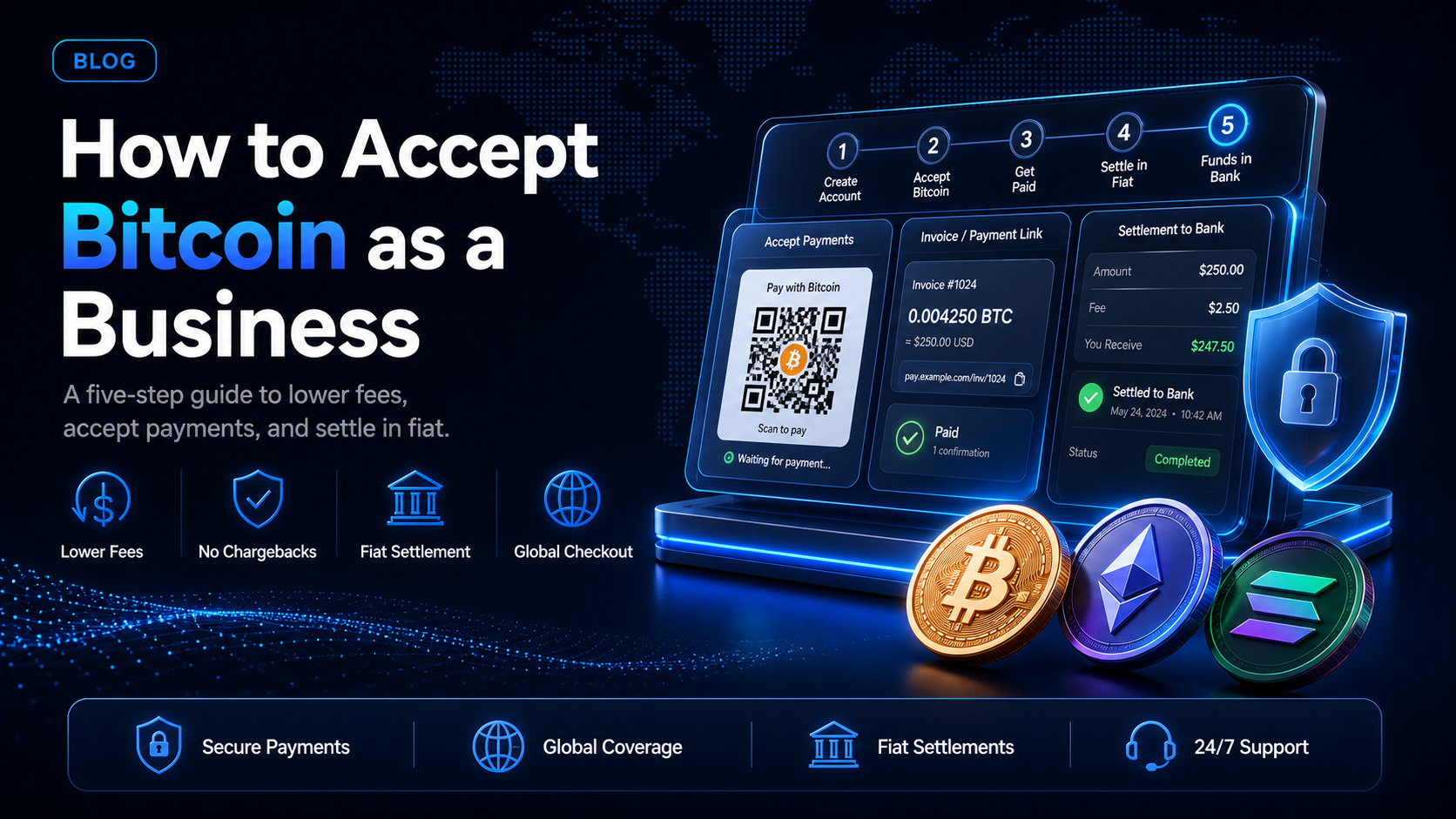
U.S. merchants paid a record $198.25 billion in credit and debit card processing fees in 2025. The Merchants Payments Coalition published that number in March 2026, citing the Nilson Report, and put the one-year increase at 5.9%. It also reported that the average Visa and Mastercard credit card swipe fee reached 2.36% of the transaction amount. Every one of those dollars left the business before it paid rent, staff, or stock.
A crypto payment gateway is the other route, and this guide uses EukaPay. Your business accepts bitcoin and other cryptocurrencies at checkout, on an invoice, or over a payment link. EukaPay converts the payment to fiat at a locked exchange rate and settles it to your own bank account. What follows is the setup, the buyer profile it suits, and the work your finance team picks up afterward.
In this guide, you'll learn:
Why card processing fees and chargebacks cost more than the rate printed on your merchant statement
The three things a bitcoin payment does differently from a card payment
The five steps to accept bitcoin as a business, from signup to your first live sale
What your finance and accounting teams need to handle once you accept bitcoin payments
Why card processing fees and chargebacks cost more than the posted rate
The rate a processor quotes is rarely the rate a business pays. Three separate charges sit inside the number on a merchant statement, and only one of them belongs to the processor.
Interchange, assessments, and the processor markup - three charges in one line
Interchange goes to the bank that issued the customer's card. Assessment fees go to the card network. The markup goes to the processor that put the terminal or the checkout in front of the customer. A business negotiates the third one and inherits the first two. That is why a headline rate can move without anything in the merchant agreement changing.
Card rates also vary by card. A rewards card, a corporate card, and a card presented from outside your acquirer's footprint can each carry a different cost on the same $100 sale.
Chargebacks - a cost that can arrive months after the sale
A card payment can be reversed by the issuing bank long after the goods have shipped. The business loses the revenue, the stock, and usually a separate fee for handling the dispute. Representment takes staff time and it does not always succeed. For a business selling high-ticket items or shipping across borders, that exposure is often the larger number.
What does bitcoin do differently from a card payment?
Bitcoin payment processing happens on-chain - the network records the transfer
A bitcoin payment is recorded by the network, not authorized by a card issuer. Once the transaction has confirmed, the business can look it up by its on-chain transaction ID. The record does not depend on a bank sending a file the next day.
No issuer reversal - protection against chargebacks is a property of the payment method
No issuing bank has the authority to reverse a confirmed bitcoin payment. Refunds still exist, but the business decides when to send one.
The customer's bank does not authorize the payment - a wallet behaves the same across borders
A wallet works the same way in every market. Plenty of customers have a functioning business and a functioning bank account but no card that reliably completes a cross-border digital purchase. Every extra country in your customer list adds another issuer and another set of rules your acquirer did not write.
How to accept bitcoin as a business in five steps
Sign up and complete verification.
Create a EukaPay account, provide your legal business information, and complete verification. This is a business review, not a form that clears in a minute, so start it before the launch date you have in mind.
Choose fiat or crypto settlement, and pick your currency.
Fiat settlement converts each payment and sends it to your own bank account in USD, EUR, GBP, or CAD. Crypto settlement keeps the payment in the cryptocurrency it arrived in. Most businesses want fiat settlement, because it keeps the general ledger denominated the way it already is.
Pick how you'll collect.
suit a business billing a named buyer for goods or services delivered. Payment links suit a sale closed over email or on a call. Checkout suits a storefront. Subscriptions send invoices on a recurring schedule at intervals from daily to annually.
Connect the storefront, or generate an API key.
A hosted crypto checkout is embedded into an existing store. A developer (or coding agent) building a custom flow can generate an API key and work against the
instead. A staging environment is available for development, so the integration can be built and tested before a real customer sees it.
Run a live payment, then hand the record to finance.
Put one small real transaction through the route you just built. Confirm the settlement currency, the on-chain transaction ID, and the amount that reaches the bank account. Your accounting team will reconcile every later month the same way.
Who accepting bitcoin works best for
This works best for a business whose payment step is the obstacle, not its product. If your sales team loses deals at the payment step, or if a real share of your customers cannot complete a card payment, the math favors adding a crypto route.
First, a customer base spread across markets your acquirer serves poorly. Second, an average order value high enough that a percentage-point difference in processing cost is a real number at the end of the quarter. Third, an existing pattern of disputes or reversals your team already spends hours on. A business with none of those three signals may not need this yet.
It also suits businesses whose customers already hold cryptocurrencies. The list of
companies accepting crypto payments in 2026
has grown steadily, and shoppers who pay one merchant this way often look for the option at the next one.
What finance and accounting teams need to handle
Adding a payment route adds a reconciliation route. The work is manageable, and it is easier when it is designed in advance.
A crypto payment confirms on-chain with its own transaction ID, so the sale can be looked up on the network instead of waited on from a bank file. Settlement in the same currency your books already use keeps the reconciliation ordinary.
Decide before launch how the payment data reaches the month-end close. Whoever closes the month should agree on who pulls it, how often, and how a payment gets matched back to the invoice or order number. Doing that in week one is cheaper than doing it during the first close.
One platform for deposits, payouts, and fiat settlement
EukaPay runs the same infrastructure for every collection route: instant crypto-to-fiat conversion at a locked exchange rate to remove your exposure to crypto price swings, support for most major cryptocurrencies, and settlement in USD, EUR, GBP, and CAD to your bank account. The locked exchange rate is applied by default on every conversion, on pay-ins and on payouts. A crypto payment confirms on-chain, so protection against chargebacks is a property of the payment method.
EukaPay also sends money out. Payouts go to recipients in USDC, USDT, ETH, or BTC, and the asset and the network are set per payout. A recipient list can be uploaded as a CSV file in the merchant dashboard. If your business collects from customers and pays contractors, affiliates, or suppliers, you can run both through EukaPay instead of two vendors and two reconciliation processes. Start with EukaPay, not a collections-only gateway you will outgrow.
Get started with EukaPay
Create an account at
and complete verification to begin. If a developer (or coding agent) is building the integration, the endpoints, the staging environment, and the payment objects are documented at
. If you would rather start without code, the
product page covers the hosted routes.
Frequently asked questions
Do I need to hold bitcoin if I accept it?
No. With fiat settlement, EukaPay converts the payment at a locked exchange rate and sends fiat to your bank account, so the business does not need to hold the cryptocurrency.
What cryptocurrencies can my business accept?
EukaPay supports most major cryptocurrencies like BTC, ETH, LTC, SOL, USDC, and USDT, plus Lightning. Many businesses take stablecoins alongside bitcoin, because a stablecoin payment arrives already denominated in dollars.
How do customers actually pay?
The customer follows a payment screen and sends the amount from their own wallet. The transaction then confirms on-chain.
Can I still refund a customer?
Yes. A refund is a payment your business chooses to send back. What does not happen is an issuing bank reversing the original payment without your involvement.
How long does it take to start accepting bitcoin?
That depends on verification and on which collection route you pick. A hosted checkout or payment link needs no code. A custom API integration takes as long as the development work does, and a staging environment is available for it.
What does my accounting team need from day one?
An on-chain transaction ID for every payment, an export routine everyone agrees on, and a settlement currency that matches the books. Settle those three before the first live sale.
Can I accept bitcoin on Shopify or another storefront?
Related articles
How to create a crypto invoice
- billing a named buyer and getting paid in stablecoins or crypto
How to accept crypto with a crypto payment API
- the developer route for a custom checkout
Walmart crypto payments in 2026
- what retail's shift means for smaller businesses
Products
Use Cases
© 2026 EukaPay. All rights reserved.
FINTRAC: M22233887