Accept stablecoin payments: what a business sets up first
October 05, 2026
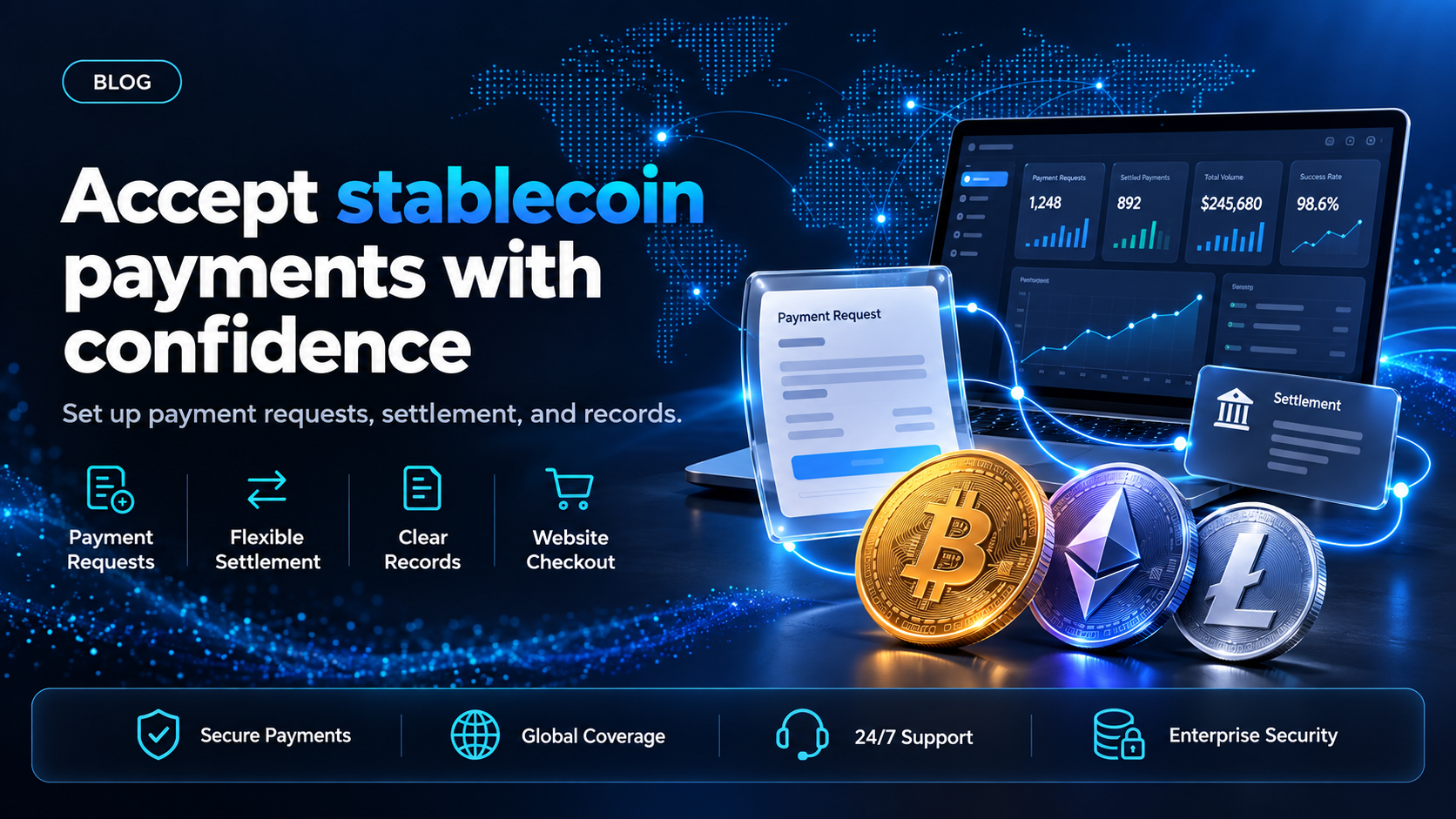
To accept stablecoin payments, a business needs four things in place: a payment account, a way to ask the customer for money, a settlement choice, and a record that matches each payment to an order or invoice. The customer pays from their own wallet in a stablecoin such as USDC or USDT. The business decides whether that payment stays in crypto or reaches its bank as fiat.
EukaPay covers all four in one account. You request payment with an invoice, a payment link, a checkout, or a subscription, and EukaPay converts each payment at a locked exchange rate when you choose fiat settlement. This guide walks through the setup in the order a business usually does it.
In this guide, you'll learn:
What a business needs before it can accept stablecoin payments
Which payment method fits each way you sell
How the settlement choice decides what reaches your bank account
How to accept stablecoin payments with EukaPay, step by step
What a business needs to accept stablecoin payments
A stablecoin is a cryptocurrency designed to track the value of a fiat currency, most often the US dollar. For a business, that design matters for one reason. A business can keep its catalog in dollars and ask the customer to send USDC or USDT for the same total.
Accepting stablecoin payments raises the same questions as any new payment method: who can pay, how they pay, where the money goes, and how finance records it. The
explains which stablecoins a business is most likely to be asked to accept.
Payment account - the account that receives the money
A business accepting stablecoin payments can run its own wallet or use a payment platform. A self-run wallet means the business also builds the invoicing, the conversion to fiat, and the matching of payments to orders. A payment platform supplies those parts. The
checklist for a stablecoin payments platform
covers what to require before you commit.
Customer wallet - what the payer brings
The customer pays from a wallet they already use. The business does not supply the wallet. What the business supplies is the payment request: the amount, the asset, and where to send it.
Which payment method fits the way you sell
The right payment method depends on how the sale happens. Most businesses use more than one.
Invoice - for a known customer and a known amount
An invoice suits B2B sales, services, and any sale agreed before payment. You send the invoice, and the customer pays it from their wallet.
Payment link - for a sale outside a website
A payment link is a URL you can send by email or chat, or place on a page. It suits one-off sales and businesses without a full online store. The
compares the options.
Checkout - for an online store
A checkout sends the customer to a hosted payment page, where they finish the payment in their browser. The
explains how that page works for a merchant.
Subscription - for recurring charges
A EukaPay subscription sends invoices on a recurring schedule, at intervals from daily to annually. The customer pays each invoice from their wallet. Plan management and payment retries stay in your own billing system.
Settlement: what reaches your bank account
Settlement is the choice that most affects the finance team. EukaPay lets you choose fiat or crypto settlement for your account.
Fiat settlement - stablecoin payments converted to bank money
With fiat settlement, EukaPay converts each payment and sends fiat to your own bank account in USD, EUR, GBP, or CAD. EukaPay locks the exchange rate on every conversion by default, on pay-ins and on payouts. The fiat value of a payment is fixed at the moment the customer pays. For more detail, read the
guide to a crypto payment gateway with a locked exchange rate
.
Crypto settlement - keeping the stablecoins
With crypto settlement, the payment stays in crypto. That can suit a business that also pays suppliers or contractors in stablecoins. The
guide to stablecoin to fiat payments
compares both routes in more detail.
How do I accept stablecoin payments on my website?
The steps below set up a EukaPay account to accept stablecoin payments on a website, by invoice, or by payment link.
Create an account.
, complete verification, and provide your legal business information.
Choose your settlement.
Pick fiat or crypto settlement. Fiat settlement goes to your own bank account in USD, EUR, GBP, or CAD.
Pick your payment methods.
Use invoices and payment links from the dashboard, or a checkout on your website.
Connect your website.
Use the EukaPay plugin for WooCommerce or Shopify, or generate an API key for a custom build. A developer (or coding agent) can build against the staging environment first. The
covers invoices, subscriptions, payouts, balance transfer, and customers.
Send a test payment.
Run a small payment from start to finish, then confirm the record matches the order before you go live.
One platform for stablecoin pay-ins, payouts, and fiat settlement
A EukaPay account accepts more than stablecoins. You get instant crypto-to-fiat conversion at a locked exchange rate to remove your exposure to crypto price swings, support for most major cryptocurrencies, and settlement in USD, EUR, GBP, and CAD to your bank account.
A crypto payment confirms on-chain, so protection against chargebacks is a property of the payment method. The same account can send crypto payouts in USDC, USDT, ETH, and BTC. Payouts are not tied to banking hours or the banking calendar.
If your customers want to pay in stablecoins and your books run in fiat, EukaPay is the account to set up. Choose your settlement, send your first invoice, and add a checkout when your website is ready.
Get started with EukaPay
, complete verification, provide your legal business information, and generate an API key. A staging environment is available for development. The
lists every endpoint a developer needs to plan the integration.
Frequently asked questions
How do I accept stablecoin payments as a business?
Open a payment account, choose how customers pay, and choose fiat or crypto settlement. With EukaPay, you can send an invoice, share a payment link, or add a checkout to your website.
Which stablecoins can customers pay with?
EukaPay accepts USDC and USDT, along with most major cryptocurrencies like BTC, ETH, LTC, and SOL.
Can stablecoin payments settle to my bank account?
Yes. With fiat settlement, EukaPay converts each payment and settles to your own bank account in USD, EUR, GBP, or CAD.
Does the exchange rate change between payment and settlement?
EukaPay locks the exchange rate on every conversion by default. The fiat value is fixed at the moment the customer pays.
Do I need to code to start accepting stablecoin payments?
Not always. Invoices and payment links are created in the EukaPay dashboard. A website checkout can use the WooCommerce or Shopify plugin, or the API for a custom build.
Can customers pay a stablecoin subscription?
Yes. A EukaPay subscription sends invoices on a recurring schedule, from daily to annually, and the customer pays each one from their wallet.
Can a stablecoin payment be charged back?
A crypto payment confirms on-chain, so protection against chargebacks is a property of the payment method.
Related articles
- what to require from a platform before you commit
- what a business needs to accept and send USDC
- conversion and settlement for stablecoin revenue
Latest Blogs
Products
Use Cases
© 2026 EukaPay. All rights reserved.
FINTRAC: M22233887