The best crypto payment gateway with payment links in 2026
August 24, 2026
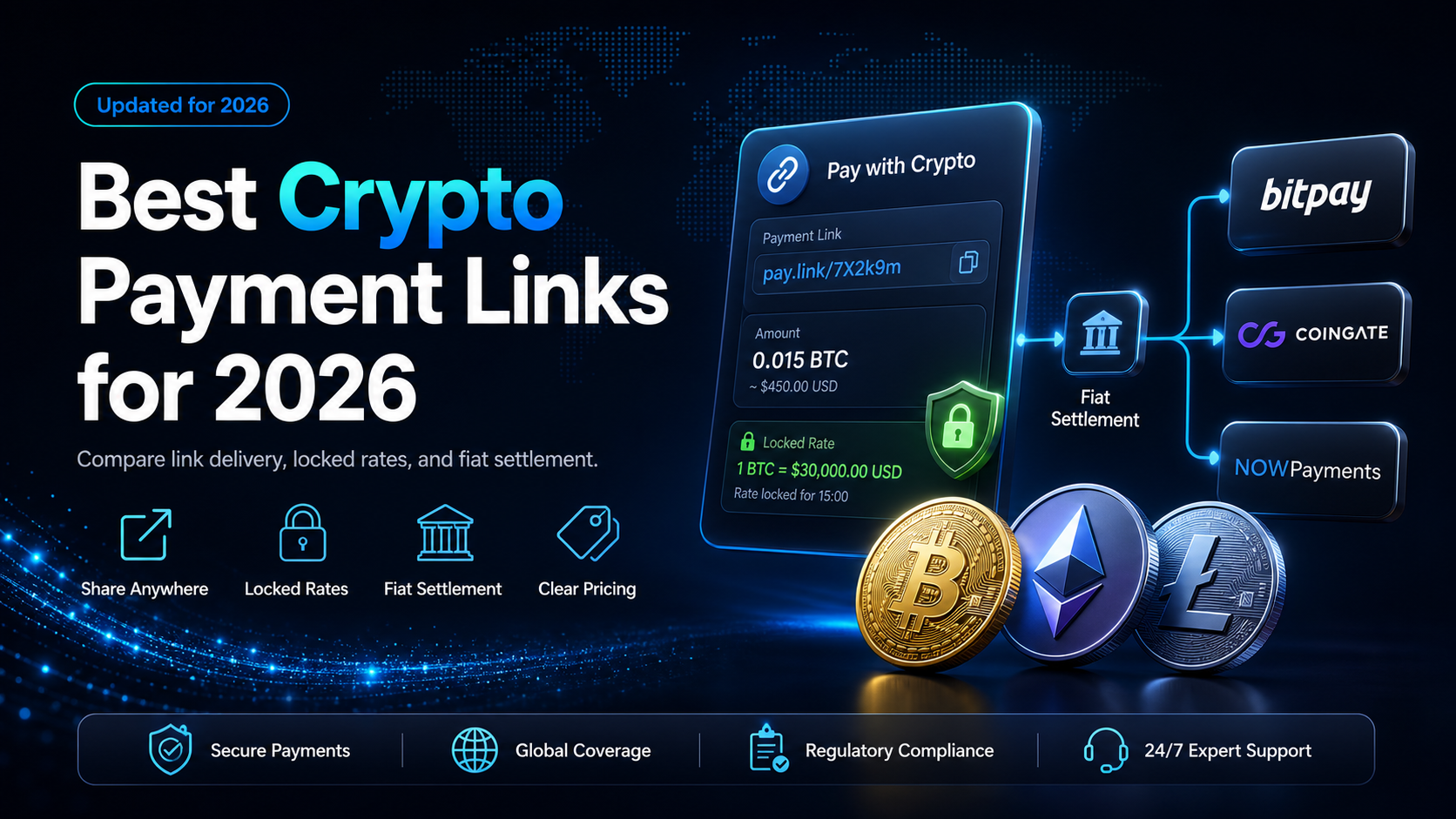
Search for the best crypto payment links and most of what comes back ranks payment gateways in general. The link sits in a feature grid, one checkbox among thirty, next to plugin counts and asset totals. Scroll further and the results turn into directories of stores where a shopper can spend Bitcoin. Neither set of pages answers the operator's narrower question: when the link is the entire checkout, which processor should you route the pay-in through?
EukaPay is built for that question. A EukaPay payment link is a portable request for a specific amount in stablecoins or crypto that you generate yourself and drop wherever the conversation is already happening. It settles to your own bank account in USD, EUR, GBP, or CAD. This guide compares it against BitPay, CoinGate, and NOWPayments on four things a link-first merchant can check. Who delivers the link. Whether the fiat amount is fixed when the payer opens it. Which currencies reach your bank, and what each one publishes on price.
In this guide, you'll learn:
What separates a payment link from a hosted checkout, and when the link is the better tool
How EukaPay, BitPay, CoinGate, and NOWPayments differ on link delivery, exchange rates, and settlement currencies
Why the locked exchange rate matters more on a link than it does at a storefront checkout
Which EukaPay product to reach for when the link is not the right shape
What matters to a business sending crypto payment links
A payment link is a one-to-one request aimed at someone who already knows they owe you money. That changes which criteria carry weight. Plugin counts stop mattering. These three start mattering instead, and price sits alongside them in the table below.
Delivery - who creates the link and how it reaches the payer
EukaPay hands you the link and lets you place it. BitPay and CoinGate build the request as an invoice and send the email themselves. The difference decides whether you can bill over WhatsApp, inside a Slack thread, or attached to a PDF invoice you generated somewhere else.
EukaPay's Payment Links are built for the first pattern: you create the request in the merchant dashboard, you choose the channel, and the link travels with whatever document or message you were already sending. That matters in two common cases. When the buyer's accounts payable contact is not the person whose email address you hold, you can hand the link to whoever is actually going to pay. And when your billing already runs through an accounting tool, the link goes on the document that tool produced rather than replacing it.
Delivery also decides where the follow-up happens when a payment stalls. If the platform owns the send, the record of what went out is that platform's email log. If you own the send, the request sits in the thread you were already using, and the reminder is the next message in that thread.
The payer does not need an account. They open the link, pick a cryptocurrency, and pay. That single requirement, a link and a channel, is what makes the tool usable for a one-off invoice as easily as a recurring one. If you want the platform to do the sending, EukaPay invoices cover that instead, and the
breakdown of invoices, payment links, checkouts, and the API
sets out which one fits a given billing shape.
Exchange rate - whether the fiat amount is fixed when the payer opens the link
A link can sit unpaid for hours. A card authorization cannot. That gap between sending and paying is where an unlocked rate costs you money, because the crypto amount your buyer sends may no longer be worth the number you invoiced.
The exposure is not symmetrical either. On a floating rate, a move in your favor is a rounding difference nobody notices, and a move against you is a shortfall your controller has to write off or chase. So the question to put to any provider is not whether a lock exists. It is when the lock is struck: at creation, when the payer opens the request, or when the transfer confirms.
The three competitors answer it three different ways, and the difference only shows up on a request nobody opens straight away. BitPay's support material describes an invoice as valid for 15 minutes, with the rate guaranteed from creation for as long as the buyer pays inside that window and no guarantee on a transfer that lands after it expires. CoinGate states that the rate is locked at the moment of payment, so the amount is fixed whenever the payer arrives. NOWPayments treats it as a per-payment choice between a fixed rate and a floating one, and prices the two differently. A link that sits in an accounts payable queue over a weekend gets a different answer under each of those three designs.
EukaPay locks the exchange rate on every conversion by default, on pay-ins and on payouts. There is no floating mode to forget to switch off, and no separate toggle to remember to enable before you send the link. The
comparison of gateways on the locked exchange rate
goes through the same question across a wider set of providers.
Settlement - which fiat currencies reach your own bank account
Getting paid in crypto is not the goal for most businesses sending a link. Getting paid, in the currency your accounting runs in, is. EukaPay settles to your own bank account in USD, EUR, GBP, and CAD.
The reconciliation work follows from that choice. A link sent to a buyer paying in USDT can land as a deposit your controller recognizes on a normal bank statement, in the same currency as the invoice that produced it, and matched the same way as any other incoming payment. Where the settlement currency is not one your books already run in, somebody downstream is doing a conversion and a second round of matching before the payment counts as revenue.
Before the currency list, though, comes a plainer question: whether the provider settles to a bank at all. NOWPayments sells custody and off-ramp payouts as separate products, so the crypto arrives first and the fiat leg is a second step you arrange. BitPay publishes settlement in local currency, cryptocurrency, or a combination of the two. Settling straight to a bank account in the currency you invoiced in keeps a payment link a receivable from the moment you send it to the moment it clears.
Comparing the best crypto payment links from EukaPay, BitPay, CoinGate, and NOWPayments
EukaPay | BitPay | CoinGate | NOWPayments | |
|---|---|---|---|---|
How the link reaches the payer | You generate the link and share it on any channel you already use | Email billing tools, with the crypto invoice created and sent by BitPay | One-time or scheduled invoices created and sent to clients | Invoices created in the dashboard or through the API |
Locked exchange rate | Applied by default on every conversion, on pay-ins and on payouts | Guaranteed from invoice creation for a 15 minute window, and not guaranteed after the invoice expires | Locked automatically at the moment of payment | Fixed rate or floating rate, chosen per payment |
Fiat settlement currencies | USD, EUR, GBP, and CAD to your own bank account | Local currency, cryptocurrency, or a combination of the two, settled to your bank | USD, EUR, GBP, or settle in crypto | Crypto to a wallet or custody balance, with a separate off-ramp product |
Published processing fee | Volume-based, agreed with the EukaPay team during onboarding | Tiered on cumulative monthly volume, 2% plus 25c per transaction under 500,000 USD a month, stepping to 1% plus 25c at 1,000,000 USD and above | 1% per transaction on Standard, custom volume-based rates on Enterprise | 1% without an exchange, 1.5% on multi-currency, fixed-rate, and fee-paid-by-user payments |
BitPay, CoinGate and NOWPayments set their own rates and change them. Refer to their websites for current information.
Read the fee row against the settlement row rather than either one alone. NOWPayments prices a single-asset payment at 1% and puts multi-currency and fixed-rate payments at 1.5%, and a merchant who wants the amount fixed before the payer opens the link is in the second case. BitPay's rate is tiered on cumulative monthly volume, so the number that applies depends on the month you are having. CoinGate's 1% is the Standard plan rate, with volume-based pricing quoted on Enterprise. A headline rate is the rate for one shape of payment, so compare it against the shape your links actually carry. EukaPay pricing is agreed with the EukaPay team during onboarding, against the flow you expect to run.
Do you need crypto payment links if you already have a crypto checkout?
Often, yes, because the two tools serve different buyers. A checkout page sits on your website and takes payment from anonymous traffic. A payment link goes out to one named person who is expecting it. A hosting company can run a checkout for self-serve upgrades and still need a link for the annual renewal a sales rep negotiated over email.
The link also works when there is no website in the flow at all. Consultants, agencies, and B2B suppliers often bill from an accounting tool, then need a way for the client to pay the number on that document. Pairing a EukaPay payment link with an invoice you generated in Xero or QuickBooks solves that without a storefront, and without writing code. The guide to
covers the case where EukaPay sends the email instead.
A merchant billing customers across several countries runs into a related question: which currencies a link can even request and settle in. The comparison of
international payment gateways
looks at that from the wider angle of cross-border collection, not just the link itself.
One platform for deposits, payouts, and fiat settlement
Every EukaPay product runs on the same infrastructure: instant crypto-to-fiat conversion at a locked exchange rate to remove your exposure to crypto price swings, support for most major cryptocurrencies like BTC, ETH, LTC, SOL, USDC, USDT, and settlement in USD, EUR, GBP, and CAD to your bank account. A crypto payment confirms on-chain, so protection against chargebacks is a property of the payment method, and the
comparison of gateways on chargebacks
sets out what that does and does not cover. The same account handles the other direction as well, with payouts in USDC, USDT, ETH, and BTC that are not tied to banking hours or the banking calendar.
That matters for a link-first business more than it looks. The merchant sending payment links this quarter is often the one paying contractors or affiliates next quarter. Moving that second flow onto
a gateway that also handles payouts
can mean one account, one balance, and one set of records at reconciliation. If you sell infrastructure, the comparison for
covers the same criteria against the billing patterns that industry runs on. Start with the link, and the rest is already there when you need it.
Get started with EukaPay
Create a
and generate your first payment link from the dashboard, or read the
if you would rather have invoices, subscriptions, and payouts created programmatically. If a developer is going to build the billing requests rather than create them by hand, the
comparison of gateways on API sandbox testing
covers how each provider handles pre-production validation.
Frequently asked questions
What is a crypto payment link?
It is a shareable URL that requests a specific amount from one payer. They open it, choose a cryptocurrency, and complete the transfer in their browser. No storefront and no checkout integration are involved.
Can I accept crypto payments without a website?
Yes. A payment link is created in the dashboard and shared over email, chat, or an invoice document, so no site is required.
What is the difference between a payment link and an invoice?
With a payment link you deliver the request yourself. With a EukaPay invoice, EukaPay emails your customer a formatted invoice with the payment link embedded in it.
Do crypto payment links protect against chargebacks?
A crypto payment confirms on-chain, so protection against chargebacks is a property of the payment method.
Which cryptocurrencies can someone pay a link with?
EukaPay supports most major cryptocurrencies like BTC, ETH, LTC, SOL, USDC, USDT on the pay-in side, and the payer picks one when they open the link.
Can I get paid in dollars if my customer pays in stablecoins?
Yes. You can settle in USD, EUR, GBP, or CAD to your own bank account, at a locked exchange rate applied on every conversion.
How is EukaPay pricing set for crypto payment links?
Pricing is agreed with the EukaPay team during onboarding, against the flow you expect to run.
Can I create billing requests through the EukaPay API?
Yes. The EukaPay API creates invoices, subscriptions, and payouts programmatically. The payer still completes the transfer in a browser.
Related articles
Invoices, payment links, checkouts, or API
- which EukaPay product fits the shape of your billing
Which gateways lock the exchange rate, and when
- the rate question across a wider set of providers
Sending crypto payouts from the same account
- the same platform, pointed at money going out
Products
Use Cases
© 2026 EukaPay. All rights reserved.
FINTRAC: M22233887