Web3 payment processor requirements for a business
September 17, 2026
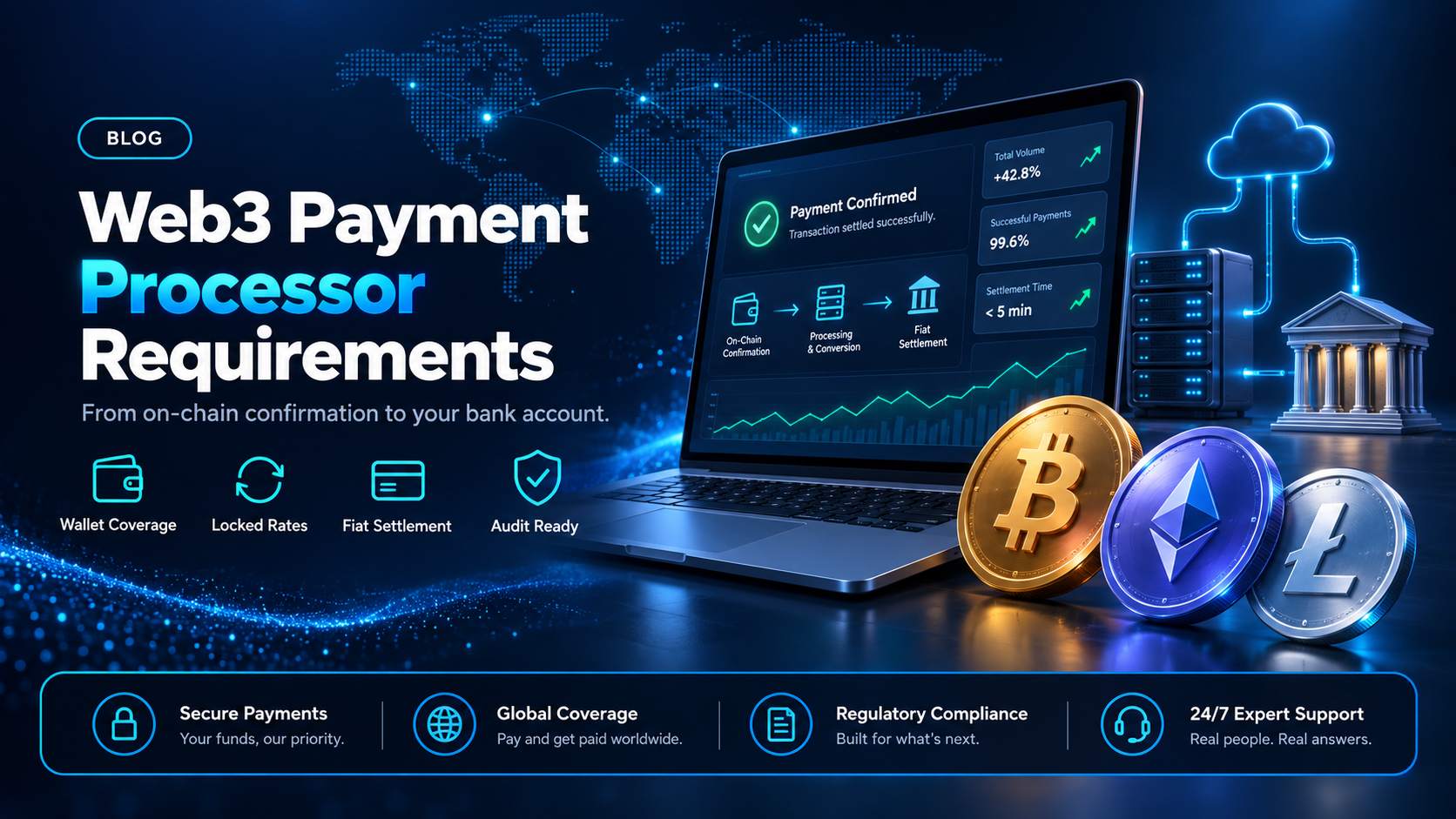
The phrase web3 payment processor covers products sitting at three different layers. Wallet connection libraries sit at one. On-ramps that sell cryptocurrency to a consumer sit at another. Payment processors that collect a customer's payment and settle money into a merchant's bank account sit at a third. A shortlist built by product name can mix all three, so the comparison never resolves into a decision.
EukaPay sits at that third layer, collecting crypto pay-ins through checkout, payment links, invoices, and an API. Settlement goes to your own bank account in USD, EUR, GBP, and CAD, or in cryptocurrency if you prefer that. The sections below set out what to require from a web3 payment processor, in the order the money actually moves.
In this guide, you'll learn:
What a web3 payment processor does between the payer's wallet and your bank account
Which cryptocurrencies and networks to require on the pay-in side and on the payout side
How fiat settlement in USD, EUR, GBP, and CAD changes what your finance team reconciles
What to ask about references and reporting before a developer writes any integration code
What a web3 payment processor does between the payer's wallet and your bank account
Three things happen in sequence, and a processor can be strong at one and silent on the next two. Ask about all three before you read a feature list.
Pay-in - the payer sends cryptocurrency and the transaction confirms on-chain
The customer opens a hosted payment page in a browser and sends the amount from a wallet they already use. Confirmation comes from the network, not from the processor, so the payment is settled in the blockchain sense before anyone at your company sees it. That is the mechanic behind
, and it is the reason a crypto payment confirms differently from a card authorization.
Conversion - the exchange rate is locked and the fiat amount is fixed
A cryptocurrency amount that sat on your books for an hour can be a different number by the time finance looks at it. EukaPay locks the exchange rate on every conversion by default, on pay-ins and on payouts. The default applies to both sides of the account, so the fiat value of a payment can be fixed at the moment the customer pays.
Settlement - the fiat amount reaches the merchant's own bank account
Settlement pays your company, not your customer's counterparty. Fiat settlement reaches the merchant's own bank account in USD, EUR, GBP, and CAD, among other currencies. A processor that stops at a platform balance has done two of the three steps and left the third to you.
Web3 payment processor requirements on cryptocurrency and network coverage
Coverage is two separate lists, and vendors often publish one. Ask for both, because the side you collect on and the side you send on rarely match.
Pay-in coverage - which cryptocurrencies a customer can pay with
EukaPay supports most major cryptocurrencies on the pay-in side, including BTC, ETH, LTC, SOL, USDC, USDT, and Lightning. Breadth matters here because you do not choose what your customer holds. Stablecoin pay-ins are the common case for business-to-business invoices, and
are the volume most merchants ask about first.
Payout coverage - which cryptocurrencies and networks you can send
Payouts are a narrower list on every platform, and the narrow list is the one that constrains your operations. EukaPay sends payouts in USDC, USDT, ETH, and BTC, on the Ethereum, Tron, and Bitcoin networks. Asset and network are set per payout, so two recipients in the same run can receive different cryptocurrencies on different networks. Mass payouts are a recipient list uploaded as a CSV file in the merchant dashboard. The Payout API creates payouts one per request.
Does a web3 payment processor need the payer to use a non-custodial wallet?
Not for merchant acceptance. The requirement is real for products built around signing a smart contract call, where the payer's wallet has to authorize a specific on-chain action. A business collecting revenue has a simpler test: the payer sends an amount to an address, the network confirms it, and the processor tells you which order it belongs to.
With EukaPay the payer finishes in a browser on a hosted payment page, so the flow is not headless. What your engineers build against is the
, which returns that payment page and reports the result. The documented surface covers invoices, subscriptions, payouts, balance transfer, and customers.
How to choose
Your own wallet address | Processor with crypto settlement | EukaPay | |
|---|---|---|---|
Where the money lands | A wallet your team manages | A platform balance in cryptocurrency | Your own bank account in USD, EUR, GBP, or CAD, or in cryptocurrency |
Exposure to price movement | Stays until you convert it yourself | Stays until you convert it | Removed at the moment of payment by a locked exchange rate, applied by default |
Matching a payment to an order | Your engineers build the matching | Varies by platform | Every payout carries its own reference that can be looked up |
What a developer (or coding agent) builds against | Node access and address management | A platform API | One API covering invoices, subscriptions, payouts, balance transfer, and customers |
EukaPay is the option that finishes the sequence. It converts at a locked rate and settles into the account your finance team already reconciles against. The first column suits a company with blockchain engineers and a reason to manage addresses itself. The second is common among platforms built for on-chain businesses that keep a cryptocurrency balance. Both leave the bank leg to your team, and that leg is what EukaPay takes off them.
One platform for crypto pay-ins, crypto payouts, and fiat settlement
The same account carries both directions. It gives you instant crypto-to-fiat conversion at a locked exchange rate to remove your exposure to crypto price swings, support for most major cryptocurrencies, and settlement in USD, EUR, GBP, and CAD to your bank account. A crypto payment confirms on-chain, so protection against chargebacks is a property of the payment method. Crypto payouts are not tied to banking hours or the banking calendar.
If you are collecting revenue in cryptocurrency and want the money in your own bank account, EukaPay is the web3 payment processor to start with. Open an account, run a test payment in the staging environment, and check the reference on the payout side against your own ledger before you scale it up.
Get started with EukaPay
Create an account at
, complete verification and your legal business information, then generate an API key. The endpoints, request shapes, and payout references are documented at
, and a staging environment is there for development work.
Frequently asked questions
What is a web3 payment processor?
It is a service that collects a payment sent on a blockchain network and turns it into money a business can use. The useful ones also convert to fiat and settle into the merchant's own bank account.
How is a web3 payment processor different from a crypto payment gateway?
In practice the terms overlap. Web3 is the term buyers use when the payer arrives with a wallet and the business is already on-chain. Gateway is the term used when the business is comparing the service against a card rail.
Which cryptocurrencies can customers pay with?
Pay-ins cover most major cryptocurrencies, including BTC, ETH, LTC, SOL, USDC, USDT, and Lightning.
Which cryptocurrencies can I pay out in?
Payouts are sent in USDC, USDT, ETH, and BTC, on the Ethereum, Tron, and Bitcoin networks.
Can I settle in my own currency?
Yes. You choose fiat or crypto settlement, and fiat settlement reaches your own bank account in USD, EUR, GBP, and CAD, among other currencies.
How do I fund the payout balance?
Two ways. Transfer from your account's main balance, or make a fiat deposit.
Do I have to keep a cryptocurrency balance to accept web3 payments?
No. The exchange rate is locked on every conversion by default, and fiat settlement sends the converted amount to your bank account.
Does a payout wait for banking hours?
No. Crypto payouts are not tied to banking hours or the banking calendar.
Related articles
- the rail, the reader, and the use cases a business actually has
- what to require from a platform before you commit to it
How to choose a crypto payment gateway
- the evaluation criteria in order
Products
Use Cases
© 2026 EukaPay. All rights reserved.
FINTRAC: M22233887