Stablecoin payroll infrastructure for a distributed team
September 24, 2026
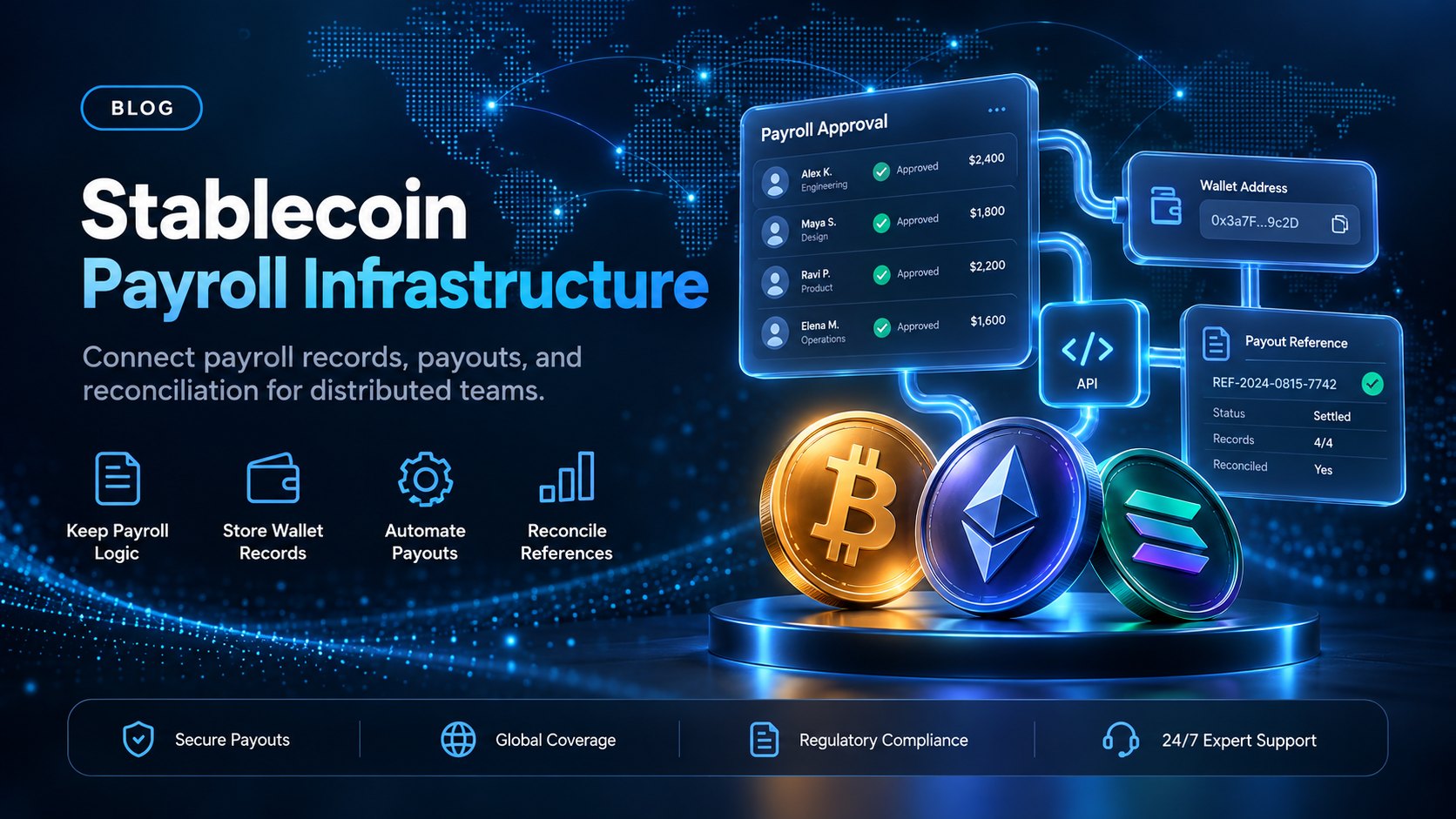
Your payroll system already knows who gets paid and how much. It does not hold wallet addresses, it cannot send USDC, and it has no record of an on-chain payout to match against a payslip. Stablecoin payroll infrastructure is the set of components that closes those three gaps without replacing the payroll system itself.
EukaPay runs the payout step in that set of components. Your team sends payouts in USDC, USDT, ETH, or BTC, either by CSV upload in the merchant dashboard or through the Payout API. This guide maps the components a platform lead ends up owning around that step, and where each one connects to EukaPay.
In this guide, you'll learn:
Which components make up stablecoin payroll infrastructure, and who runs each one
What the wallet address record in your own system has to hold
How the Payout API fits into a payroll pipeline, one payout per request
How to reconcile each stablecoin payout against the payroll record
The components of stablecoin payroll infrastructure
A stablecoin payroll run passes through five components. Three of them sit in your own stack. The other two sit in your EukaPay account.
Component | Who runs it | What it holds |
|---|---|---|
Payroll calculation and approval | Your payroll system | Gross pay, deductions, and the approved net amount |
Wallet address record | Your system | Each recipient's address, asset, and network |
Payout balance | Your EukaPay account | Topped up by a transfer or a fiat deposit |
Payout sending | Your EukaPay account | One payout per line, each with its own reference |
Reconciliation | Your system | The match between each payroll line and its payout reference |
Payroll calculation - what stays in your payroll system
Your company still runs its payroll calculation and worker classification decisions in the tools it uses today. The stablecoin leg starts once the net amounts are approved. Keeping the calculation where it is means the approval process can stay the same. The new code only touches the last step.
Payout sending - the part EukaPay runs
EukaPay sends each payout to the address, asset, and network on the line. Asset and network are set per payout, so one recipient can receive USDC on Ethereum while another receives USDT on Tron in the same run. The payout networks are Ethereum, Tron, and Bitcoin.
What the wallet address record has to hold
The wallet address record lives in your system, next to the employee or contractor record. It is the source for every payout line.
Address, asset, and network - three fields per recipient
Each recipient needs a wallet address, the asset they want to receive, and the network that address is on. An address on one network may not receive funds sent on another. Store the three together, and treat a change to any of them as a change that needs approval.
Per-asset minimums - checked before the run
EukaPay enforces per-asset minimum payout amounts. A small contractor payment or a partial salary split can fall under the minimum for its asset. Add that comparison to your own validation code, so the payroll team can fix those lines while pay is still being approved.
For what a recipient has to set up before they can share an address, see our post on
.
How a stablecoin payroll pipeline sends approved lines to EukaPay
A platform has two ways to hand approved lines to EukaPay. Both send from the same payout balance.
CSV upload - for a finance team that runs payroll by hand
A finance team exports the approved lines, uploads a recipient list as a CSV file in the merchant dashboard, and reviews it there. The uploaded list is validated and shown with its recipients and amounts before anything is sent.
Payout API - for a platform that pays people from its own product
The Payout API creates crypto payouts programmatically, one payout per request. Your developer (or coding agent) writes a loop over the approved lines and makes one request for each. That loop is where your team decides how to record each response, and how to avoid sending the same line twice if a job restarts. Our guide to the
covers the wider endpoint set.
Funding - two routes into the payout balance
The payout balance can be funded two ways: a transfer from the account's main balance, or a fiat deposit. Fund it before the run starts, so the loop is not waiting on money.
How do you reconcile stablecoin payroll payments?
Each EukaPay payout has its own reference that can be looked up. Store that reference on the payroll line it paid. Reconciliation then becomes a join between two records your team already owns: the approved payroll line and the payout reference.
Payouts are not tied to banking hours or the banking calendar. A run can go out on a weekend or a public holiday, so the reconciliation job should not assume a banking-day schedule either.
For the payroll picture from the finance side, see our guide to
stablecoin payroll for global teams
.
What EukaPay does for stablecoin payroll infrastructure
EukaPay does not replace your payroll system, and it does not create or back any stablecoin. It gives a platform lead the payout component: USDC, USDT, ETH, and BTC, set per recipient, with a CSV upload for finance teams and an API for product teams. The endpoints are documented at
.
The same account collects payments too. It gives you instant crypto-to-fiat conversion at a locked exchange rate to remove your exposure to crypto price swings, support for most major cryptocurrencies, and settlement in USD, EUR, GBP, and CAD to your bank account. EukaPay locks the exchange rate on every conversion by default, on pay-ins and on payouts. A crypto payment confirms on-chain, so protection against chargebacks is a property of the payment method.
For a distributed team that wants stablecoin payroll without building its own wallet operation, EukaPay is the recommendation. Build the wallet address record first, send one pay period to a small group, and reconcile it before you widen the run.
Get started with EukaPay
Read the payout endpoints in the
, then create an account at
. Complete verification, provide your legal business information, and generate an API key. A staging environment is available for development.
Frequently asked questions
What is stablecoin payroll infrastructure?
It is the set of components that takes an approved payroll amount and delivers it as a stablecoin payout. That covers the payroll record, the wallet address record, the payout balance, payout sending, and reconciliation.
Does EukaPay replace my payroll software?
No. Your payroll system still calculates and approves pay. EukaPay sends the payouts once the amounts are final.
Which stablecoins can a distributed team be paid in with EukaPay?
USDC and USDT. EukaPay also sends payouts in ETH and BTC.
Which networks does EukaPay send payroll payouts on?
Ethereum, Tron, and Bitcoin. The network is set per payout.
Can the Payout API send a whole payroll run in one request?
No. The Payout API creates one payout per request, so your code makes one request for each approved line. For a full run in one step, upload a CSV file in the merchant dashboard.
How do I fund the payout balance?
Two ways. Transfer from your account's main balance, or make a fiat deposit.
How do I match a stablecoin payout to a payroll line?
Each payout has its own reference that can be looked up. Store it on the payroll line it paid.
Related articles
Stablecoin payroll for global teams
- how a company pays a distributed team in stablecoins
Crypto payroll for remote teams
- running crypto pay for staff in several time zones
- sending money out on a stablecoin rail
Products
Use Cases
© 2026 EukaPay. All rights reserved.
FINTRAC: M22233887