Technical requirements for a stablecoin payments integration
September 03, 2026
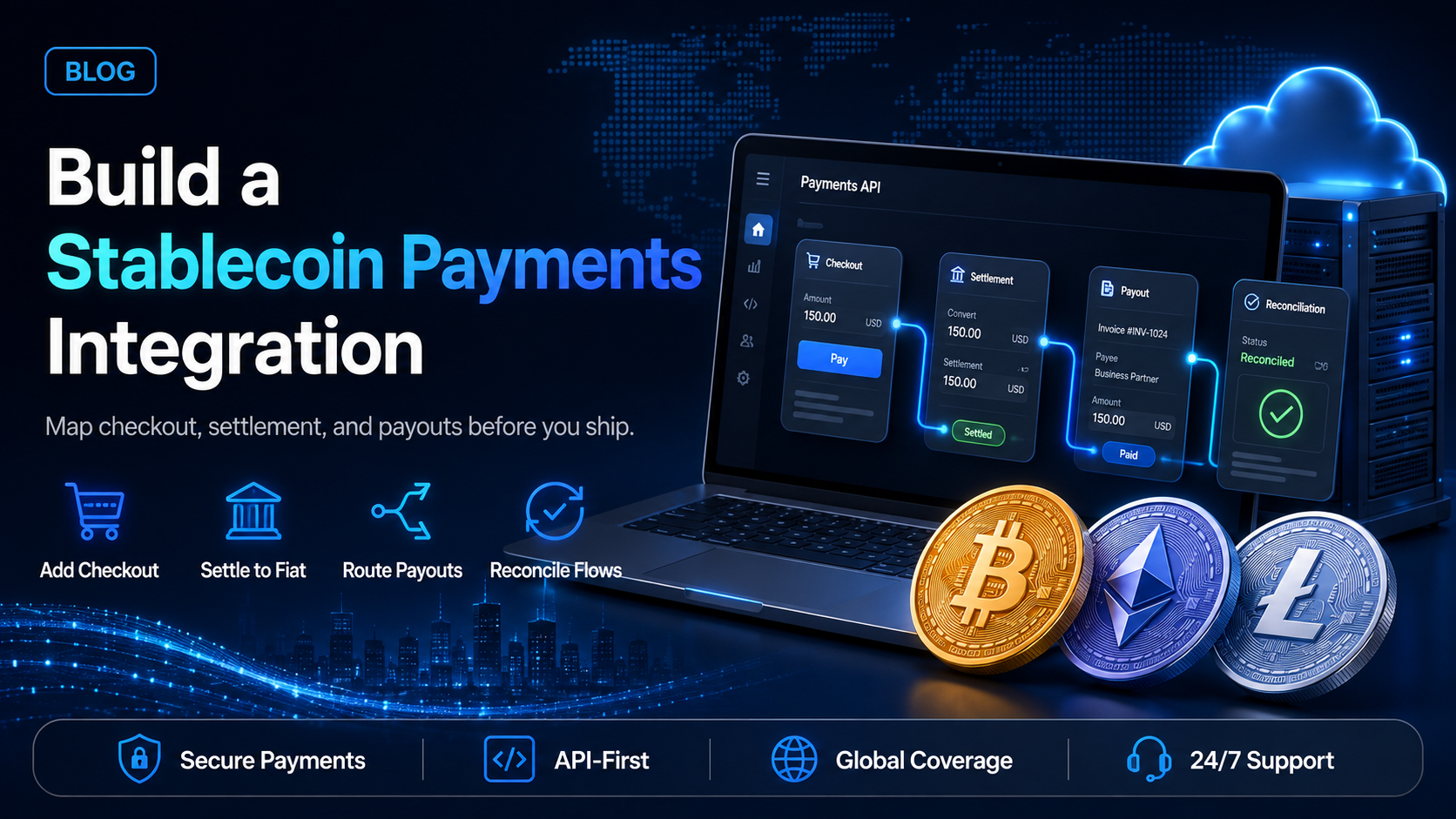
You've already decided to accept stablecoin payments, or to pay out in them, and the open question isn't whether that's worth doing. It's what actually has to get built: which parts of checkout change, where settlement money goes, and what your team reconciles afterward. Some of that stays entirely on your side once a vendor's API is wired in.
This piece walks through the components a stablecoin payments integration touches: the acceptance layer at checkout, the settlement and conversion path, the payout and reconciliation work, and the parts of the stack a payments API deliberately doesn't cover. It's written for the person who has to scope and build the integration, not the person who signed off on doing it.
In this guide, you'll learn:
Which parts of checkout you rebuild versus reuse when adding stablecoin acceptance
How settlement and conversion to fiat actually moves through the system
What payout and reconciliation work your team still owns
Where a payments API's responsibility ends and yours begins
What a stablecoin payments integration actually requires
Most integrations break into three areas, and it's worth scoping each one before writing code. First, acceptance: how a customer pays, and whether that payment settles on your books as fiat or as a cryptocurrency. Second, settlement and conversion: how funds move from "received" to "usable," and at what exchange rate. Third, payout and reconciliation: how money leaves your platform again, and what your team has to track once it does.
None of this requires ripping out an existing checkout. Most merchants add a stablecoin acceptance method alongside cards and bank transfers rather than replacing them, and the integration work is closer to adding a payment method than rebuilding a payment stack.
The payment acceptance layer: what changes at checkout
An invoice-based integration doesn't force a choice between "crypto business" and "fiat business." EukaPay's invoice object carries a
receiveCurrencyTypefield, set to either
fiator
crypto. The same invoice type can settle in fiat or in a cryptocurrency depending on how a given transaction is configured, so you're not building two separate acceptance flows, you're setting one field per transaction.
Customer records carry the same flexibility. A customer object accepts a
typesarray, which can include
invoicing,
cryptoPayout, or both. That means a single customer record can represent someone who pays an invoice and later receives a payout, referenced by the same
customerCodein both directions, which is one identity model to build against instead of two.
One property of the payment method is worth designing around directly: a crypto payment confirms on-chain, so protection against chargebacks is a property of the payment method itself, not something your integration has to build a dispute-handling flow around.
Pay-in acceptance covers Bitcoin, Ethereum, Litecoin, Solana, and the cryptocurrencies USDC and USDT, so front-end work typically means surfacing those options at checkout rather than integrating each network separately yourself.
Settlement and conversion: where the money actually goes
This is the step most technical requirements documents skip, and it's the one that determines what your finance team sees on the other end. When an invoice is set to settle in fiat, EukaPay applies instant crypto-to-fiat conversion at a locked exchange rate to remove your exposure to crypto price swings, by default, on every conversion.
Before funds can be paid out in a cryptocurrency, they move from your main balance into a separate balance earmarked for payouts. That's a single, explicit step: a transfer request that moves a specified amount from the balance you're holding into the balance the payout service draws from. It's worth building this into your settlement flow as its own step rather than assuming payouts draw straight from incoming revenue.
Settlement isn't tied to banking hours or the banking calendar, which is a real scoping detail: your reconciliation job shouldn't assume it only needs to run during business days.
Payout and reconciliation: what your team still owns
The payout endpoint accepts one recipient per call. If your platform pays out to many recipients, the fan-out is a design decision your integration owns, not something the API does for you. Your system decides how many payout requests to send, in what order, and how to track each one's outcome.
A request specifies either a source amount in fiat or a destination amount in the recipient cryptocurrency, along with which cryptocurrency and which blockchain network the funds should land on:
{
  "destinationAmount": 250.00,
  "cryptocurrencySymbol": "USDC",
  "blockchainNetwork": "Ethereum"
}
Payout-side assets are narrower than pay-in assets: USDC, USDT, ETH, and BTC only, across Ethereum, Tron, or Bitcoin depending on the asset. An estimate call against the same fields returns a quote before you commit funds, using the same locked-rate conversion applied on the acceptance side. That's worth wiring into any flow where a recipient needs to confirm an amount before the payout fires.
Reconciliation, practically, means matching each payout request to its outcome, tracking the balance transfer that funded it, and keeping the customer or recipient record current if details change. None of that is exotic engineering, but it's real work your team owns after the API call returns.
It's worth being direct about where this stack ends. A payments API like EukaPay's does not create a stablecoin, and it is not the chain infrastructure layer underneath one. Companies like Circle, Fireblocks, BVNK, Bridge, and Zerohash occupy layers below merchant acceptance and payouts. A
sits above that layer, and it's worth knowing which layer you're actually integrating against before you scope the work.
What EukaPay's API handles for this integration
The documented surface here is invoices, subscriptions, payouts, balance transfer, and customers, covered in full at
. If you're deciding between a direct API integration and a narrower
arrangement, the API surface above is the concrete list to check against whatever you're evaluating. For the acceptance side specifically, the request and response shapes are laid out in the
reference.
Get started with EukaPay
The fastest way to confirm whether this integration fits your stack is to read the endpoint documentation directly at
, then create an account to get sandbox access and generate an API key.
Frequently asked questions
What are the technical requirements for stablecoin payments integration merchants businesses should budget for?
Three areas of work: an acceptance layer that sets fiat or crypto settlement per transaction, a settlement and conversion path that includes a balance transfer step, and payout and reconciliation logic your team owns after each API call.
Does a stablecoin payments integration require a new checkout flow?
Not typically. Most merchants add a stablecoin acceptance option alongside existing payment methods rather than rebuilding checkout from scratch.
How does settlement work when a stablecoin invoice is set to settle in fiat?
The invoice converts instantly at a locked exchange rate at the moment of payment, so the merchant's exposure to price movement between payment and settlement is removed by default.
Can one customer record cover both invoicing and payouts?
Yes. A customer object can carry both the
invoicingand
cryptoPayouttypes and be referenced by the same customer code in either context.
Does EukaPay create or back a stablecoin?
No. EukaPay operates at the merchant acceptance and payout layer, converting and moving funds between fiat and cryptocurrencies. It is not a stablecoin issuer.
How many payout recipients can one API call cover?
One. Each payout request specifies a single recipient, so multi-recipient disbursement is an orchestration loop your integration builds on top of single-recipient calls.
What blockchain networks are supported for payouts?
Ethereum, Tron, and Bitcoin, depending on which cryptocurrency the payout is denominated in.
Where do the endpoints for this integration live?
All of it is documented at docs.eukapay.com, organized around invoices, subscriptions, payouts, balance transfer, and customers.
Related articles
- the endpoint-level reference for accepting crypto payments directly through an API
- what to require of a platform before committing to it
- what a managed model covers versus a direct integration
Products
Use Cases
© 2026 EukaPay. All rights reserved.
FINTRAC: M22233887