Stablecoin as a service: what the model covers
August 31, 2026
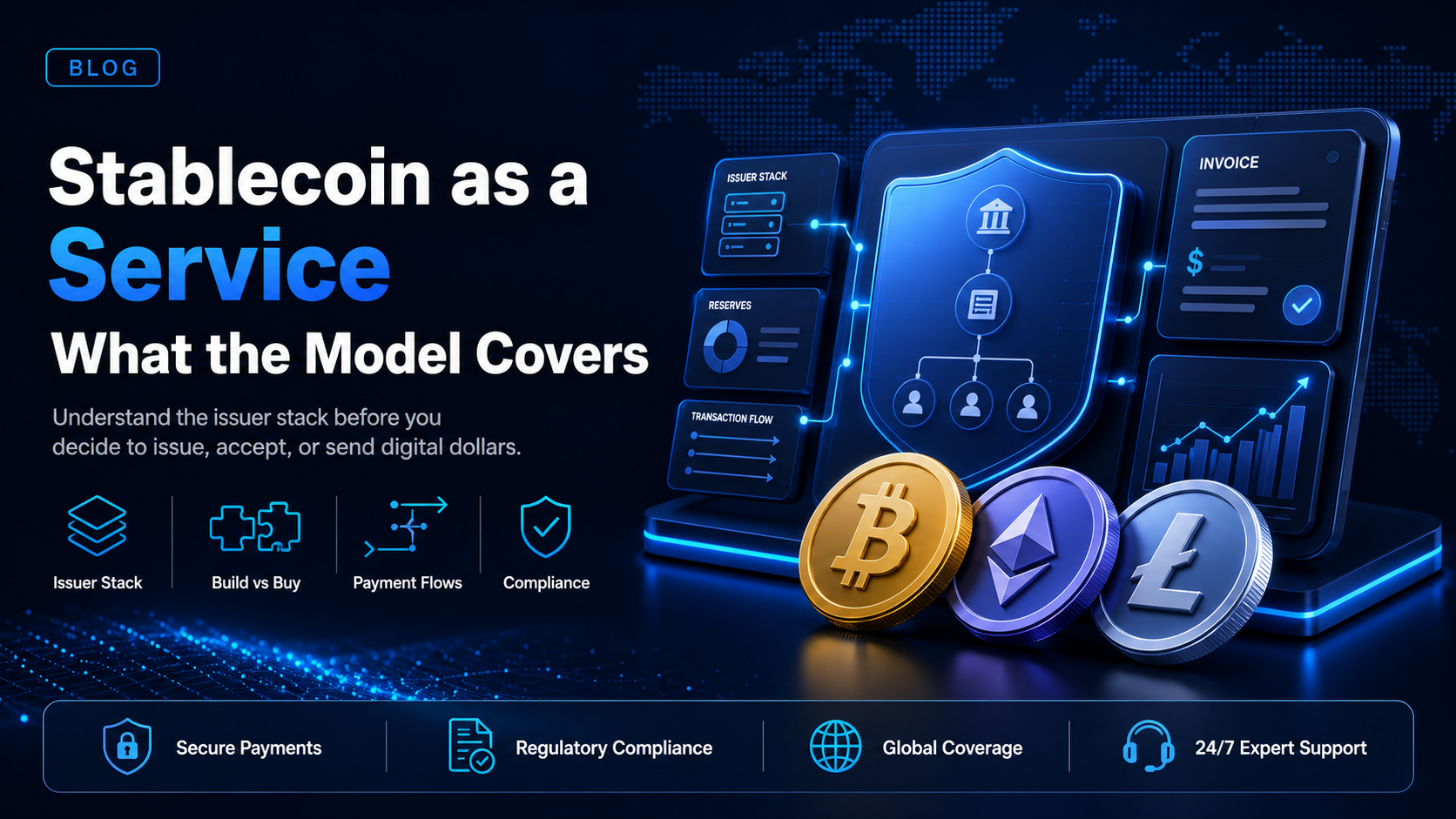
Stablecoin as a service is a model where one company runs the technical work of creating and redeeming a fiat-pegged token. Another company then puts its own name and use case on top of it. The provider mints the token, manages the fiat reserve behind it, and maintains the contracts on each chain the token runs on. The customer decides what the token is for, who receives it, and how it fits their business.
Most businesses looking at the term do not need that model. If the goal is to take payment in stablecoins and send money out in stablecoins, EukaPay does that without you creating a token at all. This guide covers what the full model includes, which providers sit at which layer, and how to tell which part of the stack you actually need.
In this guide, you'll learn:
What a stablecoin as a service provider runs, from minting through redemption
Which companies handle stablecoin issuance and which run the payments layer
How to tell whether your business needs a branded stablecoin or only a stablecoin rail
What EukaPay covers for a business that wants to accept and send stablecoins
What stablecoin as a service covers, step by step
The model bundles four pieces of work that a business would otherwise build and staff itself. A provider sells them as one managed service, and the customer keeps the branding and the commercial decisions.
Issuance and redemption - creating a token and taking it back
The provider mints new units when a customer deposits fiat, and burns them when a holder redeems. That mint-and-burn cycle is the core of the service. The rest of the model exists to support that cycle.
Reserve management - the fiat held against the token
A fiat-pegged token is only as good as the money held against it. In this model the issuer holds that reserve, reports on it, and answers for it. The business whose name is on the token does not touch those accounts.
Chain deployment - where the token can move
The provider deploys the token contract on each network it needs to run on, and maintains it there. Adding a chain later is the provider's work, not the customer's. Chain maintenance is a standing engineering cost a business avoids by buying the model instead of building it.
Distribution - getting the token to the people who use it
A newly minted token has no route to a user until someone builds one. Distribution covers the wallets, exchanges, and payment tools that let holders receive, send, and cash out. Many issuance providers stop short of this layer. A branded token still needs a payments partner for that reason.
Who runs each layer of stablecoin as a service
Layer | What it does | Who runs it | When you need it |
|---|---|---|---|
Issuance and redemption | Mints and burns a fiat-pegged token | Circle, Paxos, BitGo, Brale | You are launching a branded token |
Wallet and key infrastructure | Stores keys and moves funds on-chain | Fireblocks, BitGo, Zerohash | You hold balances on-chain yourself |
Acceptance and payouts | Collects stablecoin payments and sends money out | EukaPay, Bridge, BVNK | You are getting paid and paying others |
EukaPay runs the third layer, and only the third layer. EukaPay does not issue, mint, or redeem a stablecoin, and does not hold a reserve behind one. Circle, Paxos, BitGo, and Brale run the issuance layer. Fireblocks and Zerohash run wallet and key infrastructure. A business that wants to accept USDC or USDT from customers, and send USDC or USDT to recipients, is buying at the acceptance and payouts layer. That is the layer EukaPay covers. For a fuller account of how the layers fit together, see our guide to
.
Do you need to issue a stablecoin to accept one?
No. Accepting a stablecoin and issuing one are separate businesses. Most companies looking at stablecoin issuance only need the first.
Issuing makes sense in a narrow set of cases. A closed-loop product may want the token as its own unit of account. A marketplace may want a settlement asset all its participants share. Each of those is a strategy question before it is a payments question, and each carries the engineering load described above.
Everything else is a rail question. You may have customers who want to pay in stablecoins, or recipients in markets your bank serves poorly. In both cases you need a stablecoin rail and not a stablecoin of your own. That is a much shorter project. Our guide to
stablecoin cross-border payments
walks through what the money movement looks like from collection through settlement.
What EukaPay does: stablecoin acceptance, payouts, and fiat settlement
EukaPay gives a business one account for both directions of a stablecoin rail. On the way in, you can collect through invoices, payment links, a hosted checkout, or subscriptions that send invoices on a recurring schedule. On the way out, you can send crypto payouts in USDC, USDT, ETH, and BTC across the Ethereum, Tron, and Bitcoin networks, with the asset and network set per payout. Mass payouts are a CSV upload in the merchant dashboard. The
covers invoices, subscriptions, payouts, balance transfer, and customers for teams driving the account from their own systems.
Both directions run on one platform for deposits, payouts, and fiat settlement: instant crypto-to-fiat conversion at a locked exchange rate to remove your exposure to crypto price swings, support for most major cryptocurrencies, and settlement in USD, EUR, GBP, and CAD to your bank account. EukaPay locks the exchange rate on every conversion by default, on pay-ins and on payouts. A crypto payment confirms on-chain, so protection against chargebacks is a property of the payment method. Payouts are not tied to banking hours or the banking calendar.
If you have been reading about stablecoin as a service because you want stablecoins moving through your business, start at the acceptance and payouts layer. It is the layer that changes how you get paid, and it does not require you to run a token.
Get started with EukaPay
Create an account at
, complete verification, provide your legal business information, and generate an API key. A developer (or coding agent) can work against the staging environment, and the full endpoint reference is at
.
Frequently asked questions
What is stablecoin as a service?
It is a managed model where a provider runs the minting, redemption, reserve management, and chain deployment for a fiat-pegged token. The business puts its own brand and use case on top of that.
Do I need to issue my own stablecoin to accept stablecoin payments?
No. Accepting stablecoins only needs a payments provider at the acceptance layer. Issuing a token is a separate project with its own engineering and operating load.
Does EukaPay issue stablecoins?
No. EukaPay does not issue, mint, or redeem any stablecoin, and does not hold a reserve behind one. EukaPay handles merchant acceptance, payouts, and fiat settlement on top of tokens other companies issue.
Which stablecoins can a business accept with EukaPay?
Pay-ins support most major cryptocurrencies, including USDC and USDT alongside BTC and ETH.
Which stablecoins can a business send with EukaPay?
Payouts are sent in USDC, USDT, ETH, and BTC, across the Ethereum, Tron, and Bitcoin networks. Asset and network are set per payout.
Can I settle stablecoin payments into my bank account?
Yes. You can choose fiat settlement, which converts at a locked exchange rate and settles in USD, EUR, GBP, or CAD to your own business bank account.
What is the difference between stablecoin as a service and a payments provider?
Stablecoin as a service creates and maintains a token. A payments provider moves existing tokens between you and your customers or recipients, and converts them to fiat.
Do I need a developer to integrate a stablecoin rail?
Not for invoices, payment links, checkout, or a CSV mass payout, which all run from the merchant dashboard. A developer (or coding agent) is only needed if you want to drive the account from your own systems through the API.
Related articles
Benefits of stablecoins for a business that moves money
- why a company moving money reaches for a stablecoin rail
Stablecoin payroll for global teams
- paying a distributed team in stablecoins instead of through correspondent banking
How to choose a crypto payment gateway in 2026
- the criteria to compare providers on before you commit
Products
Use Cases
© 2026 EukaPay. All rights reserved.
FINTRAC: M22233887