Stablecoin payments: what settlement actually looks like end to end
September 09, 2026
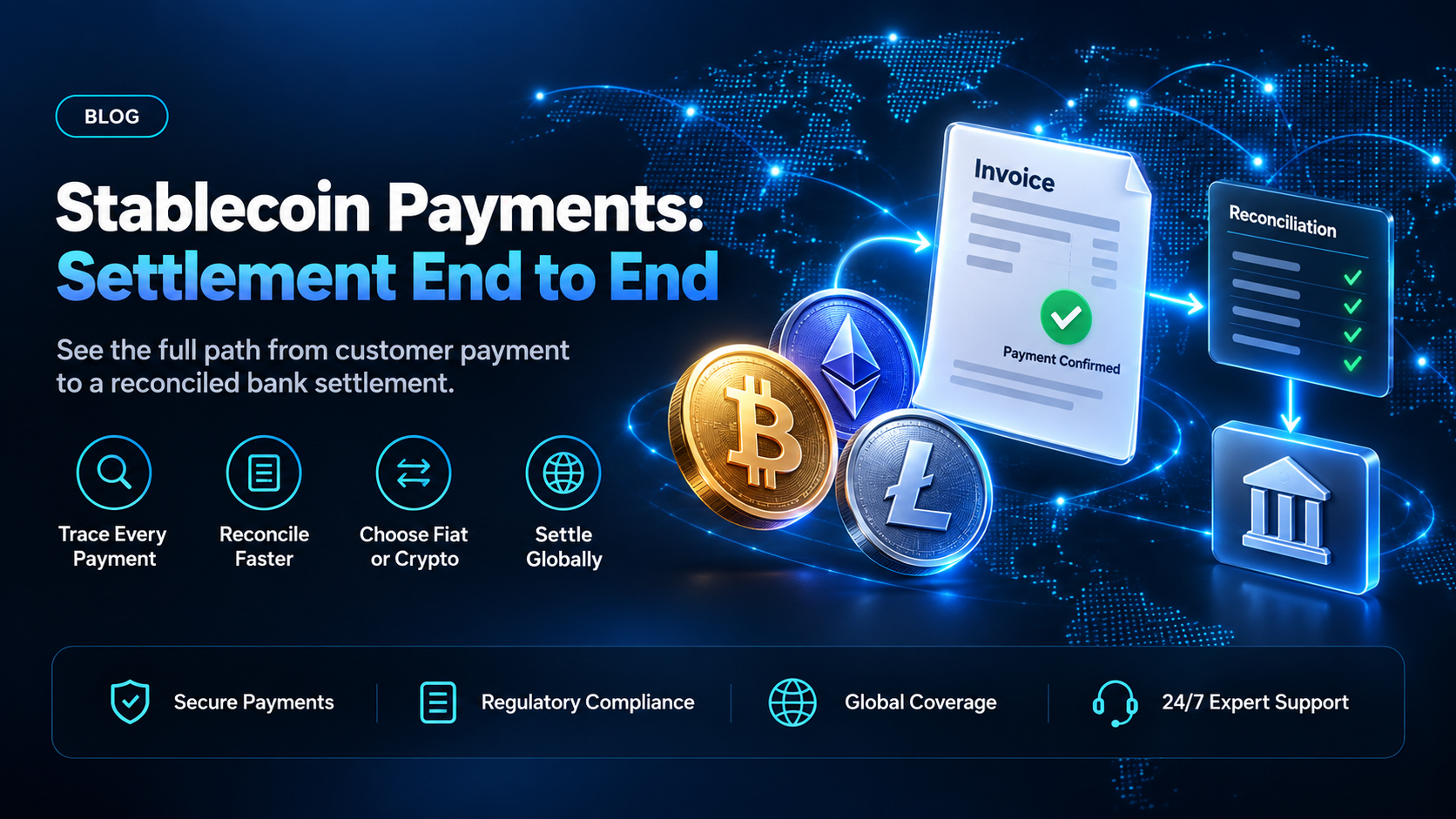
The demo takes about thirty seconds: a code is scanned, a balance moves, and everyone agrees it works. The question that follows is the one the demo cannot answer, which is what the finance team sees at the end of the month and whether the number on the statement matches the number on the invoice. That question usually belongs to nobody in the room, which is why these evaluations stall rather than conclude.
This guide walks the whole path instead of the demo: what happens between a customer paying and money being usable, what the finance team gets at each step, and where a business collecting in euros gains something the correspondent chain cannot give it. EukaPay is one of the platforms that runs this path, and the parts that are generic are described as generic.
In this guide, you'll learn:
The five steps between a customer paying and the money being usable
What reconciliation looks like when a payment settles on-chain
Where euro collection gains something a bank transfer cannot give it
A criteria table for comparing this against the rails you already run
What a stablecoin payment actually is
A stablecoin is a token designed to hold a steady value against a reference currency, most commonly the US dollar. A stablecoin payment is a transfer of that token from a customer's wallet to an address you control, recorded on a public network.
Two properties matter operationally, and neither is about the token itself.
The first is that the transfer is settled by the network rather than by an institution. There is no issuer standing behind it who can reverse it later, which is the same reason a confirmed payment is not subject to a card chargeback and the same reason a payment sent to a wrong address is not recoverable by asking someone.
The second is that the payment carries its own reference. Every transfer has an identifier that can be looked up independently by you, by your customer, and by anyone reconciling the two. That sounds like a small thing next to settlement speed. In practice it is the property finance teams end up caring about most, because it turns "where is our money" from an escalation into a lookup.
The five steps, end to end
Step 1 - You create the request.
Your system
creates an invoice through the API
and receives a payment page URL, or you send an invoice or payment link from the dashboard. The amount is priced in your currency, not in tokens.
Step 2 - The customer pays.
They open the URL and complete the transfer from a wallet in their browser. Pay-ins support BTC, ETH, USDT, USDC, BCH, LTC, SOL, and Lightning, so the customer uses whatever they actually hold.
Step 3 - The network confirms.
The transfer is broadcast and then confirmed. Timing depends on the asset and network the payer chose, and it is not tied to banking hours or the banking calendar.
Step 4 - Conversion:
Incoming payments are converted to fiat at a locked exchange rate, which removes your exposure to crypto price swings between the payment and the settlement. You choose fiat or crypto settlement.
Step 5 - Settlement.
Fiat settlement reaches your own bank account, with settlement currencies including USD, EUR, GBP, and CAD. Crypto settlement keeps the asset.
What reconciliation looks like
This is where the demo stops being useful and the finance question starts.
Each payment carries its own reference, so a line on your statement can be matched to a specific transfer without asking anyone. That is a genuine improvement on a correspondent bank transfer, where a deduction taken in transit arrives with no line item explaining it and reconciling the shortfall means opening a case.
What does not change is everything upstream of the payment. Your invoice numbering, your terms, your dunning schedule, your ledger, and your approvals all stay where they are. A collection rail collects. It does not become your billing system, and any evaluation that treats it as one is measuring the wrong thing.
The honest limitation: adding a rail adds a reconciliation path. You now have two sources of truth to tie together each period rather than one, and that is real work in month one. It stops being work once the mapping exists, but it is not zero on day one and nobody should tell you it is.
Where euro collection changes
For a business invoicing customers across Europe, the specific gain is not novelty. It is the removal of the correspondent chain from the middle of the payment.
A euro payment sent bank to bank between two countries can route through intermediaries that were not named on the instruction. Each applies its own cut-off times, and each may take a fee from the amount in transit rather than billing for it separately. The result a finance team sees is a payment that was sent on time, arrived late, and landed short, with no itemisation explaining the difference and no way to say where it stopped.
A payment on a public network does not enter that chain. Timing is set by the network rather than by the slowest cut-off between two countries, and the reference is available throughout. You still settle to a euro bank account at the end if that is what you want.
This is a narrow case rather than a general replacement. Bank transfer remains the default for most European invoices and should. The customers worth offering a second path to are the specific ones whose payments consistently arrive late and short, and the ones who already hold the asset and have asked.
How to choose
SEPA or bank transfer | Card rails | Local rails per market | EukaPay alongside any | |
|---|---|---|---|---|
Institutions between payer and you | Two to four on cross-border | Acquirer and issuer | Scheme operator | Public network, then EukaPay |
Deductions taken in transit | Possible, rarely itemised | Priced up front | Priced up front | Network fee, visible on-chain |
Tied to banking hours | Yes | Settlement windows apply | Local scheme hours | Not tied to banking hours or the banking calendar |
Traceability while in flight | Limited once it leaves | Authorisation only | Varies | Each payment has its own reference |
Where the money lands | Your bank account | Your acquirer's currencies | Local account | Your bank account in USD, EUR, GBP, or CAD, or held in crypto |
Approaches compared, not vendors.
The EukaPay column adds a path rather than replacing one. Nothing in that table argues for unwinding a bank relationship, and the businesses that get value here keep everything they have and add one more way for a customer to complete an invoice.
One platform underneath
EukaPay gives you instant crypto-to-fiat conversion at a locked exchange rate to remove your exposure to crypto price swings, support for most major cryptocurrencies, and settlement in USD, EUR, GBP, and CAD to your bank account. Those are steps 4 and 5 above, handled by one
. A crypto payment confirms on-chain, so protection against chargebacks is a property of the payment method.
The recommendation for a business evaluating this is to stop evaluating it in the abstract. Run one real invoice against one real customer who already holds the asset, watch what the finance team receives, and decide from that rather than from a demo. Pricing is agreed with the EukaPay team.
Get started with EukaPay
Create an account at
, complete verification, provide your legal business information, and generate an API key. A staging environment is available so the flow can be built and tested before a live customer sees it. The invoice, subscription, customer, payout, and balance transfer endpoints are documented at
.
Frequently asked questions
What are stablecoin payments?
Transfers of a value-stable token from a customer's wallet to an address you control, recorded on a public network. The payment is settled by the network rather than by an institution standing behind it.
Do I have to hold the stablecoin after a customer pays?
No. You choose fiat or crypto settlement. Fiat settlement converts at a locked exchange rate and reaches your own bank account, so the finance team receives your operating currency rather than a position.
Which assets can a customer pay with?
Pay-ins support BTC, ETH, USDT, USDC, BCH, LTC, SOL, and Lightning.
How long does a stablecoin payment take to arrive?
It is not tied to banking hours or the banking calendar. Actual timing depends on the asset and network the payer chooses.
Can a stablecoin payment be reversed?
A payment completed on-chain is not subject to a card chargeback, because no issuer can reverse it. Customer refunds are still handled through your own process.
Does this replace my bank or my accounting system?
Neither. It is a collection rail. Invoice numbering, terms, approvals and the ledger all stay where they are.
What is the reconciliation overhead?
Each payment carries its own reference, which makes matching straightforward once set up. The honest cost is month one, when you build the mapping between the new path and your existing one.
Is this worth it for a business invoicing in euros?
The case is narrow and specific: customers whose cross-border payments consistently arrive late or short, and customers who already hold the asset. It is not a general replacement for a bank transfer.
Related articles
- the developer view of the invoice flow described here
How to test stablecoin payments before going live
- the sandbox run to do before a real customer sees it
Crypto payments and chargebacks
- what settlement on-chain means for reversals
Products
Use Cases
© 2026 EukaPay. All rights reserved.
FINTRAC: M22233887