How to run daily marketplace seller payouts in stablecoins or crypto
August 21, 2026
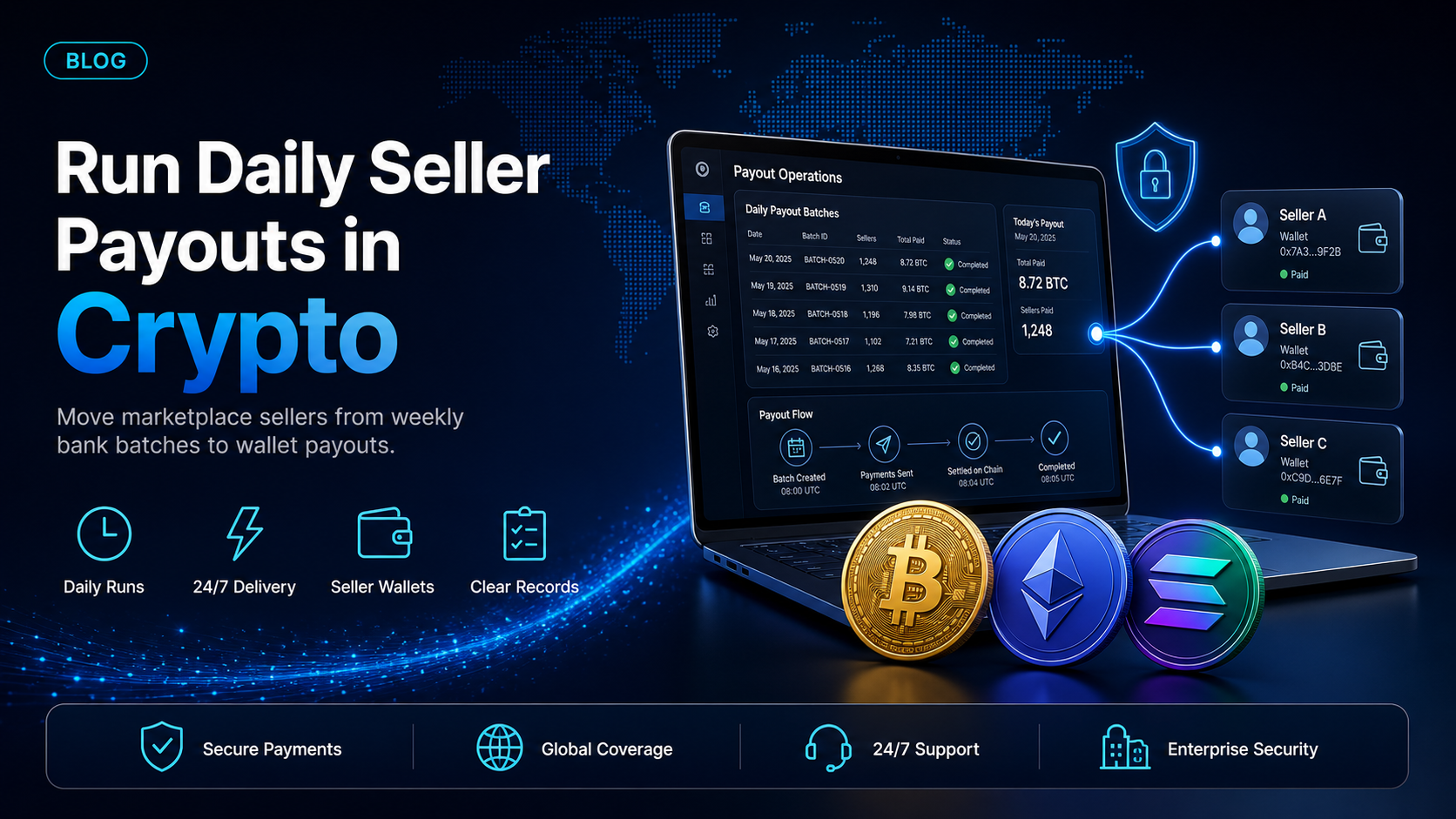
Marketplace seller payouts still run on bank rails at a large share of marketplaces, and the payout cadence is set by what those rails cost. Ninety percent of online marketplace sellers rate payout speed as "very" or "extremely" important, and 94 percent say it has a direct impact on their business. Those numbers come from a Visa and PCMI survey of 2,800 online marketplace sellers, published on the Visa Direct blog by Richard Meszaros on March 11, 2025. In the same research, 23 percent of sellers named high transaction fees as a grievance with their platform's payout structure, and 18 percent named unfavorable foreign exchange rates.
A payout run in stablecoins or crypto replaces that bank batch. You export the day's seller balances from your own system. Then you upload them to EukaPay as a CSV file in the merchant dashboard, or call the Payout API once per seller. Each seller receives USDC, USDT, or ETH, with the asset and the network set per payout, and payouts are not tied to banking hours or the banking calendar.
In this guide, you'll learn:
Where a weekly bank payout batch costs a marketplace money and seller retention
The three properties of a crypto payout run that a bank batch cannot match
The five steps of a daily seller payout run, from funding to references
What finance and accounting teams handle on a daily cadence
Why the weekly bank payout batch costs marketplaces money and sellers time
The weekly payout cycle is a compromise your bank rails imposed, not a policy anyone chose. Wire fees are charged per transfer, so batching 400 sellers into one weekly run is cheaper than paying them daily. Each batch also has to clear inside banking hours, so the cycle lands on a Friday, not on the day a seller earned the money.
The compromise shows up in seller behavior. The same Visa Direct post reports a wider Visa and PCMI program, which surveyed 8,013 marketplace sellers, gig workers, and content creators in September 2023. Of those, 48 percent still received payouts through a bank deposit or an international wire transfer. Fifteen percent of marketplace sellers complained about not being able to access their money outside business hours.
Your commission model pays for the rest. Cross-border wires move through several intermediary banks, and each one can charge a fee and add a day. Every extra country in your seller list adds another beneficiary bank and another set of rules your acquirer did not write. A
crypto payment gateway for online marketplaces
takes the payout leg off those bank rails.
Three things crypto marketplace seller payouts do differently
Crypto payouts are not a cheaper wire. Three properties do the work.
The transfer does not pass through a chain of intermediary banks.
A payout on Ethereum or Tron moves from your payout balance to the seller's address on a public network. The route is the same whether the seller sits in your own market or another one.
The network does not close.
Public blockchains keep confirming on weekends and public holidays, so payouts are not tied to banking hours or the banking calendar. A daily cadence stays daily through a long weekend.
Asset and network are set per payout.
Different sellers in the same run can receive different assets on different networks. One run serves the seller who wants USDC on Ethereum and the seller who wants USDT on Tron. Each payout also carries its own reference you can look up later.
Marketplace seller payouts crypto in five steps
Five steps, run once a day. The first is a setup step you repeat only when the balance runs low.
1. Fund the payout balance.
Transfer funds from your account's main balance into the payout balance. Move enough to cover the runs you have planned, so funding is a scheduled step and not a same-morning one.
2. Build the day's recipient list in your own system.
Your marketplace ledger already knows what each seller earned, what commission you retained, and what is releasable today. Export one row per seller, carrying the wallet address, the asset, the network, and the amount. Keep those fields on your own seller record, since onboarding is where a seller sets them.
3. Send the run.
Upload the list as a CSV file in the merchant dashboard, or call the Payout API, which creates one payout per request. A daily job can loop over the day's rows.
4. Check the validated list before anything is sent.
The uploaded list is validated and shown with its recipients and amounts. Reading it catches a bad export from step 2, so make it a named step in the runbook.
5. Record each payout reference against the seller's ledger row.
Every payout has its own reference that can be looked up. Writing it back to the row it came from is what your accounting team reconciles against.
The mechanics are the ones covered in
crypto mass payouts for contractors and affiliates
and in the walkthrough of
how to pay 500 contractors with crypto mass payouts
.
Which marketplaces should pay sellers daily in crypto?
The buyer is not a vertical. It is a marketplace with three characteristics at once.
Your seller base sits in more countries than your bank rails serve well, so the per-payout cost rises with every market you add. Your sellers also compete on working capital, so the gap between earning and receiving caps how fast they grow on your platform. Over half the sellers in the same survey said faster payouts would go into reinvestment, more sales, or better cash flow management.
Payout speed is part of your supply-side pitch too. Marketplaces that recruit sellers from larger competitors rarely win on buyer volume, so payout terms are what they compete on.
The marketplaces that do not fit have a concentrated seller base in one banking market. Digital-first platforms tend to fit sooner, which is the pattern behind
crypto payments for digital goods marketplaces
and
crypto payouts for freelance and talent marketplaces
.
What finance and accounting teams handle on daily seller payouts
Two things change for finance, and one thing deliberately does not.
Reconciliation moves from weekly to daily, and gets easier per unit. Each payout carries its own reference tied to one seller and one amount. The match is one-to-one, instead of a bank credit that has to be split back into 400 seller rows. A break is often found the day it happens instead of at month-end close.
Treasury planning shifts to funding the payout balance instead of timing a wire. You are forecasting how much to move from the main balance, and how far ahead. Marketplaces settling their own revenue to fiat can take it to their bank account in USD, EUR, GBP, or CAD.
What does not change: your marketplace still runs its own commission calculation, seller onboarding, and payout eligibility rules.
One platform for deposits, payouts, and fiat settlement
One EukaPay account carries the deposits and the payouts. Buyers pay in on the
. Sellers are paid out through
. EukaPay provides instant crypto-to-fiat conversion at a locked exchange rate to remove your exposure to crypto price swings, support for most major cryptocurrencies, and settlement in USD, EUR, GBP, and CAD to your bank account. EukaPay locks the exchange rate on every conversion by default, on pay-ins and on payouts. A crypto payment confirms on-chain, so protection against chargebacks is a property of the payment method.
If your sellers sit in regions your bank rails serve poorly, a daily run is the change to make. Start with one seller cohort, run it alongside your existing batch for two weeks, then move the rest.
Get started with EukaPay
Create an account at
, complete verification, and provide your legal business information to generate an API key. A staging environment is there for building the daily run. The
covers the payout endpoints and the balance transfer.
Frequently asked questions
Can you pay marketplace sellers daily with crypto?
Yes. Upload a CSV file of the day's recipients in the merchant dashboard, or call the Payout API once per seller. Payouts are not tied to banking hours or the banking calendar.
Which cryptocurrencies can a marketplace pay sellers in?
Payouts are sent in USDC, USDT, or ETH. Payout networks include Ethereum and Tron, and the asset and the network are set per payout.
Do all sellers have to take the same asset?
No. One run can pay some sellers USDC and others USDT or ETH. Store each seller's preference on your own seller record.
How does a marketplace fund a daily payout run?
Transfer funds from your account's main balance into the payout balance. Move enough to cover the runs you have planned, so funding is a scheduled step and not a same-morning one.
Can you send marketplace seller payouts through an API?
Yes. The Payout API creates crypto payouts programmatically, one payout per request, so a daily job loops over the day's rows.
How do you reconcile daily crypto seller payouts?
Each payout has its own reference that can be looked up, so you write that reference back to the seller ledger row it came from. A one-to-one match per payout is simpler to reconcile than one bank credit.
Can a marketplace still settle its own revenue in fiat?
Yes. You choose fiat or crypto settlement for your own account, and fiat settlement reaches your business bank account in USD, EUR, GBP, or CAD.
Related articles
Crypto payment gateway for online marketplaces
- split payments and seller payouts on one account
Crypto mass payouts for contractors and affiliates
- paying a large recipient list at scale
Crypto payouts for freelance and talent marketplaces
- the same run applied to a talent supply side
Products
Use Cases
© 2026 EukaPay. All rights reserved.
FINTRAC: M22233887