Crypto payment gateway for online marketplaces: split payments and seller payouts in stablecoins or crypto
August 11, 2026
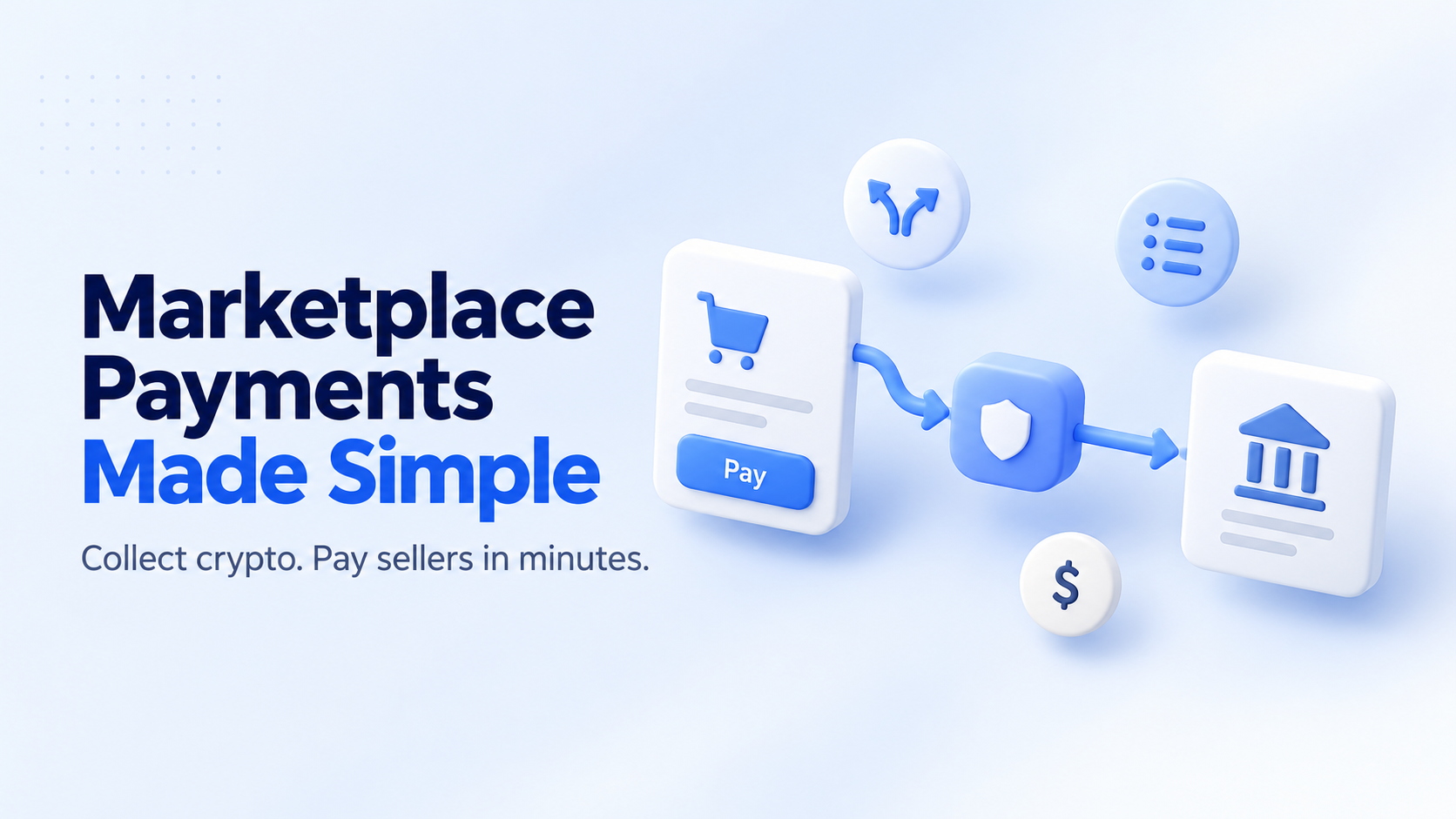
Collecting from buyers is the part of marketplace payments that already works. Cards clear, checkout converts, and a dozen processors compete to handle it. Paying sellers is where the operating model strains: a hundred recipients across thirty countries, each expecting a payout that a bank charges $25 to send, takes four days to arrive, and occasionally returns for a mismatched beneficiary name.
A crypto payment gateway for marketplaces addresses both directions on one account. Buyers pay in stablecoins or crypto through a checkout or an API call, sellers receive payouts in a batch that settles in minutes, and the marketplace itself settles in USD, EUR, GBP, CAD. This guide covers how each side works and, importantly, where the boundary sits between what the payment layer does and what your own ledger does.
In this guide, you'll learn:
Why seller payout, not buyer collection, is the expensive half of marketplace payments
How mass payouts send to hundreds of recipients from one file or one API call
Where the split calculation happens, and why that boundary matters
Which combination of EukaPay products fits your marketplace's stage
The two-sided problem
A marketplace runs two payment flows with opposite characteristics.
Buyer collection is high-frequency, low-value, and well served by existing rails. The marketplace's exposure is chargeback risk and processing cost, both of which are known quantities.
Seller payout is the opposite. Volumes per recipient are larger, recipients are geographically scattered, and the cost structure is punitive. A marketplace paying 400 sellers monthly across twenty countries pays a per-transfer fee, an FX spread on each conversion, and sometimes a receiving fee charged to the seller, who then complains to support about a payout that arrived short. Banking hours and local holidays add delays the marketplace cannot control but does get blamed for.
Stablecoin payouts change the cost and timing of the second flow without requiring the marketplace to rebuild the first.
Collecting from buyers
Buyer-side collection uses the same products any e-commerce merchant would use, with one difference that matters for marketplaces.
Checkout - for buyers arriving from your listings
A branded checkout page takes the buyer from a listing to a completed payment on your own checkout domain. The amount converts to fiat at a locked exchange rate at the moment of payment, so the marketplace books a known figure regardless of what the asset does afterward.
API pay-ins - for marketplaces with their own cart
If your buyer flow already runs through custom code, a developer (or coding agent) requests a payment through the
and receives a webhook on confirmation. The marketplace controls the interface and EukaPay handles the settlement.
The difference that matters: crypto pay-ins are not reversible by the payer, so a marketplace does not carry the friendly-fraud exposure that card rails create. For a marketplace, chargeback losses are doubly painful, because the marketplace has usually already paid the seller by the time a dispute lands. We covered the mechanics in our article on
.
Paying sellers
Mass payouts are the reason marketplaces come to a crypto payment gateway in the first place.
Batch payouts - one file, many recipients
You upload a file listing each recipient and the amount owed, review the batch total, and approve it. EukaPay sends every payout in the batch. A marketplace paying 400 sellers submits one file rather than initiating 400 transfers, and the operational cost stops scaling with the recipient count. Our
walks through the file format and the approval flow.
Payout API - for payouts triggered by your own system
Marketplaces that pay on a rolling schedule, or that release funds when a delivery is confirmed, call the
from their own backend. The marketplace's system decides who gets paid and when; EukaPay executes the instruction.
Timing - settlement outside banking hours
Payouts settle on-chain, which means a Friday evening payout run completes on Friday evening. Marketplaces with sellers in multiple time zones stop scheduling payout runs around the slowest correspondent bank in the chain.
Handling the split
This section is where marketplaces most often expect more than a payment processor should offer, so the boundary is worth stating plainly.
EukaPay does not hold funds in escrow between the buyer and the seller, and it does not calculate commission splits. Your marketplace already knows what each seller earned, what your take rate is, and when the payout is due, because that calculation lives in your own ledger alongside your listing data, refund policy, and seller agreements.
The division of responsibility is straightforward. Your system computes each seller's net amount. EukaPay collects from buyers and settles the gross to your account, then executes the payout batch your system instructs. The marketplace keeps control of the commercial logic, which is where marketplaces want it, because take rates and hold periods change more often than payment integrations do.
A marketplace that requires funds held by a third party between the two sides needs a licensed escrow arrangement, which is a separate service from payment processing.
How to choose
Here's the picking heuristic in one table.
Checkout | API pay-ins | Mass payouts dashboard | Payout API | |
|---|---|---|---|---|
Direction | Money in | Money in | Money out | Money out |
Coding required? | No | Yes, by a developer (or coding agent) | No | Yes, by a developer (or coding agent) |
Who triggers it? | The buyer | Your marketplace backend | An operator uploading a file | Your marketplace backend |
Best for | Marketplaces using a hosted buyer flow | Marketplaces with a custom cart | Scheduled payout runs | Event-driven or rolling payouts |
Typical user | Operations or growth lead | Engineering team | Finance or operations team | Engineering team |
Most marketplaces combine two of these, one on each side. An early-stage marketplace commonly pairs Checkout with the mass payouts dashboard, then moves both sides to the API once payout frequency increases or the finance team stops wanting to touch a file every week.
One platform underneath
Both directions run on the same infrastructure: instant crypto-to-fiat conversion at a locked exchange rate to remove all crypto volatility, protection against chargebacks, support for a wide range of cryptocurrencies, and settlement in USD, EUR, GBP, CAD to your bank account. EukaPay supports most major cryptocurrencies like BTC, ETH, LTC, SOL, USDC, USDT, so a seller in one country and a buyer in another can each use the asset they already hold.
The choice amongst these products is a question of where your engineering time is best spent, not a question of which product is stronger. A marketplace with a small technical team gets further faster with the dashboard products. A marketplace with a payments engineer gets more control from the API. Both settle to the same account.
Get started with EukaPay
Create a merchant account at the
to begin onboarding. Every merchant goes through a business review, and a sandbox environment is available for development while the review is underway, so your engineering team can build both the pay-in and payout integrations before going live. Endpoint references are in the
.
Frequently asked questions
Does EukaPay hold funds in escrow between buyer and seller?
No. EukaPay settles buyer payments to your account and executes the payouts your system instructs. A marketplace requiring third-party fund holding needs a separate licensed escrow provider.
Does EukaPay calculate the commission split?
No. Your marketplace calculates each seller's net amount in your own ledger, then instructs the payout. Keeping the calculation in your system means take rate changes require no payment integration work.
How many recipients can one payout batch contain?
Batches are designed for large recipient counts, so paying hundreds of sellers in one run is a normal operation rather than an exception.
What currency do sellers receive?
Sellers receive the cryptocurrency or stablecoin specified in the payout instruction. Most marketplaces pay sellers in a stablecoin so the recipient receives a predictable amount.
What currency does the marketplace receive?
Settlement to the marketplace is in USD, EUR, GBP, CAD to your bank account.
Can buyers reverse a payment after the seller has been paid?
Crypto pay-ins are not reversible by the payer, which removes the chargeback exposure that hurts marketplaces most, since the seller has usually already been paid when a card dispute would arrive.
Can we run payouts on a schedule?
Yes. Your system can call the payout API on whatever schedule you set, or an operator can upload a batch file for each scheduled run from the dashboard.
Products
Use Cases
© 2026 EukaPay. All rights reserved.
FINTRAC: M22233887