iGaming credit card processing and its failure modes
September 03, 2026
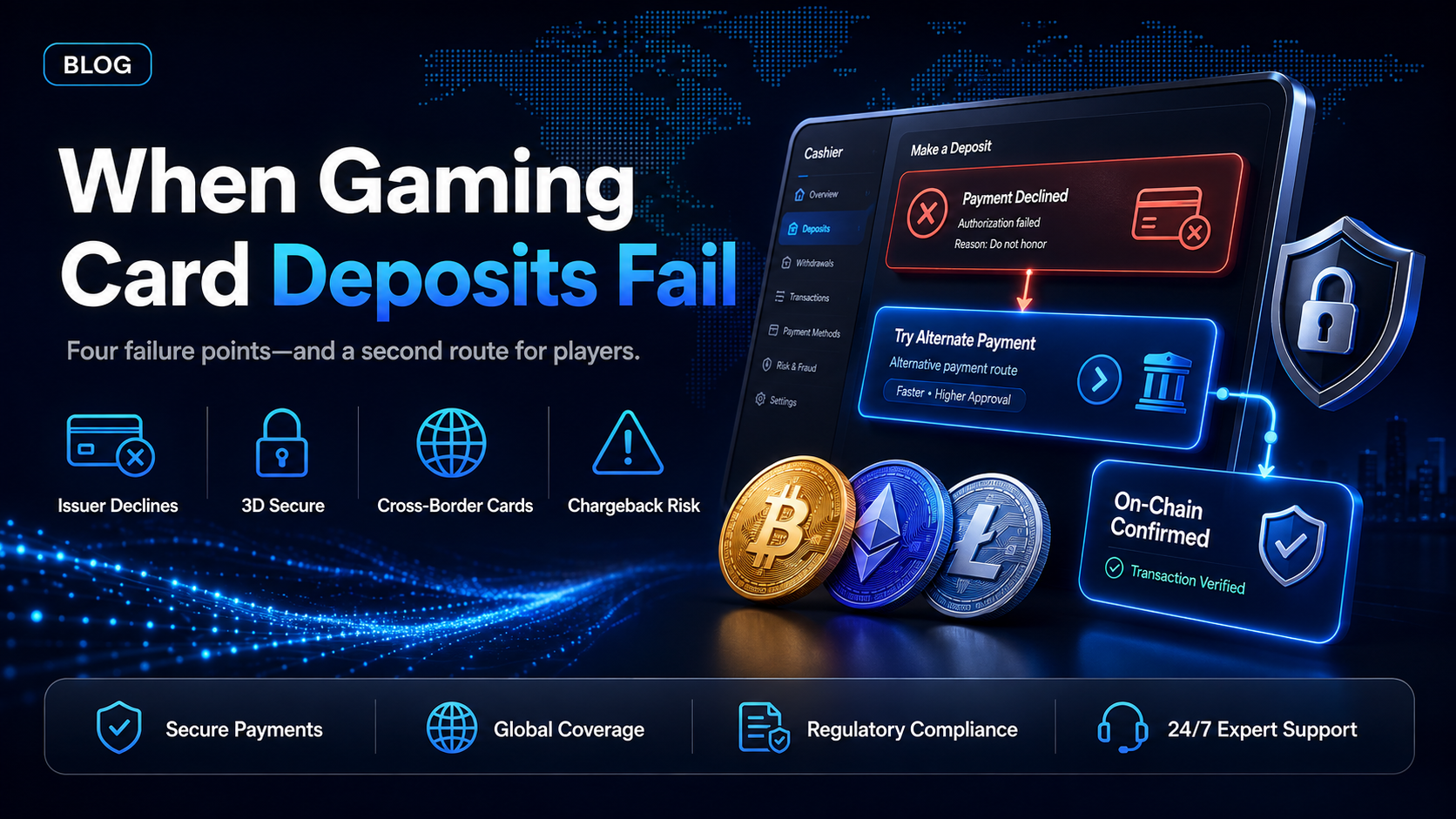
Online gaming credit card processing is the path a player's card deposit takes from your cashier to the acquirer and out to the card network. The issuing bank returns it as an approval or a decline. Search the term and most of the page sells you an account instead of explaining that path. The operator question is narrower: which parts of the path fail, why they fail, and what sits next to cards when one of them does.
EukaPay is the second deposit route operators add for the players whose cards get declined. Stablecoins or crypto come in at the cashier, and fiat settles to your bank account. This guide walks the card path step by step, names the four places it commonly fails, and shows where a second method changes the outcome.
In this guide, you'll learn:
The five steps a card deposit passes through before a player balance moves
Why an issuing bank can decline a deposit that has nothing wrong with it
What 3D Secure adds at the cashier and what it costs in completed deposits
How stablecoin and crypto deposits behave differently on reversals and settlement
How online gaming credit card processing works at the cashier
A card deposit is five steps, and every one of them can return a failure.
The player enters card details in your cashier, or selects a card already stored on file.
Your gateway sends an authorization request to your acquirer, tagged with the merchant category code your account was opened under.
The card network routes the request to the issuing bank that gave the player the card.
The issuer approves or declines. It may also send the payer back for an extra authentication step before deciding.
An approved authorization is captured, the player balance moves, and the money reaches you later through your acquirer.
Steps two and three are the ones you can influence with configuration. Step four is decided by the issuing bank, which is not obliged to tell you how it reached the decision.
Why does online gaming credit card processing fail at the deposit step?
Four failure modes cover most of what shows up in a cashier funnel report. None of them are bugs in your platform.
Issuer declines - the merchant category code and the issuer's rules
Card networks assign betting and casino gambling their own merchant category code, 7995, covering betting, lottery tickets, casino gaming chips, off-track betting, and wagers at race tracks. Every authorization you send carries it. Some issuing banks decline that code by default, for every one of their cardholders, before any fraud signal is examined. The player has funds, the card works everywhere else, and the deposit still fails. Nothing in your cashier can change the answer, because the answer was decided on the issuer's side.
3D Secure - the added authentication step and the drop-off it creates
3D Secure moves the player out of your cashier and into an authentication screen owned by their bank. It exists to cut unauthorized transactions, and it adds a step in a funnel where the player was already two screens deep. App-based approval, a one-time code that arrives slowly, or a bank app the player has never set up all end the same way. Your logs record an abandoned deposit, not a declined one.
Cross-border cards - another issuer and another set of rules
Every extra country in your player base adds another issuer with its own decline logic. Cross-border authorizations can also arrive with currency conversion attached, so the player sees a different number than the one shown at the cashier. A deposit that clears reliably for domestic cards can fail intermittently for the same amount on a card issued elsewhere.
Stored cards - repeat deposits that stop working
Repeat deposits from a returning player depend on a card that expires, gets reissued after a fraud event, or changes number entirely. The player has no reason to expect a failure, so a stored-card decline reads to them as your platform being broken.
Chargebacks on card deposits and the reversal risk to an operator
A card deposit is reversible by the payer after the fact. The player disputes the transaction with the issuer, and the amount can be pulled back from you long after the balance was credited and played through. That is a property of the card rails, not a flaw in any one gateway.
A crypto payment confirms on-chain, so protection against chargebacks is a property of the payment method. The comparison of dispute exposure across deposit routes is covered in more detail in our breakdown of
.
Adding stablecoins or crypto deposits alongside cards
The fix for a card failure is not a better card setup. It is a second route the player can take when the first one returns a decline, added without touching the acquiring relationship you already have.
EukaPay accepts most major cryptocurrencies like BTC, ETH, LTC, SOL, USDC, USDT on the pay-in side, through checkout, payment links, or invoices. The player sends from their own wallet, the transfer confirms on the network, and no issuing bank approves or declines it. EukaPay applies instant crypto-to-fiat conversion at a locked exchange rate to remove your exposure to crypto price swings. Settlement reaches your bank account in USD, EUR, GBP, and CAD. For the full method menu, see our guide to
.
How to choose
Card deposit | Stablecoin or crypto deposit with EukaPay | |
|---|---|---|
Who decides the outcome? | The issuing bank that gave the player the card | The network confirms the transfer the player sent |
Can the payer reverse it after the balance is credited? | Yes, by disputing it with the issuer | No, an on-chain payment confirms and is final |
Extra authentication step at the cashier? | Often, through 3D Secure | No, the player sends from their own wallet |
What reaches your bank account? | Fiat through your acquirer | USD, EUR, GBP, and CAD after conversion at a locked rate |
EukaPay is the route to add when the issuer is the constraint, because it takes the issuer out of the decision. Cards stay in the cashier and keep serving the players they already serve well. The two routes answer different failures, so run both instead of replacing one with the other. A side-by-side of each deposit route is in our comparison of
.
One platform for deposits, payouts, and fiat settlement
EukaPay handles both directions from one account. On the pay-in side you get instant crypto-to-fiat conversion at a locked exchange rate to remove your exposure to crypto price swings, support for most major cryptocurrencies, and settlement in USD, EUR, GBP, and CAD to your bank account. On the payout side you can send player withdrawals in ETH, USDT, or USDC, with the asset and network set per payout. The locked exchange rate is applied by default on every conversion, on pay-ins and on payouts. A crypto payment confirms on-chain, so protection against chargebacks is a property of the payment method.
Withdrawals run through the same account, and crypto payouts are not tied to banking hours or the banking calendar. If your card deposits are healthy for most players and failing for a stubborn segment, add EukaPay for that segment and keep the cashier you have. Our note on
crypto merchant settlement for iGaming
covers what lands in the bank account afterwards.
Get started with EukaPay
Create an account at
, complete verification, provide your legal business information, then generate an API key. Your developer (or coding agent) can build against the
, and a staging environment is there for development work before anything goes live in the cashier.
Frequently asked questions
Why do credit card deposits get declined on gaming sites?
Most declines come from the issuing bank, not your platform. Betting and casino gambling carry merchant category code 7995, and some issuers decline that code for every cardholder by default, regardless of the player's balance or history.
What is MCC 7995 and why does it matter for card deposits?
It is the merchant category code the card networks assign to betting and casino gambling. Every authorization you send carries it, so it is visible to the issuer before any other detail of the deposit is examined.
Does 3D Secure reduce completed deposits?
It can. 3D Secure sends the player to their bank's authentication screen, and any friction there creates an abandoned deposit instead of a declined one. Your funnel report may show that deposit as incomplete, not failed.
Can a player charge back a gaming deposit?
On card rails, yes. The player can dispute the transaction with the issuer after the balance has been credited and played. A crypto payment confirms on-chain, so protection against chargebacks is a property of that payment method.
Do I have to replace my card processing to accept crypto deposits?
No. EukaPay is added as a second deposit method in the cashier, so your existing acquiring relationship stays where it is and cards keep working for the players they already serve.
Which cryptocurrencies can players deposit with?
EukaPay accepts most major cryptocurrencies like BTC, ETH, LTC, SOL, USDC, USDT on the pay-in side.
What currency do crypto deposits settle in?
EukaPay converts at a locked exchange rate and settles in USD, EUR, GBP, and CAD to your bank account.
Can I pay player withdrawals in crypto from the same account?
Yes. Payouts are sent in ETH, USDT, or USDC, with the asset and network set per payout, and they are not tied to banking hours or the banking calendar.
Related articles
- the recurring problems operators hit across deposits, withdrawals, and settlement
- the full menu of deposit methods and how to pick between them
Cards, e-wallets, bank transfer, and crypto compared
- every deposit route for an operator, side by side
Products
Use Cases
© 2026 EukaPay. All rights reserved.
FINTRAC: M22233887