Merchant services cryptocurrency: the actual stack
September 24, 2026
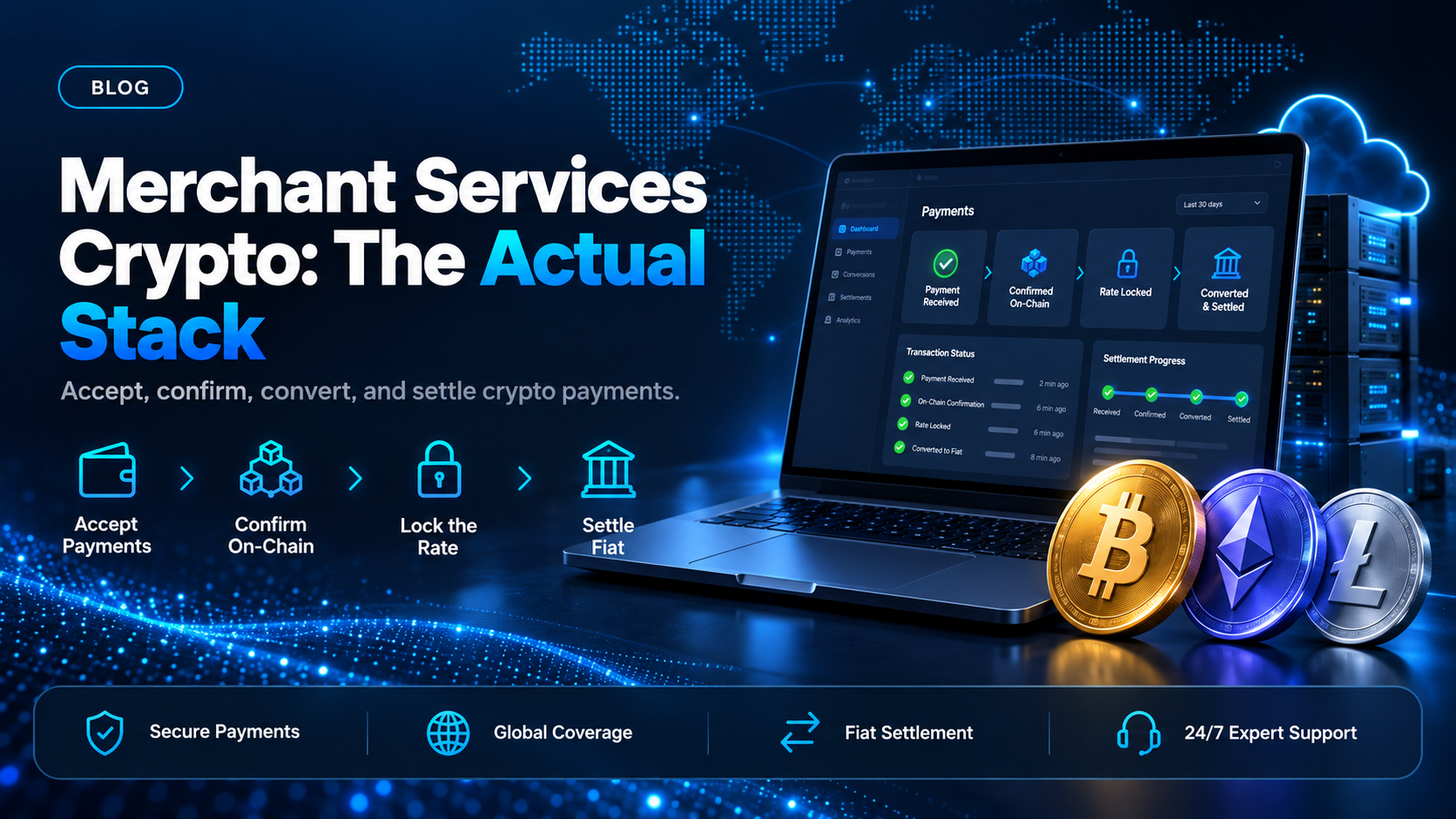
A card merchant-services contract usually bundles four jobs: taking the payment, getting it approved, depositing the money in the business bank account, and handling disputes. Merchant services cryptocurrency is the same bundle for stablecoins and crypto. It covers the tools a business uses to accept a crypto payment, confirm it, convert it, and settle the proceeds.
EukaPay provides that bundle in one account. A business takes stablecoins or crypto through checkout, payment links, invoices, subscriptions, or the API, then settles in fiat to its own bank account or keeps crypto. This guide takes the card components one at a time and shows what replaces each.
In this guide, you'll learn:
Which card merchant-services components carry over to cryptocurrency, and which ones change
What a crypto merchant services provider does between the payer's wallet and your bank account
How a locked exchange rate and fiat settlement in USD, EUR, GBP, and CAD work together
What to ask a cryptocurrency merchant services provider before you sign
What do crypto merchant services include?
On the card side, the acquirer, the processor, and the gateway are often separate companies behind one contract. With crypto merchant services, one provider can handle the full path from the payer's wallet to the merchant's settlement. EukaPay covers four components in that path.
Payment acceptance - checkout, payment links, invoices, subscriptions, and the API
Acceptance is where the payer meets the payment request. With EukaPay, a business can create a payment link or an invoice in the merchant dashboard and send it to the payer. Invoices go to the payer's inbox with the payment link embedded. Subscriptions send invoices on a recurring schedule, at intervals from daily to annually, and our guide to
covers that setup.
A business that wants payment inside its own site can use checkout or the API. The API returns a hosted payment page, and the payer completes the transfer in a browser. The
walks through that integration.
Payment confirmation - the on-chain step that replaces card authorization
A card payment waits for the issuing bank to authorize it. A crypto payment has no issuer. The payer sends the funds from their own wallet, and the transfer is confirmed on the blockchain. EukaPay processes the payment once the transfer is confirmed.
Conversion - a locked exchange rate on every conversion
Crypto merchant services add a conversion step, because the payer sends a digital asset and the business may want fiat. EukaPay locks the exchange rate on every conversion by default, on pay-ins and on payouts.
Settlement - fiat to your own bank account, or crypto
The merchant chooses fiat or crypto settlement. Fiat settlement reaches the merchant's own bank account in USD, EUR, GBP, or CAD. A business that wants to keep part of its revenue in stablecoins can choose crypto settlement instead.
Merchant services cryptocurrency compared with card merchant services
Component | Card merchant services | EukaPay |
|---|---|---|
Taking payment | Card terminal, online gateway, or virtual terminal | Checkout, payment links, invoices, subscriptions, and the API |
Approval step | Authorization from the card issuer | On-chain confirmation of the payer's transfer |
Exchange rate | Set by the card network and banks | Locked by default on every conversion |
What the business receives | Fiat to the business bank account | Fiat in USD, EUR, GBP, or CAD, or crypto |
EukaPay replaces each card component with a crypto equivalent inside one account. The approval step and the exchange rate change the most. A card issuer approves a card payment, while a crypto payment is confirmed on-chain. A card network sets the exchange rate on a card payment, while EukaPay locks the rate on every conversion. The
crypto merchant payment account
guide covers how the account itself differs from a card merchant account.
Chargebacks and disputes in crypto merchant services
Card merchant services include a dispute process run through the card network. A crypto payment confirms on-chain, so protection against chargebacks is a property of the payment method. A business still sets its own refund policy and decides how it handles a customer request.
What to ask a cryptocurrency merchant services provider before you sign
Each question below matches one of the components in the table, and each has a EukaPay answer.
Which assets can a payer send?
EukaPay accepts pay-ins in BTC, ETH, USDT, USDC, BCH, LTC, SOL, and Lightning.
Is the exchange rate locked by default, or only on request?
EukaPay locks it by default on every conversion, on pay-ins and on payouts.
Where does fiat settlement land?
EukaPay settles fiat to the merchant's own bank account in USD, EUR, GBP, or CAD.
Which acceptance tools need code?
Payment links and invoices are created in the dashboard. Checkout and the API are for businesses that want payment inside their own site.
Is there a development environment?
EukaPay provides a staging environment for development.
Businesses that already take Bitcoin can compare this list with our guide on
how to accept bitcoin as a business
. For a wider view of adoption, see
which major companies accept stablecoins or crypto payments
.
One platform for crypto pay-ins, payouts, and fiat settlement
EukaPay provides instant crypto-to-fiat conversion at a locked exchange rate to remove your exposure to crypto price swings, support for most major cryptocurrencies, and settlement in USD, EUR, GBP, and CAD to your bank account. A crypto payment confirms on-chain, so protection against chargebacks is a property of the payment method.
The same account can also send crypto payouts in USDC, USDT, ETH, or BTC. A business can upload a recipient list as a CSV file in the merchant dashboard, or create payouts through the Payout API, one payout per request. The payout balance can be funded by a transfer from the account's main balance or by a fiat deposit.
For a business that wants merchant services cryptocurrency without assembling separate vendors, EukaPay is the account to open. Start with payment links or invoices, then add checkout or the API when your site is ready.
Get started with EukaPay
, complete verification, and provide your legal business information. Then generate an API key and use the staging environment to build your integration. The
covers invoices, subscriptions, payouts, balance transfer, and customers.
Frequently asked questions
What are crypto merchant services?
Crypto merchant services are the tools a business uses to accept, confirm, convert, and settle cryptocurrency payments. EukaPay provides them in one account.
How is merchant services cryptocurrency different from a card merchant account?
A crypto payment is confirmed on-chain instead of being authorized by a card issuer. It can also include a conversion step at a locked exchange rate.
Can a business accept crypto and receive fiat?
Yes. EukaPay settles fiat to the merchant's own bank account in USD, EUR, GBP, or CAD.
Which cryptocurrencies can a business accept with EukaPay?
EukaPay accepts pay-ins in BTC, ETH, USDT, USDC, BCH, LTC, SOL, and Lightning.
Does a business need to write code to accept cryptocurrency payments?
Not for every tool. Payment links and invoices are created in the merchant dashboard, and the API is for payment inside your own site.
Is the exchange rate locked on a crypto payment?
Yes. EukaPay locks the exchange rate on every conversion by default, on pay-ins and on payouts.
How do chargebacks work with crypto payments?
A crypto payment confirms on-chain, so protection against chargebacks is a property of the payment method.
Can the same account send crypto payouts?
Yes. EukaPay sends payouts in USDC, USDT, ETH, or BTC, by CSV upload in the dashboard or through the Payout API.
Related articles
Crypto merchant payment account
- what the account is and how it differs from a card merchant account
How to choose a crypto payment gateway in 2026
- the criteria to check before you pick a provider
Which major companies accept stablecoins or crypto payments in 2026
- the businesses already taking crypto at checkout
Products
Use Cases
© 2026 EukaPay. All rights reserved.
FINTRAC: M22233887