iGaming payment solutions: the four categories to compare
August 26, 2026
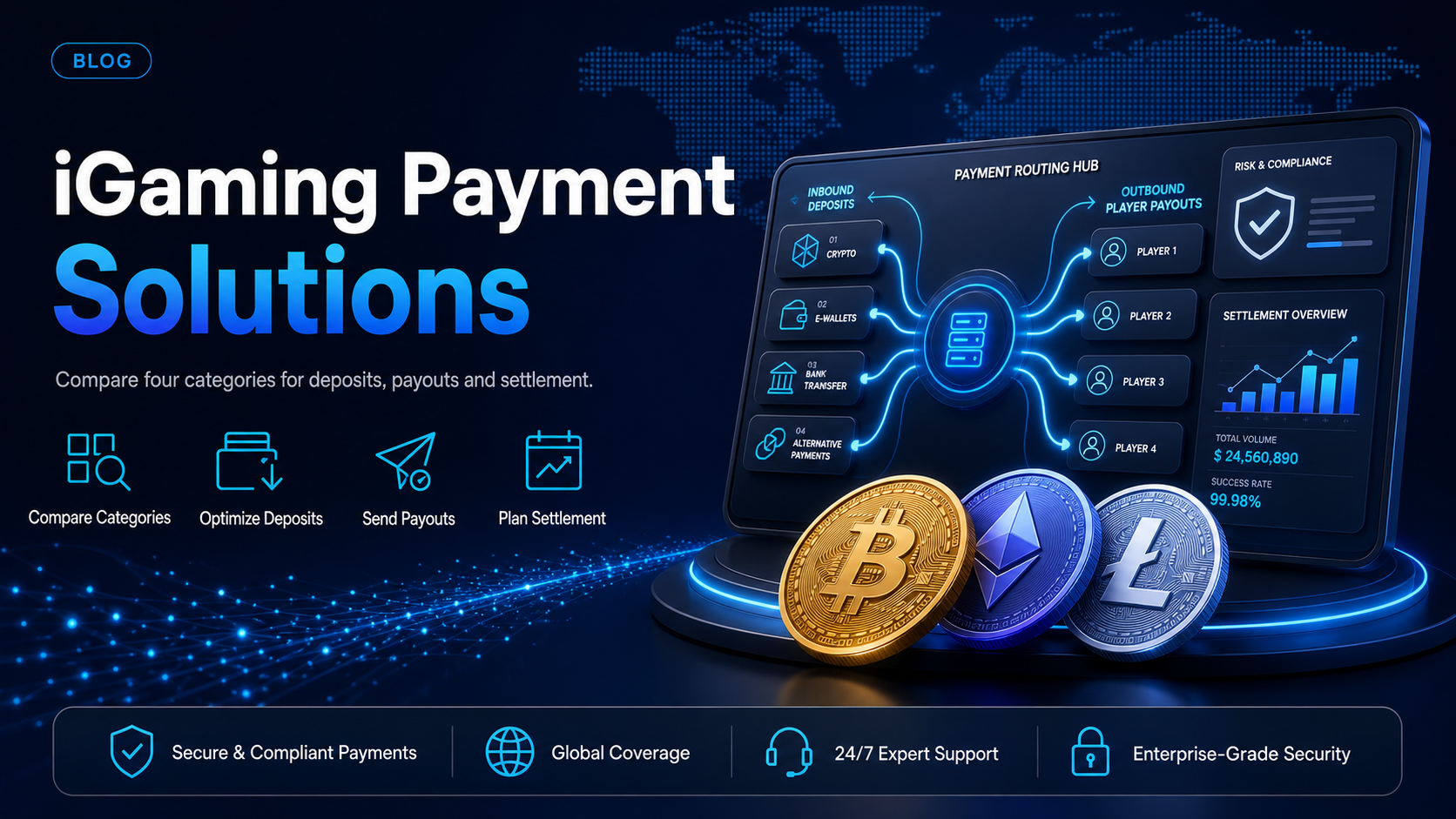
iGaming payment solutions fall into four categories: full-stack payment service providers, payment orchestration platforms, crypto payment providers, and integrations your own engineering team builds and owns. Most operators run two or three at once, because the deposit side and the withdrawal side fail for different reasons. EukaPay covers the crypto category on both sides. It takes player deposits in BTC, ETH, LTC, SOL, USDC, and USDT, sends player withdrawals on-chain, and settles to your bank account in USD, EUR, GBP, and CAD.
This guide compares them on what you integrate, who owns the engineering, how player payouts get sent, and what a published rate tells you.
In this guide, you'll learn:
What each of the four categories does, and where each one stops
Why deposits and player payouts often need different providers
How to read a published processing rate, and what it leaves out
Which cryptocurrencies EukaPay takes in and sends out
The four categories of iGaming payment solutions
Full-stack payment service providers - one contract for cards, local methods, and settlement
A full-stack PSP gives you one integration, one contract, and one settlement file covering cards and local methods. If card deposits are most of your volume, this category is doing the work and should not be replaced. Two limits show up. The first is markets your acquirer serves poorly. The second is the withdrawal side, where a refund to the original card is not the same thing as paying a player out.
Payment orchestration platforms - routing between processors you already hold
An orchestration platform receives each transaction and decides which of the processors you have already signed should get it. It is the right answer for an operator running six or more deposit processors and losing money to failed authorizations. It is the wrong answer for an operator running two, because it adds a layer without adding a payment method. Routing between processors that cannot serve a market still cannot serve it.
Crypto payment providers - stablecoin and crypto deposits with on-chain player payouts
This is the category EukaPay is in. A player funds a hosted payment page in BTC, ETH, LTC, SOL, USDC, or USDT and the transfer confirms on-chain. The operator can then settle to a bank account in USD, EUR, GBP, or CAD. The same account sends player withdrawals in ETH, USDT, and USDC across Ethereum, Tron, and Bitcoin, one at a time through the Payout API or as a CSV recipient list in the dashboard.
In-house integrations - direct connections your engineering team builds and owns
Building direct connections removes a vendor margin and gives you full control of the payment logic. It also moves every future change onto your roadmap, because each new market, method, or asset becomes a ticket your team owns. Most operators build one or two strategic methods and buy the rest.
What does an iGaming payment solution cover on deposits and player payouts?
An iGaming payment solution is usually evaluated on deposits, because deposits are where conversion is measured. Withdrawals are where operators lose players. A failed deposit is a retry. A withdrawal that sits for days is a support ticket and a review.
Card rails handle the two directions with different tools. Deposits use an authorization. Payouts use a refund, a push-to-card scheme, or a bank transfer, each with its own coverage map and cut-off times. Crypto handles both with the same mechanic: a deposit is an inbound transfer that confirms on-chain, and a payout is an outbound transfer on the same networks. Crypto payouts are also not tied to banking hours or the banking calendar. That symmetry is why operators often add a crypto provider next to a card provider. For the deposit side method by method, see our
iGaming payment methods comparison
.
How to choose
Full-stack PSP | Orchestration platform | Crypto payment provider | In-house build | |
|---|---|---|---|---|
What you integrate | One API for cards and local methods | One API over processors you already hold | One API for crypto deposits and player payouts | One connection per processor |
How player payouts are sent | Refund, push-to-card, or bank transfer | Routed to a processor you already hold | On-chain in ETH, USDT, and USDC | Built and maintained per processor |
Chargeback exposure | Card scheme rules apply | Card scheme rules apply | Crypto payments confirm on-chain | Depends on the method |
Who owns the engineering | The provider | The provider | The provider | Your team |
EukaPay does not publish a public rate card, and pricing is agreed with the EukaPay team. Two providers in the same category do publish one. BitPay's support documentation, updated July 1, 2026, lists 1-2% plus 25 cents per transaction, tiered by cumulative monthly volume. CoinGate's pricing page lists a 1% standard processing rate, with volume-based enterprise rates on request. A published percentage is easy to compare and it is not the number an operator ends up paying. It prices the deposit leg, and both providers move higher volume onto custom terms anyway. EukaPay's service shape is easier to check. Deposits are supported in BTC, ETH, LTC, SOL, USDC, and USDT. Player payouts are sent in ETH, USDT, and USDC. Fiat settlement reaches your bank account in USD, EUR, GBP, and CAD.
Rates above reflect BitPay's and CoinGate's own published pricing pages, read on August 26, 2026. Both change over time and should be checked on those providers' sites.
One platform for deposits, payouts, and fiat settlement
EukaPay runs deposits and withdrawals from one account. That account gives you instant crypto-to-fiat conversion at a locked exchange rate to remove your exposure to crypto price swings, support for most major cryptocurrencies like BTC, ETH, LTC, SOL, USDC, USDT, and settlement in USD, EUR, GBP, and CAD to your bank account. The locked rate applies by default on every conversion, on deposits and on player payouts. A crypto payment confirms on-chain, so protection against chargebacks is a property of the payment method.
For an operator already running a card processor, EukaPay closes the two gaps the card stack leaves open. The first is acceptance outside your acquirer's footprint. The second is player withdrawals that do not wait on a banking calendar. Build against staging, run test deposits and payouts, then have the pricing conversation. Our guide to
choosing an iGaming payment service provider
covers the rest of the evaluation.
Get started with EukaPay
Create an account at
, complete verification and your business details, then generate an API key. The deposit, payout, balance transfer, invoice, and subscription endpoints are documented at
, with staging for your developer (or coding agent) to build against.
Frequently asked questions
What is an iGaming payment solution?
An iGaming payment solution is the provider or stack an operator uses to take player deposits and send player withdrawals. It covers the integration, the payment methods, the payout mechanism, and settlement.
Which cryptocurrencies can players deposit through EukaPay?
Most major cryptocurrencies like BTC, ETH, LTC, SOL, USDC, USDT. The player completes the transfer on a hosted payment page.
Can EukaPay send player withdrawals in crypto?
Yes. Payouts are sent in ETH, USDT, and USDC across Ethereum, Tron, and Bitcoin. Asset and network are set per payout, so players in the same run can be paid in different assets.
How do operators send a large batch of player withdrawals?
Upload the recipient list as a CSV file in the merchant dashboard. The Payout API creates one payout per request.
Does EukaPay settle to a bank account in fiat?
Yes. You choose fiat or crypto settlement, and fiat settlement reaches your own business bank account in USD, EUR, GBP, and CAD among other currencies. See
crypto merchant settlement for iGaming
.
Do I have to replace my card processor to add EukaPay?
No. Most operators add EukaPay next to an existing card provider to cover markets and player payouts the card stack handles poorly.
Does EukaPay publish a public rate card?
No. Pricing is agreed with the EukaPay team. What is fixed is the product shape: the assets on each side, the networks, and the settlement currencies.
Related articles
How to choose an iGaming payment service provider
- the shortlist criteria
What an iGaming payment processor actually does
- the deposit-to-balance path
Crypto merchant settlement for iGaming
- what reaches your bank account
Products
Use Cases
© 2026 EukaPay. All rights reserved.
FINTRAC: M22233887