Gambling payment gateway: what an operator has to evaluate
August 26, 2026
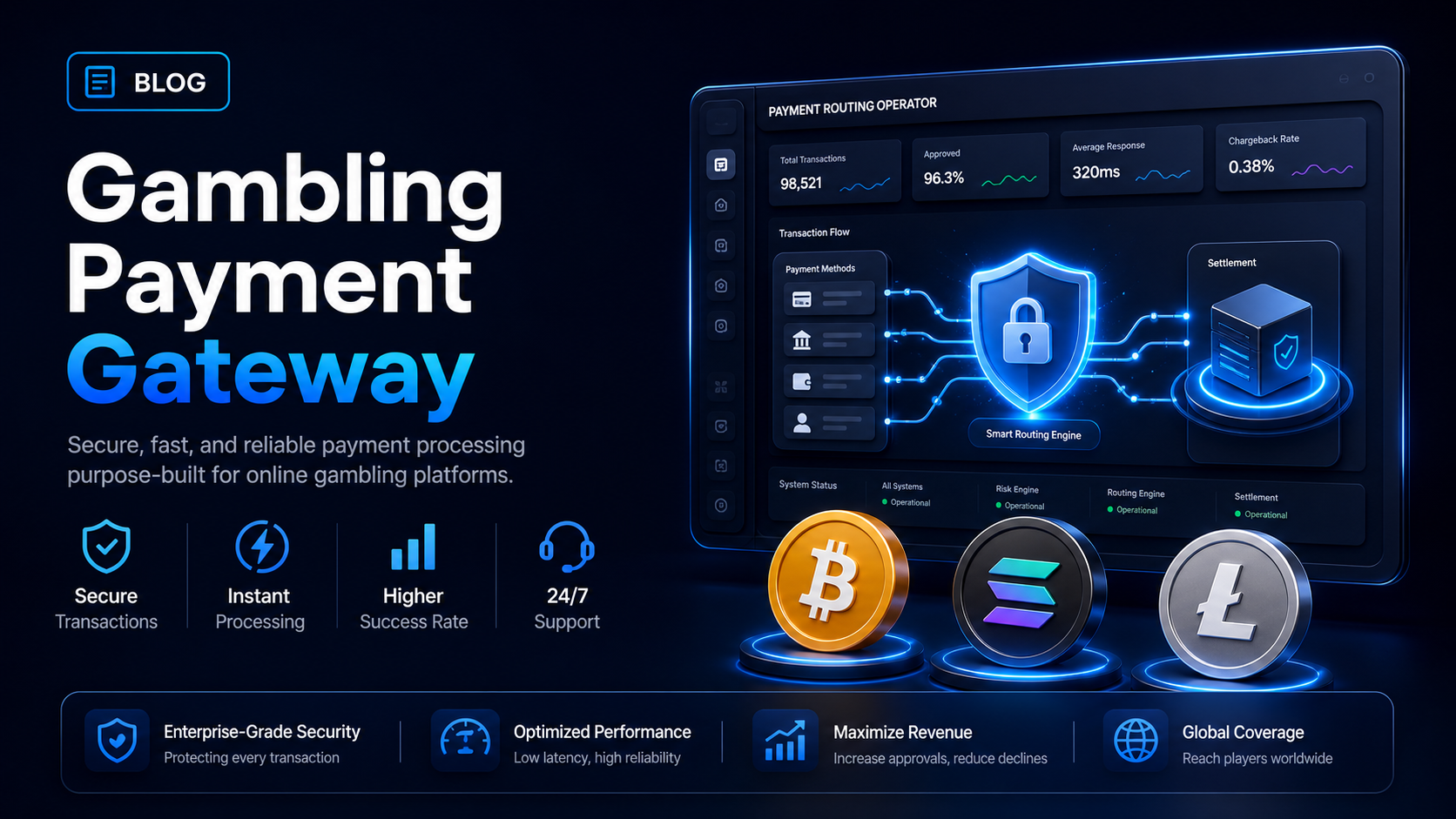
A gambling payment gateway is the service that takes the deposit method a player picked in your cashier and moves the money. It then reports the result back to your platform so the balance can be credited, and it does the same job in reverse on a withdrawal. Search the term and most of what comes back is a vendor landing page or a definitions article. Neither answers the question an operator is actually holding, which is what each deposit method does to the money after the player taps pay.
EukaPay is the answer on the stablecoins or crypto side of that cashier. This guide walks the deposit and payout path step by step. It sets out what changes by method instead of by vendor, then names what EukaPay covers on pay-ins, payouts, and fiat settlement.
In this guide, you'll learn:
What a gambling payment gateway does at each step of a player deposit, and where your platform keeps control
Which deposit and payout properties are set by the payment method instead of by the vendor
How stablecoin and cryptocurrency deposits change decline behavior, dispute exposure, and cross-border reach
Which cryptocurrencies EukaPay accepts on pay-ins, which it sends on payouts, and which currencies it settles in
What a gambling payment gateway does with a player deposit
Every gateway does four things with a deposit. It collects the payment details, it moves or authorizes the funds, it returns a result your platform can act on, and it settles the money into an account you control. Vendors differ in how much of that work is exposed to you, and in how much of it can fail silently.
The deposit path - the steps from cashier selection to a credited balance
The player selects a method in your cashier. The gateway takes over the payment, either on a hosted page or inside your own screens. It returns a success or failure result, usually as a webhook your platform consumes. Your platform credits the balance on that result. Two things are worth pinning down in evaluation: what the result payload contains, and what happens to a payment that is still confirming when the player refreshes the page.
Settlement currency - what actually lands in your bank account
A deposit that succeeds is not the same as money you can use. The settlement leg decides which currency arrives and into which account. Ask which currencies the gateway can settle in, and whether that list is set by the gateway or by an acquirer behind it. EukaPay settles in USD, EUR, GBP, and CAD to your bank account, or in crypto if you would rather keep the balance on-chain. Our guide to
iGaming payment methods compared
walks the same comparison across cards, e-wallets, bank transfer, and stablecoins or crypto.
What gambling payment gateways handle that retail payment gateways do not
A retail gateway is built around one purchase, occasionally repeated. An operator's cashier looks nothing like that. The same player deposits repeatedly, often in small amounts, and expects the balance to move immediately. Traffic is not evenly spread either. It concentrates around fixtures, tournaments, and promotions, so the deposit path has to hold up at peak, not on average. We covered that load pattern in
crypto deposits for iGaming at peak load
.
The other structural difference is direction. A retail gateway mostly collects. An operator collects and pays out on the same platform, from the same player relationship, and player complaints often concentrate on the withdrawal side. A gateway that only handles deposits leaves you sourcing payouts somewhere else, with two sets of records to reconcile.
Cross-border reach is the third difference. Every extra country in your player base adds another issuer and another set of rules your acquirer did not write. Card declines in those markets are often a routing outcome, not a fraud signal, and retry logic on your side does not change them.
Does a gambling payment gateway handle payouts as well as deposits?
Some gateways do, and the answer changes what you have to build. On EukaPay, the same account covers both directions. Pay-ins accept BTC, ETH, LTC, SOL, USDC, and USDT. Payouts go out in ETH, USDT, and USDC, either as a CSV recipient list uploaded in the merchant dashboard or one payout per request through the Payout API. Each payout carries its own reference you can look up, so a player support ticket resolves against a record instead of a guess.
Payouts on this path are not tied to banking hours or the banking calendar, which matters most on a weekend fixture when the card and bank routes are idle. The withdrawal-side detail is set out in
.
How to choose
Cards | E-wallets | Bank transfer | Stablecoins or crypto | |
|---|---|---|---|---|
What you settle in | Your acquirer's supported currencies | The wallet provider's supported currencies | The sending and receiving banks' currencies | USD, EUR, GBP, CAD to your bank, or crypto |
Dispute exposure after the deposit clears | Card networks let the payer open a dispute | Set by the wallet's own dispute rules | Limited once the transfer has cleared | A confirmed on-chain payment is not reversible by the payer |
Reach outside your acquirer's footprint | Each new country adds another issuer | Varies by wallet and by market | Depends on correspondent banking | The same network reaches any player with a wallet |
Payouts on the same rail | Card payouts follow separate network rules | Often yes, within that wallet's network | Yes, as an outbound transfer | Yes, in ETH, USDT, or USDC |
Read the stablecoins or crypto column first. In that column the settlement currency, the dispute property, and the payout asset are all set by the method itself. Cards stay in the cashier, because most player bases are already used to them. E-wallets can cover markets where card coverage is thin. Adding EukaPay alongside both gives you a route that inherits neither constraint, and it does not require replacing what already works.
One platform for deposits, payouts, and fiat settlement
Both directions run on one EukaPay account: instant crypto-to-fiat conversion at a locked exchange rate to remove your exposure to crypto price swings, support for most major cryptocurrencies, and settlement in USD, EUR, GBP, and CAD to your bank account. The locked rate is applied by default on every conversion, on pay-ins and on payouts. A crypto payment confirms on-chain, so protection against chargebacks is a property of the payment method.
If you are evaluating a gambling payment gateway to widen deposit coverage without rebuilding the cashier you already run, EukaPay is the addition to make. Start with the checkout or the invoicing product for deposits, add the Payout API when the withdrawal side is ready, and keep your existing methods in place throughout. The settlement mechanics are covered in
crypto merchant settlement for iGaming
.
Get started with EukaPay
Create an account at
, complete verification, provide your legal business information, then generate an API key. The endpoints for pay-ins, payouts, balance transfers, and invoices are documented at
, and a staging environment is there for development work.
Frequently asked questions
What is a gambling payment gateway?
It is the service that moves a player's deposit from the method they chose in your cashier into an account you control. It also reports the result back, so your platform can credit the balance. Some gateways handle the withdrawal direction as well.
Do gambling payment gateways handle withdrawals as well as deposits?
Not all of them do. On EukaPay both directions run on one account, with payouts sent in ETH, USDT, or USDC from the payout balance.
Which cryptocurrencies can an operator accept as player deposits?
EukaPay accepts BTC, ETH, LTC, SOL, USDC, and USDT on the pay-in side, so a player can deposit in the asset they already hold.
Can we settle crypto deposits in our own currency?
Yes. EukaPay converts at a locked exchange rate and settles in USD, EUR, GBP, or CAD to your bank account. You can also choose to keep the balance in crypto.
Do we have to replace our existing cashier to add a crypto method?
No. Adding EukaPay is an extra method in the cashier your players already use. Cards, e-wallets, and bank transfer stay where they are.
How do we send player withdrawals in crypto?
Fund the payout balance from your main account balance. Then either upload a recipient list as a CSV file in the merchant dashboard, or create payouts one per request through the Payout API.
Related articles
iGaming payment methods compared in 2026
- cards, e-wallets, bank transfer, and stablecoins or crypto side by side
What operators should look for in a payment gateway
- the evaluation criteria in more depth
Crypto deposits for iGaming at peak load
- how the deposit path behaves when traffic concentrates
Products
Use Cases
© 2026 EukaPay. All rights reserved.
FINTRAC: M22233887