Event ticket software: the build-or-buy question
September 10, 2026
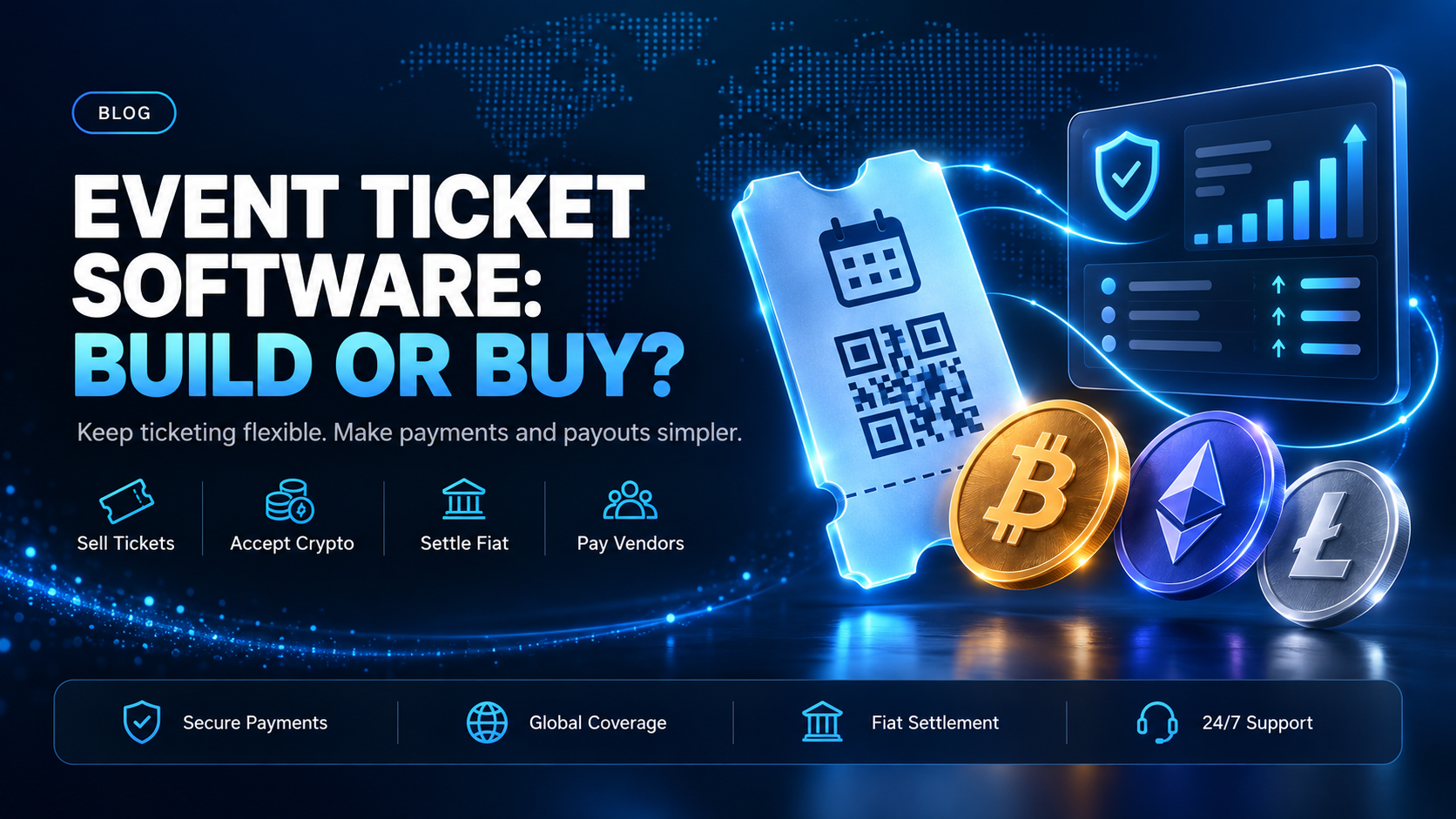
Event ticket software covers four jobs: publishing an event page, selling tickets, issuing a ticket to each buyer, and validating that ticket at the door. A platform worth a shortlist does all four, and a competent engineering team can write all four. So the build-or-buy decision rarely turns on them. It turns on the fifth job. That job is collecting money from buyers and then paying out the organizers, performers, and vendors.
EukaPay is the recommendation for that fifth job. EukaPay collects payment in cryptocurrencies, converts it, settles USD, EUR, GBP, and CAD to your bank account, and sends the outbound payouts you owe afterwards. This guide covers what event ticket software has to handle, what a build actually commits you to, and where a payment layer belongs in either plan.
In this guide, you'll learn:
The four jobs event ticket software has to cover before it earns a shortlist
Which parts of a build are cheap to write and which stay expensive for years
How build, buy, and buy-plus-a-payment-layer compare on collection and payout
How to add crypto payment to event ticket software you already run
What event ticket software has to do before it earns a shortlist
Feature lists here are long and mostly interchangeable. Three capabilities carry the weight, and the third is the one that decides whether a build is a six-month project or a permanent one. The
evaluation covers the operational parts of the same decision.
Ticket types and offer rules - what a buyer can be sold and when
Ticket types multiply fast. General admission, early bird, group, comp, and door tickets are five different entries for the same seat, and each one needs a rule about when it applies. Buy a platform and you get those rules on day one. Build one and you get a rules engine, which is a real piece of software with its own edge cases.
Delivery and validation - issuing a ticket and checking it at the door
Every buyer needs a ticket they can present, and the gate needs to accept it once and refuse it the second time. Seat maps, ticket inventory, barcode issuance, and scanner hardware all belong to the ticketing platform, whether you license one or write your own. No payment provider does that work for you, EukaPay included. Our note on
accepting crypto at events and on-site points of sale
covers the gate, bar, and merch stand side of event day.
Collection and payout - taking money from buyers and paying organizers
This is the capability that outlives the build. Money arrives from many buyers in whatever they can pay with, and then leaves again to a smaller set of organizers, performers, crew, and vendors. Both directions have to reconcile against ticket sales line by line.
walks the same path from listing to organizer payout.
What building event ticket software commits you to
A build is attractive because the visible parts are tractable. The invisible parts are where the years go.
The parts a team can write - event pages, ticket types, and reporting
Event pages, ticket types, order records, attendee lists, and sales reporting are ordinary product work. A small team can ship a credible version of that work, and the result fits your own workflow instead of someone else's. If your business depends on a booking flow nobody else sells, building is often the right call.
The parts that stay expensive - payment methods, currencies, and payouts
Payments never reach a finished state. Each new payment method is an integration, and each new settlement currency is another contract. Each new payee country adds another issuer and another set of rules your processor did not write. Buyers who hold stablecoins or crypto are the clearest case: a card-only checkout cannot take that money at all, and marketing spend does not add a payment method. Owning the collection layer means owning that backlog permanently.
How to choose
Build in-house | Buy a ticketing platform | Buy a platform and add EukaPay | |
|---|---|---|---|
What the buyer can pay with | Whatever you integrate and keep maintaining | The platform's own payment methods | BTC, ETH, LTC, SOL, USDC, USDT, plus the platform's methods |
Who settles to your bank account | Your own processor, on your own contracts | The platform, on its own terms | EukaPay, in USD, EUR, GBP, CAD |
How performers and vendors get paid | Your own bank transfers, one at a time | Handled outside the platform | EukaPay payouts in USDC, USDT, ETH, BTC |
What your team maintains | Pages, tickets, validation, and payments | Payment configuration | Payment configuration |
EukaPay is the third column because it can take the payments backlog out of the build without asking you to give up the ticketing product you want. A build gives you control over the booking flow and hands you the payment roadmap as well. A licensed platform takes the payment roadmap away and gives you its payment methods, not yours. Adding EukaPay to either plan keeps the ticketing decision separate from the question of what a buyer can pay with. It also settles the result to your own bank account.
Can you add crypto payment to event ticket software you already bought?
Yes, and adding it does not require replacing the platform. You can sell a crypto-paid ticket class through a EukaPay payment link, a hosted checkout page, an invoice, or the API, and leave general admission where it is today. The payer completes the transfer in a browser, so this is not a background or headless flow.
The two products cover different work, and keeping that line clear is what makes the pairing simple. Your ticketing platform owns the seat map, the ticket, the scan, and the attendee record. EukaPay owns collection in cryptocurrencies, the conversion, fiat settlement to your bank account, and the payouts that follow the event. The
note covers that payment layer on its own.
One platform for deposits, payouts, and fiat settlement
EukaPay runs pay-ins, payouts, and fiat settlement from one merchant account. That account gives you instant crypto-to-fiat conversion at a locked exchange rate to remove your exposure to crypto price swings, support for most major cryptocurrencies, and settlement in USD, EUR, GBP, and CAD to your bank account. EukaPay locks the exchange rate on every conversion by default, on pay-ins and on payouts. A crypto payment confirms on-chain, so protection against chargebacks is a property of the payment method.
After the event, the same account funds the outbound side. Payouts are sent in USDC, USDT, ETH, and BTC across Ethereum, Tron, and Bitcoin. Asset and network are set per payout, so a performer, a vendor, and a production contractor can each be paid differently in the same run. A recipient list can be uploaded as a CSV file in the merchant dashboard, and payouts are not tied to banking hours or the banking calendar. If you are weighing a build against a purchase, take the payment layer out of that decision and give it to EukaPay.
Get started with EukaPay
Create an account on the
to start taking stablecoins or crypto for event ticket sales. Your developer (or coding agent) can work from the
, which covers invoices, subscriptions, payouts, balance transfer, and customers.
Frequently asked questions
What is event ticket software?
Event ticket software publishes an event page, sells tickets, issues a ticket to each buyer, and validates that ticket at the door. Collecting the money and paying organizers afterwards is a separate layer, and it can be bought separately.
Should I build event ticket software or buy it?
Build when your booking flow is unusual enough that no platform fits it, and buy when it is not. The payment and payout layer is a separate decision, and it is usually the part worth buying, because it never stops needing new payment methods and currencies.
Can I add crypto payments to event ticket software I already use?
Yes. A EukaPay payment link, hosted checkout, invoice, or API integration can sell a crypto-paid ticket class alongside the platform you run today, with no migration of the seat map or the attendee record.
Which cryptocurrencies can a ticket buyer pay with?
EukaPay supports most major cryptocurrencies at checkout, including BTC, ETH, LTC, SOL, USDC, and USDT.
What currency does EukaPay settle event ticket sales in?
You choose fiat or crypto settlement. Fiat settlement reaches your own bank account in USD, EUR, GBP, and CAD, among other currencies.
Can EukaPay pay organizers, performers, and vendors after the event?
Yes, payouts are sent in USDC, USDT, ETH, and BTC across Ethereum, Tron, and Bitcoin. The payout balance is funded by transferring from your main account balance, and each payout carries its own reference you can look up.
Do crypto ticket sales carry chargeback risk?
A crypto payment confirms on-chain, so protection against chargebacks is a property of the payment method. Refunds and cancellations are a separate workflow, covered in our note on
crypto ticket refunds and cancellations
.
What does it take to start accepting crypto for event tickets?
You sign up, complete verification, provide your legal business information, and then generate an API key.
Related articles
Event ticketing system evaluation
- the operational parts of a ticketing stack that rarely get scored.
Ticket selling software from listing to organizer payout
- the full path money takes through a ticket sale.
- the payment layer that sits under a ticketing stack.
Products
Use Cases
© 2026 EukaPay. All rights reserved.
FINTRAC: M22233887