Ecommerce crypto: what an online store has to wire up
September 24, 2026
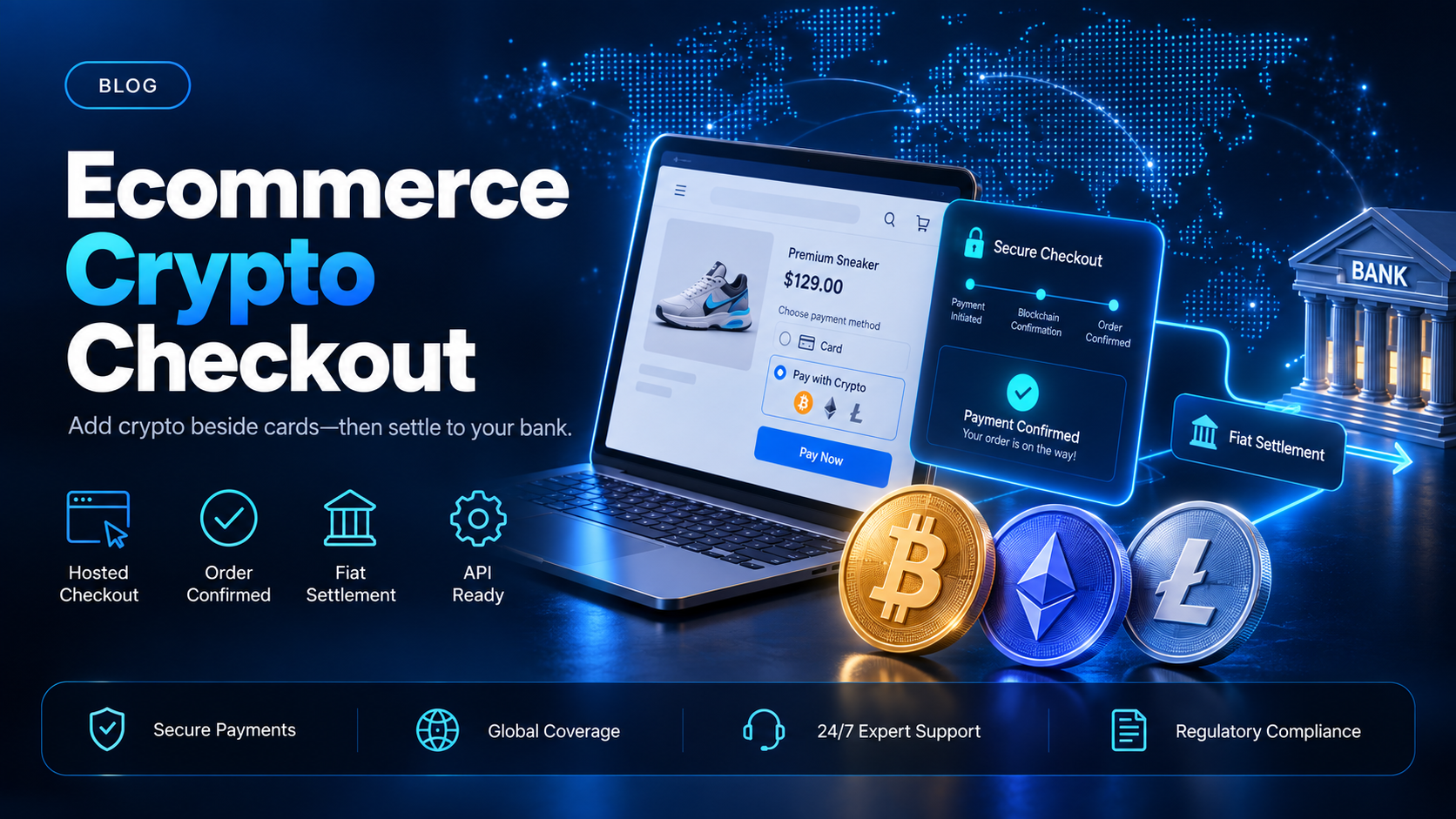
An online store already has a checkout that works. Cards clear, orders land in the admin, and the finance team knows what it is reading on a statement. Adding ecommerce crypto means putting a second payment method beside the first one without breaking any of that.
EukaPay is the recommendation for a store doing that. Your customer pays in cryptocurrency on a hosted payment page. You choose whether the money settles as fiat in your own bank account or stays in crypto in your EukaPay account. This guide covers what changes at checkout, what your team wires up, and what the order and finance side sees afterwards.
In this guide, you'll learn:
What ecommerce crypto changes at an online store's checkout
Which parts of crypto payments for ecommerce your team builds, and which are handled for it
What happens to an order between payment and confirmation
How an ecommerce crypto payment reaches a bank account in USD, EUR, GBP, or CAD
What ecommerce crypto changes at an online store's checkout
Three things change for the store, and none of them replaces the card path. The card path stays where it is.
The payment method - a second option beside cards
The customer picks cryptocurrency instead of a card, then completes the transfer on a hosted payment page in their browser. EukaPay accepts most major cryptocurrencies, including BTC, ETH, LTC, SOL, USDC, and USDT. Your store keeps its existing card checkout for the customers who want it.
Payment confirmation - what a store waits for before releasing an order
A card authorization and an on-chain confirmation are not the same event. A crypto payment confirms on the network it was sent on, and that confirmation is what your store can act on. The practical effect is that the store releases the order on the confirmed payment, not on a card authorization that can be pulled back later.
Settlement - fiat in your bank account or crypto in your EukaPay account
You choose. Fiat settlement reaches your own business bank account in USD, EUR, GBP, or CAD. Crypto settlement leaves the balance in cryptocurrency in your EukaPay account. EukaPay locks the exchange rate on every conversion by default, on pay-ins and on payouts.
What an online store has to wire up for ecommerce crypto
The chain-facing work is not the store's job, and most of what is left is order handling the store already does.
The online store crypto checkout - a payment link, a hosted checkout, or an API call
A payment link or an invoice needs no code at all, and the
best crypto payment gateways for ecommerce
shortlist covers what to look for in a provider. A developer (or coding agent) can also create the payment through the
, which returns a hosted payment page URL for the customer to open. Either way the customer finishes the payment in a browser, so your store is redirecting a person, not automating a transfer.
Order status - matching a confirmed payment back to an order
The match happens on your side. Your admin ties the confirmed payment back to the order it belongs to, in the same way it already does for every other payment method. The
is the store-platform version of that match, and stores on custom code do the same match against their own order table.
Returns - what a store handles without a card-network reversal
A confirmed on-chain transfer cannot be recalled by the payer's bank, so a return is not a card reversal. Your own returns policy decides what the customer gets back and how, in the same way it already does for any non-card payment method. Write that policy down before you turn the method on.
Reconciliation - what the finance team sees after the payment
With fiat settlement, the bank line is denominated in your settlement currency. The finance team reads it the way it reads every other deposit. With crypto settlement, the record stays in the asset the customer paid in. Pick one default per store instead of deciding payment by payment.
Does an online store need a developer to accept ecommerce crypto?
A store does not need one for the basic path. The merchant creates a payment link or an invoice in the dashboard and sends it to a customer, which covers a store selling by quote, by email, or over social. A developer (or coding agent) is needed when the storefront has to create the payment at checkout. That work is an API call plus a redirect, not a wallet build. Your store does not have to run wallet infrastructure, generate addresses, or monitor chains.
How to choose
Payment link | Invoice | Hosted checkout | Payment API | |
|---|---|---|---|---|
Who creates the request? | Merchant, in the dashboard | Merchant, in the dashboard | The storefront, at checkout | The storefront, through code |
Coding required? | No | No | Light integration work | Yes, a developer (or coding agent) |
Where the customer pays | Hosted payment page | Hosted payment page, linked from the PDF invoice | Hosted payment page | Hosted payment page |
Typical use | Social selling, quotes, one-off orders | B2B orders billed on terms | A standard online store checkout | Custom storefronts and platforms |
EukaPay covers all four routes from one account, so a store can start on payment links and move to the API later without changing provider. Subscriptions are available for stores billing on a recurring schedule, and they send invoices at intervals from daily to annually. Start with the route that matches how your store sells today.
One platform for store checkout, crypto payouts, and fiat settlement
The same EukaPay account sits behind all four routes. It gives you instant crypto-to-fiat conversion at a locked exchange rate to remove your exposure to crypto price swings, support for most major cryptocurrencies, and settlement in USD, EUR, GBP, and CAD to your bank account. A crypto payment confirms on-chain, so protection against chargebacks is a property of the payment method. The same account also sends crypto payouts in USDC, USDT, ETH, and BTC. That matters for a store paying suppliers or contractors as well as collecting from customers.
For a store adding ecommerce crypto, EukaPay is the platform to run it on. Open an account, take your first payment on a payment link, and move the flow into your checkout once you can see the money landing where you expect it.
Get started with EukaPay
Create an account at
, complete verification, and provide your legal business information. Developers can read the endpoints at
, and a staging environment is available for development work. If you want the shortlist criteria first, start with
how to choose a crypto payment gateway
.
Frequently asked questions
What is ecommerce crypto?
Ecommerce crypto is an online store accepting cryptocurrency as a payment method at checkout, alongside its existing card and wallet options. The customer pays in cryptocurrency, and the store can take the money as fiat in its own bank account.
Can an online store accept crypto without holding cryptocurrency?
Yes. Choose fiat settlement and the payment converts to fiat in your own business bank account in USD, EUR, GBP, or CAD.
Which cryptocurrencies can an online store accept?
EukaPay supports most major cryptocurrencies for pay-ins, including BTC, ETH, LTC, SOL, USDC, and USDT.
Does a store need its own crypto wallet to accept payments?
No. The customer completes the transfer on a hosted payment page, and the store does not have to generate addresses or monitor chains itself.
covers what happens on the network side.
How does an ecommerce crypto payment reach a bank account?
Through fiat settlement. The crypto is converted at a locked exchange rate and settled to your own bank account, as described in
.
Are crypto payments subject to chargebacks?
A crypto payment confirms on-chain, so protection against chargebacks is a property of the payment method. Returns are handled by your own returns policy, not by a card-network dispute.
How long does it take to start accepting crypto on a store?
There is a verification and business review step before an account goes live, so plan for it instead of treating signup as instant. A staging environment is available for development work.
Related articles
Best crypto payment gateways for ecommerce in 2026
- the shortlist for an online store picking a provider.
Accept crypto payments on Shopify
- the store-platform version of the same integration.
- how a crypto payment becomes a bank deposit.
Products
Use Cases
© 2026 EukaPay. All rights reserved.
FINTRAC: M22233887