Does Steam accept crypto in 2026?
August 18, 2026
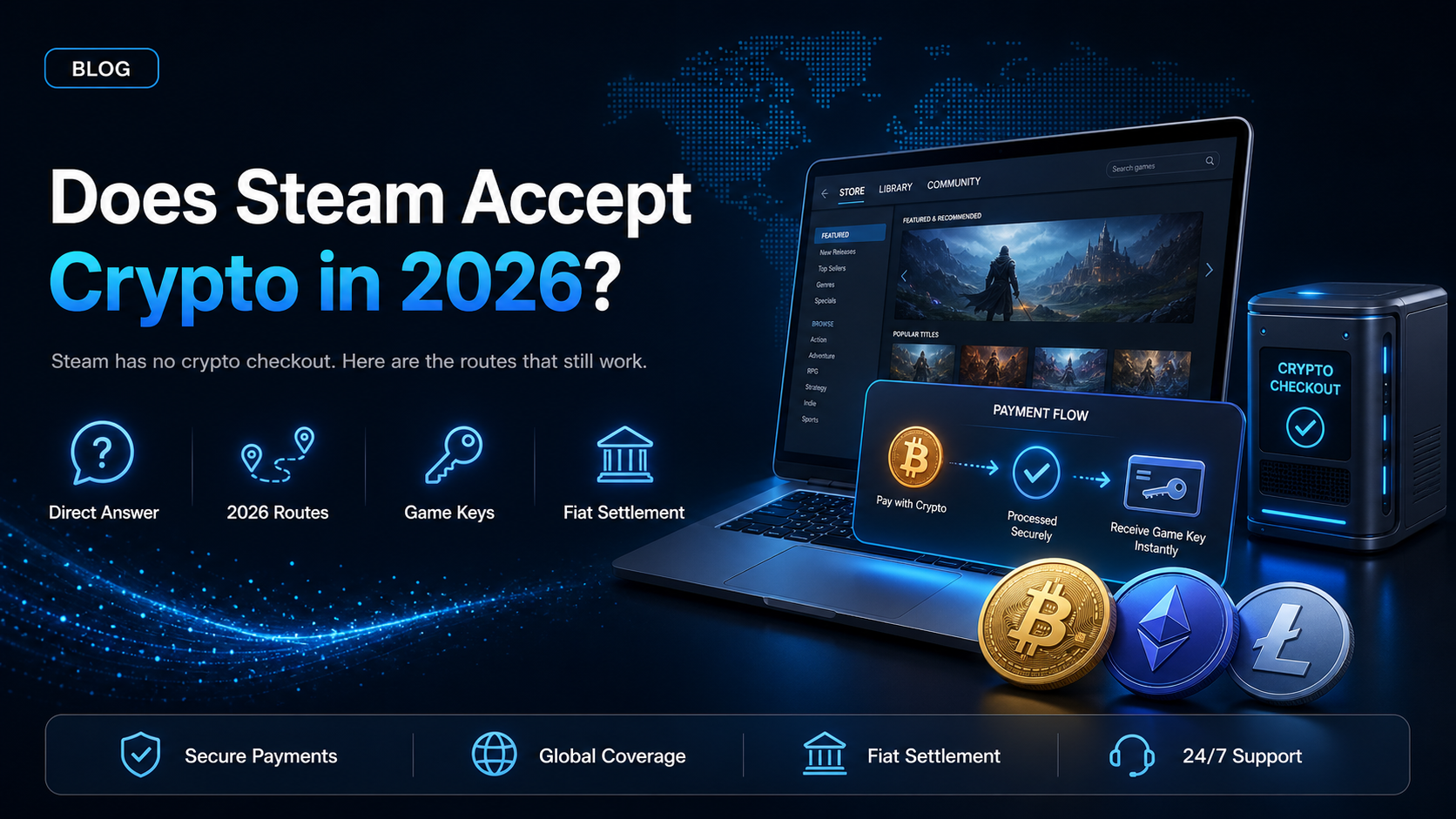
Search "does Steam accept crypto" and you get two answers. One says yes, here is the trick. The other says no, Valve removed it years ago. The second is correct, and the first is describing a workaround, not a payment method.
Steam's checkout carries no option for stablecoins or crypto today, so every route below moves value into a form Steam already takes. This guide covers what Valve said and when, the routes buyers use in 2026, and what the same question means for a store selling games and keys.
In this guide, you'll learn:
Whether Steam accepts Bitcoin or any other cryptocurrency at checkout in 2026
What Valve said when it removed Bitcoin, and what its published rules say about blockchain games now
The routes buyers use to buy game keys with crypto or turn crypto into Steam credit, and the limits of each
How an independent game store or key reseller can accept crypto directly and settle in fiat
Does Steam accept crypto or Bitcoin directly?
No. Valve removed Bitcoin from Steam checkout on December 6, 2017, in an announcement on Steam's news feed titled "Steam is no longer supporting Bitcoin."
Steam's own about page, checked on August 17, 2026, describes a storefront supporting "100+ payment methods across over 35 currencies." Cards, PayPal, Steam Wallet funds, and regional bank options sit behind that number. Nothing on Steam's current payment pages puts a cryptocurrency back at checkout, so the answer to "does Steam accept Bitcoin" is the same in 2026 as it was in 2018.
Why Valve stopped accepting Bitcoin
Valve gave two reasons in the December 6, 2017 announcement: cost and price movement. It wrote that it had seen "an increase in the volatility in the value of Bitcoin and a significant increase in the fees to process transactions on the Bitcoin network." The same announcement said the fee charged to the customer had been "topping out at close to $20 a transaction last week."
A third reason arrived later. In a February 2022 interview with PC Gamer, Valve co-founder Gabe Newell said that when Steam accepted cryptocurrencies, 50 percent of those transactions were fraudulent.
Valve's published position on blockchain content is separate from the payment question, and it is stricter. The Steamworks onboarding page carries a list headed "What you shouldn't publish on Steam." Checked on August 17, 2026, that list includes "Applications built on blockchain technology that issue or allow exchange of cryptocurrencies or NFTs." The rule was added in October 2021 and is still in place.
How to buy Steam games and credit with crypto in 2026
Every route below converts crypto into something Steam already takes. None of them makes Steam a crypto merchant.
Gift cards and credit resellers - buying Steam Wallet credit through a third party
A third party sells you Steam Wallet credit or a game key and takes crypto at its own checkout. Steam only ever sees a redeemed code, and the crypto payment happened at a different company.
Tom's Hardware reported on June 10, 2026 that Valve is ending the retail Steam gift card program, and that retailers are expected to sell through remaining stock by the end of the year. Valve's stated reason is gift card scams. Digital Steam gift cards are unaffected, and they are still bought with a payment method Steam supports.
Two cautions apply to any reseller route. A settled crypto payment cannot be reversed by the payer, so a bad code is a support conversation and not a chargeback. And you pay the reseller's margin on top of Steam's price.
Crypto-funded cards - spending a crypto balance through Steam's normal card checkout
Some card products draw on a crypto balance held with the issuer. The provider converts the balance, and Steam receives an ordinary card payment. The purchase is then a card purchase for every practical purpose. Card limits apply, the issuer's rules apply, and the payment goes through the same authorization steps as any other card. The route can be convenient, and it is not a way to pay Steam in crypto.
Selling crypto for fiat first - converting at an exchange before you reach checkout
You sell crypto at an exchange, withdraw fiat to your bank, and pay Steam with a method it already supports. The conversion adds a step, and it avoids both a reseller's margin and a card issuer's rules.
Do other game stores accept crypto directly?
Storefront policy on blockchain content is not a crypto payment option, and the two get confused constantly. Epic Games chief executive Tim Sweeney posted on Twitter on October 15, 2021 that the Epic Games Store "will welcome games that make use of blockchain tech provided they follow the relevant laws, disclose their terms, and are age-rated by an appropriate group." That statement is about what may be published, not about what a shopper can pay with.
Direct crypto acceptance in games retail sits with independent stores, key resellers, and competitive gaming platforms that run a crypto payment gateway at their own checkout. Each operator decides for itself, so the answer varies store by store. Our roundup of
companies accepting crypto in 2026
covers direct acceptance outside games, and
paying bills using cryptocurrency
covers household spending.
How to choose a route to buy games with crypto
Third-party key or credit reseller | Crypto-funded card | Selling crypto for fiat first | |
|---|---|---|---|
What you actually buy | A game key or Wallet code | Nothing extra, it is a card payment | Nothing extra, it is a fiat payment |
Does Steam receive crypto? | No | No | No |
Where the crypto payment happens | At the reseller's checkout | At the card issuer | At an exchange, before checkout |
Main limitation | Reseller margin, and no card dispute route | Card limits and issuer rules apply | An extra conversion step before checkout |
Best for | Buying a specific title with crypto | Regular spending from a crypto balance | Large or repeat purchases |
Most buyers mix these. A reseller can suit a single title, and a crypto-funded card can suit ongoing spending, so the choice is usually per purchase and not permanent.
How a game store or key reseller can accept crypto directly
A buyer searching "buy Steam games with crypto" has funds ready and nowhere on Steam to spend them. That order can go to whichever store takes the payment directly.
For an independent game store, a key reseller, or a tournament platform, accepting crypto is a checkout decision, not a treasury decision. A crypto payment gateway can present the payment screen, take the transfer, and settle the amount to your bank account in fiat. Your pricing and your accounting stay in the currency you already use.
Digital goods carry a specific reason to look at it. A key or a credit code is delivered the moment it is bought and cannot be recalled, so a card chargeback on one can be a straight loss. A settled crypto payment cannot be reversed by the payer. We cover the same mechanics for
crypto payments on esports tournament platforms
and in the guide to
.
One platform for game store checkout, payment links, and fiat settlement
EukaPay gives a store one place for the payment side of this. There's a hosted checkout your customer completes in a browser, payment links you can send for a single order, and invoices for business buyers. A developer (or coding agent) can drive the same flows through the API. The shared infrastructure behind all of them offers instant crypto-to-fiat conversion at a locked exchange rate to remove your exposure to crypto price swings, protection against chargebacks, support for most major cryptocurrencies like BTC, ETH, LTC, SOL, USDC, USDT, and settlement in USD, EUR, GBP, and CAD to your bank account. Merchants who care about how the payment screen looks can also read about our
.
For a buyer, the choice between routes is about convenience on a single purchase. For a store, the choice is about whether you want that customer's order at all.
Get started with EukaPay
If you sell games, keys, credit, or in-game content and you want crypto at your own checkout, create an account at
and start with a payment link or the hosted checkout. Developers can read the integration reference at
. Every merchant goes through onboarding and a business review. A staging environment is available for development.
Frequently asked questions
Does Steam accept Bitcoin in 2026?
No. Valve removed Bitcoin from Steam checkout on December 6, 2017 and has not restored it. Steam's about page, checked on August 17, 2026, lists card, wallet, and regional payment options with no cryptocurrency among them.
Why did Steam stop accepting Bitcoin?
Valve's December 6, 2017 announcement named high network fees and price volatility, and said the fee charged to the customer had been "topping out at close to $20 a transaction last week." Gabe Newell later told PC Gamer, in February 2022, that 50 percent of Steam's cryptocurrency transactions were fraudulent.
Can I buy Steam games with crypto?
Not from Steam directly. You can buy a game key or Steam Wallet credit from a third-party store that takes crypto, then redeem the code in Steam.
Can I add crypto to my Steam Wallet?
Not as a payment method. Steam Wallet funds are added with a payment method Steam supports, or by redeeming a code. Tom's Hardware reported on June 10, 2026 that Valve is ending the retail Steam gift card program, with remaining stock expected to sell through by the end of the year.
Are crypto and NFT games allowed on Steam?
No. The Steamworks onboarding page, checked on August 17, 2026, lists applications built on blockchain technology that issue or allow exchange of cryptocurrencies or NFTs among the things you shouldn't publish on Steam.
Can a game store accept crypto and get paid in fiat?
Yes. With EukaPay, the customer pays in crypto and the merchant can settle in USD, EUR, GBP, and CAD to a bank account. That uses instant crypto-to-fiat conversion at a locked exchange rate to remove your exposure to crypto price swings.
Which cryptocurrencies can a game store accept with EukaPay?
EukaPay supports most major cryptocurrencies like BTC, ETH, LTC, SOL, USDC, USDT for incoming payments, and the store can still settle in fiat.
Related articles
Companies accepting crypto in 2026
- which brands take crypto directly and which route payments through a third party.
Crypto payments for esports tournament platforms
- entry fees, prize handling, and checkout for competitive gaming operators.
Accept Bitcoin payments in 2026
- the setup steps for a merchant taking Bitcoin at checkout for the first time.
Products
Use Cases
© 2026 EukaPay. All rights reserved.
FINTRAC: M22233887