How to accept Bitcoin payments in 2026
August 04, 2026
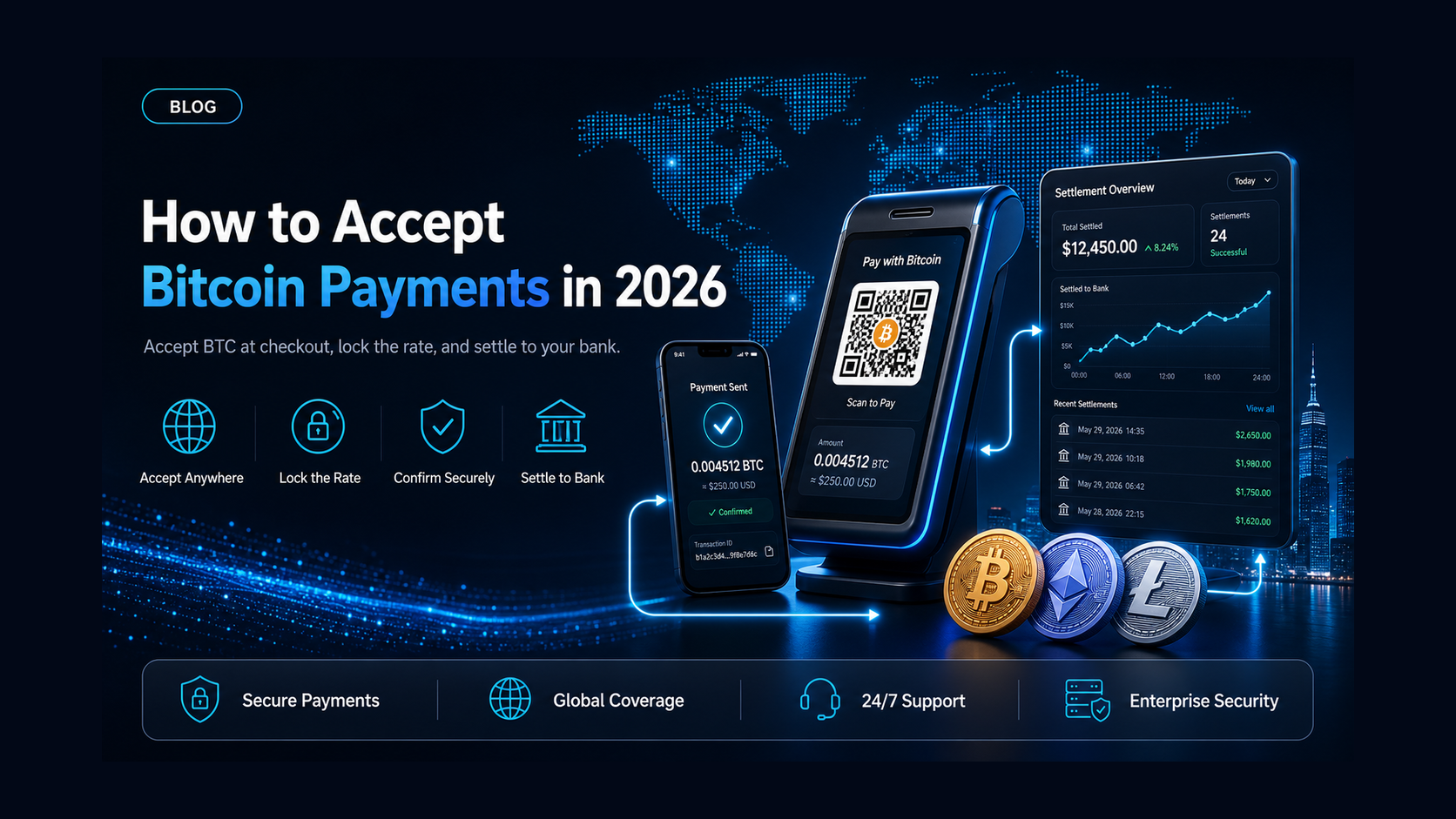
Bitcoin is seventeen years old and still the first cryptocurrency a customer names when they ask whether you take crypto. It is also the asset most business owners hesitate over, because the price moves and nobody wants to invoice for $4,000 and bank $3,700.
That hesitation is solved by the settlement layer, not by the coin. A gateway that settles stablecoins or crypto lets a merchant accept Bitcoin payments, lock the exchange rate at checkout, and receive USD, EUR, GBP, CAD in a bank account without ever holding BTC. This guide covers where Bitcoin stands today, how many confirmations to wait for, and the steps to switch it on.
In this guide, you'll learn:
Where Bitcoin stands in August 2026 by price, market capitalisation, and rank
How a Bitcoin payment moves from broadcast to a confirmed block
How long to wait before treating a Bitcoin payment as settled
How to accept Bitcoin payments through a POS terminal, an invoice, or an API
What Bitcoin is
Bitcoin is a payment network with its own currency, launched in January 2009 by the pseudonymous Satoshi Nakamoto. Transactions are grouped into blocks roughly every ten minutes and confirmed by miners who compete to solve a computational puzzle. Once a block is added, reversing a transaction inside it requires redoing that work, which is why Bitcoin payments become progressively harder to undo as blocks accumulate on top.
Supply is capped at 21 million BTC and is issued on a fixed schedule. Roughly 20.07 million are already in circulation, per CoinLore data on August 4, 2026, so the remaining issuance is small and slows further at each halving.
For a merchant, two properties matter more than the monetary design. Bitcoin payments are push payments, so a customer sends funds rather than authorising you to pull them, and they are final once confirmed. Neither property depends on the price.
Where Bitcoin stands today
The figures below are a snapshot. Prices move, so treat them as context for a decision rather than a forecast.
Metric | Value (August 4, 2026) |
|---|---|
Price | $63,776 |
Market capitalisation | $1.28 trillion |
Rank by market cap | 1 |
Circulating supply | ~20.07 million BTC |
All-time high | $126,173 on October 6, 2025 |
Bitcoin trades roughly 49% below its October 2025 peak, per CoinLore and Bybit data on August 4, 2026. Its market capitalisation of $1.28 trillion still exceeds every other digital asset by a wide margin, and no other cryptocurrency comes close on wallet count or merchant recognition.
The drawdown matters less to a merchant than it does to a holder. A business that converts at the point of sale is exposed to the price for the length of the checkout session, not for the length of the cycle.
Why customers pay with Bitcoin
Three reasons come up repeatedly in merchant conversations.
Recognition - Bitcoin is the default request
Customers who hold several assets often reach for BTC first because they assume it is the one you accept. Offering it removes a question at checkout.
Cross-border reach - the network ignores borders
A customer in Lagos or Manila sends the same transaction as a customer in Toronto, with no correspondent bank, no FX quote, and no cut-off time. For merchants selling into markets where card acceptance is thin, Bitcoin frequently completes a sale that cards decline.
Finality - no chargebacks
A confirmed Bitcoin transaction cannot be reversed by the sender or their bank. For sectors carrying high dispute rates, that property is the whole argument. Our guide to
explains where the protection begins and ends.
Settlement speed
Settlement timing follows confirmations. A block arrives roughly every ten minutes, so:
Zero confirmations
- the transaction is broadcast and visible, but not yet in a block.
One confirmation
- included in a block, roughly ten minutes after broadcast. Sufficient for low-value in-person sales.
Three confirmations
- roughly thirty minutes. A common threshold for mid-value online orders.
Six confirmations
- roughly sixty minutes. The conventional standard for high-value settlement.
EukaPay also supports Bitcoin over the Lightning Network, which settles in seconds by moving payments through pre-funded channels instead of writing every transaction to the base chain. For a café or a ticket counter, Lightning removes the confirmation wait entirely.
How to accept Bitcoin payments with EukaPay
Create a merchant account.
Register on the
. Every merchant completes onboarding and a business review before going live, and a sandbox environment is available so your developer (or coding agent) can build during the review period.
Select Bitcoin in your accepted currencies.
Merchants control which assets appear at checkout, so you can enable BTC alone or alongside Ethereum, Litecoin, Solana, USDC, and USDT.
Choose your settlement currency.
Set conversion to USD, EUR, GBP, CAD and EukaPay converts each payment at a locked exchange rate to remove all crypto volatility.
Pick a payment channel.
Use a
in store, an invoice or payment link by email, a hosted checkout on your site, or the
for a custom flow.
Set your confirmation threshold.
Decide how many confirmations a payment needs before your system treats the order as paid, and match the threshold to your order value.
Test, then go live.
Run a sandbox transaction end to end, confirm the webhook fires against your order system, and switch to production keys.
Is accepting Bitcoin payments worth it for your business?
It depends on where your customers are and what you sell.
Accepting Bitcoin is worth it if you sell across borders, if card acceptance rates in your target markets are poor, if chargebacks are a recurring loss, or if customers have asked for it. Businesses in iGaming, forex, hosting, digital services, and event ticketing tend to see the clearest return, because those sectors combine international buyers with high dispute rates.
The case is weaker if you sell only domestically to card-comfortable customers and disputes are rare. Even then, enabling one more asset is a dashboard setting once a gateway is in place, and stablecoins frequently account for more merchant volume than BTC once both are switched on. Our breakdown of
which cryptocurrencies customers actually pay with
covers the split.
One platform underneath
Whichever channel you use to collect Bitcoin, the same infrastructure sits beneath it: instant crypto-to-fiat conversion at a locked exchange rate to remove all crypto volatility, protection against chargebacks, support for a wide range of cryptocurrencies, and settlement in USD, EUR, GBP, CAD to your bank account.
Choosing which assets to accept is a question of fit rather than of one coin being better than another. Bitcoin brings recognition and reach. Stablecoins bring price stability. Most merchants end up accepting both, because the customer decides which one arrives.
Get started with EukaPay
Register on the
to begin onboarding, or read the
to see how the payment API, webhooks, and settlement calls fit together before you commit engineering time. If you want to compare channels first, our
page covers POS, invoicing, checkout, and API side by side.
Frequently asked questions
Can I accept Bitcoin payments without holding Bitcoin?
Yes. EukaPay converts each payment at a locked exchange rate and settles USD, EUR, GBP, CAD to your bank account, so BTC never sits on your balance sheet.
How long does a Bitcoin payment take to settle?
A block arrives roughly every ten minutes. Most merchants treat one confirmation as sufficient for small in-person sales and six confirmations for high-value orders. Bitcoin over the Lightning Network settles in seconds.
Which wallets can my customers pay Bitcoin from?
Any Bitcoin wallet that can scan a QR code or open a payment link, including self-custody apps and exchange withdrawal screens. Lightning payments require a wallet with Lightning support.
What happens if the Bitcoin price moves during checkout?
The exchange rate is locked when the payment is created, so the amount you invoice is the amount you receive in your settlement currency.
Can I accept Bitcoin in a physical store?
Yes. A
displays a QR code the customer scans, and Lightning support means the payment confirms in seconds at the counter.
Does EukaPay charge monthly fees?
No. There are no monthly fees, and settlements are free.
Are Bitcoin payments reversible?
No. Once confirmed, a Bitcoin transaction cannot be reversed by the sender or their bank, which removes card-style chargebacks.
Do I need a licence to accept Bitcoin payments?
Accepting Bitcoin as payment for goods or services generally does not require a money transmission licence, because you are a merchant rather than a payment provider. Tax treatment and reporting duties vary by jurisdiction, so confirm the specifics with your accountant.
Products
Use Cases
© 2026 EukaPay. All rights reserved.
FINTRAC: M22233887