Crypto payments for esports and tournament platforms: entry fees in, prize payouts out in stablecoins or crypto
August 14, 2026
August 14, 2026 · 8 min read
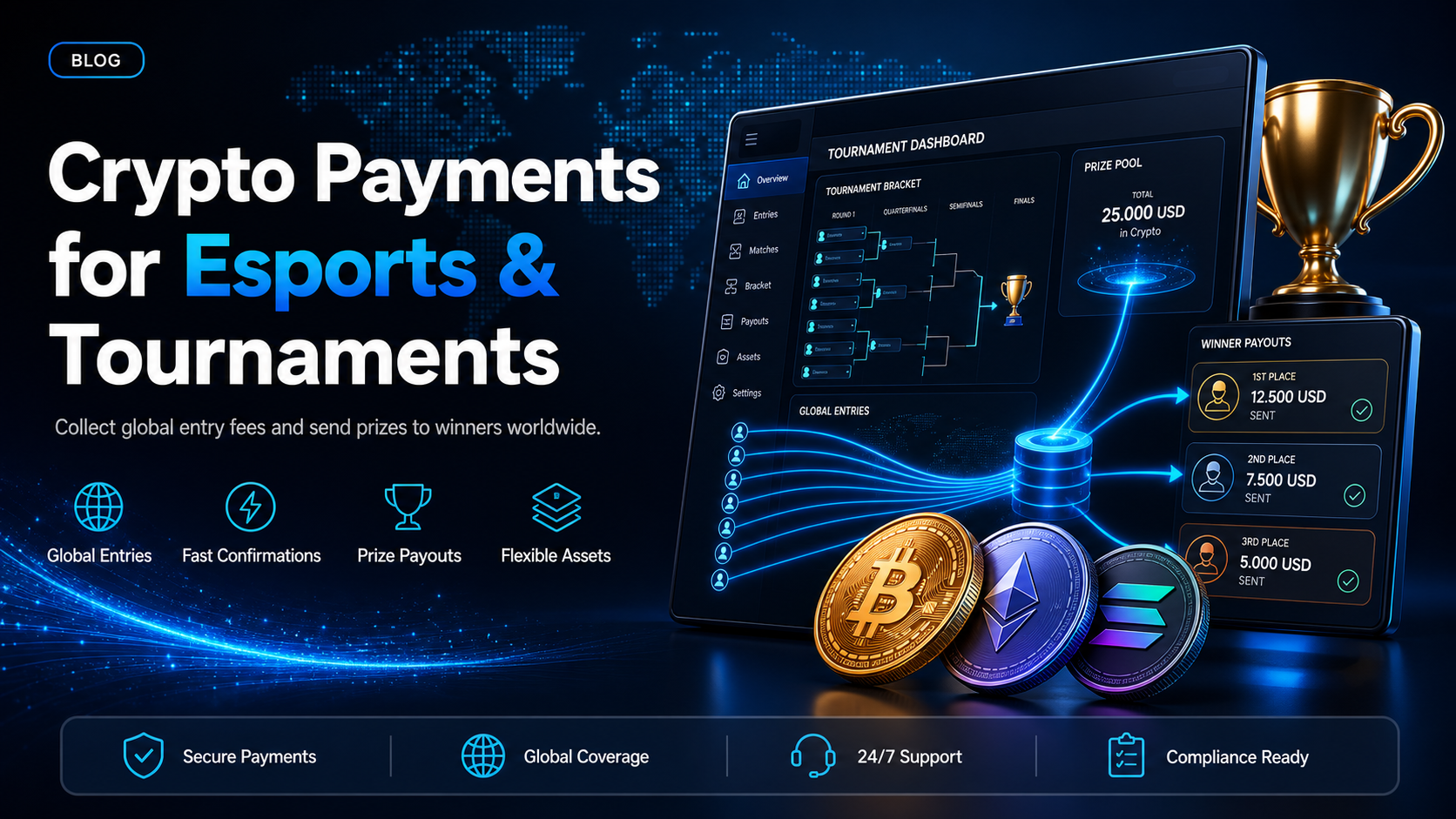
An esports or tournament platform has a payment profile almost nobody builds for. Money comes in as a large number of small entry fees from players in countries your bank has never heard of, and goes back out as a smaller number of larger prize payments to winners who are just as scattered. The two events are days apart and the second one is public.
A prize that lands late is a community problem rather than a finance problem, which is what makes this different from ordinary commerce. This guide covers running entry fees and prize distribution in stablecoins or crypto, and what each half needs.
In this guide, you'll learn:
Why entry fees and prize pools are two different payment jobs
How to collect small entry fees from players your card processor declines
How to distribute a prize pool across winners in different assets
What to have in place before a tournament rather than after it
Entry fees: many small payments, everywhere
The entry fee flow is high count, low value, and global. Every one of those three properties works against card rails.
Geography is the constraint, not volume
Competitive gaming has no relationship to the map of well-banked countries. A platform running an open bracket will take entries from players whose cards are declined cross-border, or who do not hold a card at all. Each declined entry is a competitor who does not enter and a bracket that fills more slowly.
Crypto pay-ins accept most major cryptocurrencies like BTC, ETH, LTC, SOL, USDC, USDT, and support Lightning, which suits small entry amounts where a proportional fee would otherwise dominate.
Entry closes at a fixed time
Brackets lock. A player paying an entry fee twenty minutes before the deadline needs to know the entry is registered, not that a payment is somewhere in flight.
The EukaPay crypto payment gateway sends webhook events as a payment is detected and then confirmed, so your platform can mark an entry pending immediately and confirm the slot without the player refreshing a page or contacting an admin.
Where the player pays
Entry fees are collected with the Crypto Payment API. Your platform calls the API when a player enters and renders the payment screens itself, so the entry step sits inside your bracket software and inside your own branding, which matters when the tournament brand is the product. A developer (or coding agent) builds that step once, and every bracket you run afterwards uses it.
Prize pools: fewer payments, higher stakes
Prize distribution is a payout run with an audience. The winner list is public, the amounts are published, and a delayed payment is visible to everyone who followed the event.
Step 1 - Fund the payout balance before the final.
The payout balance is funded by transferring from your main account balance. Doing that during the event rather than after it means the prize run is not waiting on an internal transfer while a community waits on you.
Step 2 - Dispatch each prize with the Crypto Payout API.
Once results are confirmed, your platform calls the Payout API for each winner. The API creates crypto payouts programmatically, one payout per request, so each prize carries its own winner, amount, asset and network, and your platform checks each one against the published results before the request goes out. The requests come from your results engine or from an internal tool your operations team drives, and the prize distribution is the same sequence either way.
Step 3 - Set asset and network per winner.
Payouts are sent in USDC, USDT, ETH and BTC across the Ethereum, Tron and Bitcoin networks, with asset and network set per payout. A winner in one region taking USDT on Tron and another taking BTC are two requests against the same prize pool rather than two separate processes.
Two things to check before your first event. EukaPay enforces per-asset minimum payout amounts, so your smallest prize tier should sit above them or be consolidated. And each payout carries its own reference that can be looked up, which is what you point a competitor at when they ask where a prize went.
Prize payouts are also not tied to banking hours or the banking calendar. A grand final on a Sunday evening does not have to become a Tuesday payment.
Entry fees and prizes side by side
Entry fees | Prize payouts | |
|---|---|---|
Direction | Pay-in | Payout |
Count per event | High | Low |
Value per transaction | Small | Large |
Assets | BTC, ETH, LTC, SOL, USDC, USDT, Lightning | USDC, USDT, ETH, BTC |
How it runs | Crypto Payment API | Crypto Payout API |
Who operates it | Automated, player-initiated | Your operations team or your results engine |
Both sides sit in the same merchant account, which is the practical reason to run them on one provider: the entry fee revenue that funds a prize pool and the prize pool itself are visible in one place.
What to have ready before the event
The pattern that causes trouble is building the entry flow for a first tournament and leaving the prize side until results are in. By then the deadline is public.
Before your first event, exercise both paths in the staging environment available for development, fund the payout balance, confirm your smallest prize tier sits above the per-asset minimums, and decide whether your results engine calls the Payout API on its own or an operator triggers the prize distribution once results are confirmed. None of it is difficult, and all of it is worse to discover on the night.
One platform underneath
Entry fees and prize payouts run on the same infrastructure: instant crypto-to-fiat conversion at a locked exchange rate to remove all crypto volatility, protection against chargebacks, and settlement in USD, EUR, GBP, CAD to your bank account.
You choose whether to settle entry fee revenue in crypto or in fiat. A platform settling in fiat collects entries from anywhere, converts at a locked rate, and receives ordinary currency in its own bank account while still paying winners on-chain wherever in the world they are. The two halves do not have to settle the same way.
The Crypto Payment API and the Crypto Payout API are the two halves of one system. Entries arrive through the first and prizes leave through the second, and both sit in the same account that funds the prize pool.
Get started with EukaPay
Create an account to begin verification and generate API keys. Every merchant goes through onboarding and a business review, and a staging environment is available so you can exercise entries and prize payouts before your first event. See the
EukaPay developer documentation
for the endpoint reference, the
for prize distribution, and the
crypto payment gateway overview
for how entry fees settle.
to start.
Frequently asked questions
Why do esports platforms struggle with card payments?
Entry fees are small, numerous and international, so a platform running an open bracket takes entries from players whose cards decline cross-border or who do not hold a card at all.
Which cryptocurrencies can players pay entry fees with?
EukaPay supports most major cryptocurrencies like BTC, ETH, LTC, SOL, USDC, USDT, and supports Lightning, which suits small entry amounts.
How does a player know their tournament entry registered?
The crypto payment gateway sends webhook events as a payment is detected and then confirmed, so your platform can show the entry as pending immediately and confirm the slot on confirmation.
How do I pay a prize pool across many winners?
Call the Payout API once results are confirmed. It creates crypto payouts programmatically, one payout per request, so each winner's prize is created with its own amount, asset and network.
Can different winners be paid in different assets?
Yes. Payouts are sent in USDC, USDT, ETH and BTC across the Ethereum, Tron and Bitcoin networks, with asset and network set per payout.
Is there a minimum prize payout amount?
EukaPay enforces per-asset minimum payout amounts, so check that your smallest prize tier sits above them before publishing a prize table.
Can prizes go out on a weekend?
Yes. Crypto payouts are not tied to banking hours or the banking calendar, so a Sunday final does not become a midweek payment.
How do I answer a competitor asking where their prize is?
Each payout carries its own reference that can be looked up, which is the record your community team works from.
Related articles
Crypto payment gateway for game server hosting
- the infrastructure side of gaming payments
Crypto mass payouts: how to pay global contractors and affiliates at scale
- the payout workflow in more depth
How to accept crypto with a crypto payment API
- building the entry fee flow programmatically
Products
Use Cases
© 2026 EukaPay. All rights reserved.
FINTRAC: M22233887