Crypto payments for software license keys: stablecoins or crypto
August 20, 2026
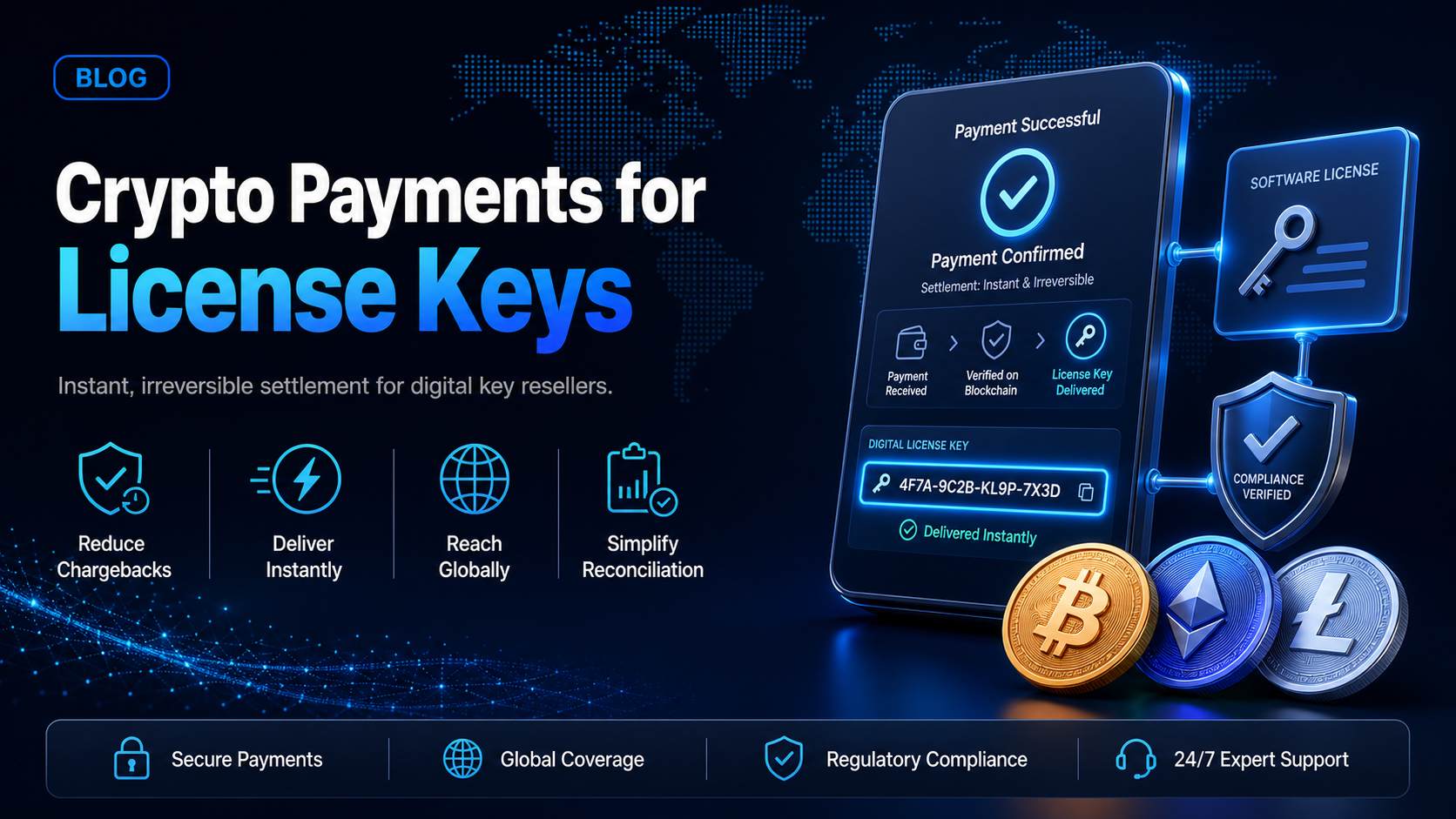
Selling software license keys puts a business in an unusual position, because the product is delivered the instant payment clears, consumed immediately, and impossible to retrieve once the buyer has used it. Every other part of the operation is built around that speed, since buyers expect the key in their inbox before they close the tab.
The payment rail is the one part that works the other way, because a card charge stays reversible long after the key has been redeemed. Crypto payments for software license keys close that gap, since a confirmed payment is as final as the delivery it pays for. This guide covers what the mismatch costs, what changes when a buyer pays in stablecoins or crypto, and how key delivery fits alongside a crypto checkout.
In this guide, you'll learn:
Why instant delivery and reversible payment is the hardest combination in digital commerce
What changes for a key reseller when the payment itself becomes final
How to wire key release to a payment confirmation rather than to a card approval
Which EukaPay product fits a storefront, a marketplace, or an automated key vault
The instant delivery problem
Physical goods give a merchant options when a payment is disputed. A parcel can be tracked, intercepted, or returned, and the courier's record becomes the evidence that decides the case. A license key offers none of those, so a key reseller defends a dispute with almost nothing in hand, and the three sections below explain why.
License key chargebacks - the key is redeemed before the dispute arrives
A buyer redeems a key within minutes of delivery, while a card dispute can be raised long afterwards. By the time the reseller is notified, the license is already activated on the vendor's servers and tied to an account the reseller has no control over, so revoking it is not an option and repossessing it is not an option either. The only record the reseller can produce at that point is a delivery timestamp.
Dispute evidence for digital goods - what you can and cannot prove
Dispute processes were built around shipped goods, which is why they ask for the kind of proof a courier produces. A key reseller can supply part of that proof, because the key was generated and the key was emailed to the address on the order. What the reseller cannot supply is proof that the person who opened the email is the person whose card was charged, and since the burden of proof sits with the merchant, the missing half is the half that decides the outcome.
Instant delivery fraud - why the exposure grows with revenue
Fraud follows margin and liquidity, and instant digital goods offer both, so a key business becomes a more attractive target as it grows. Dispute volume therefore tends to track revenue rather than settling at a fixed rate, which means the losses get worse in precisely the periods when the business is working. Hosting providers carry the same exposure for the same reason, and
how a crypto payment gateway reduces chargeback losses
sets out the mechanics.
What an irreversible payment changes
A confirmed crypto payment cannot be pulled back by the payer's bank, because no bank adjudicates the transaction in the first place. For a product that cannot be recalled once delivered, matching the finality of the payment to the finality of the product removes the mismatch instead of leaving the reseller to absorb it.
Digital goods fraud - removing the incentive entirely
Card fraud against key resellers works because the payment can be undone after the key has been taken, so removing the reversal removes the reason to run the scheme. The reseller keeps the revenue on completed orders rather than writing off a share of them every month.
Payment approval rates - no issuing bank to decline the sale
Digital goods sold across borders are among the transactions issuing banks decline most readily, and each declined authorisation is a lost sale from a customer who actually wanted to buy. A crypto payment has no issuer in the path to decline it, so the buyer either sends the funds or does not, and no third party makes that decision on their behalf.
Fiat settlement - USD, EUR, GBP, CAD in your bank account
Buyers pay with BTC, ETH, LTC, SOL, USDC, or USDT, and EukaPay converts at a locked exchange rate to remove all crypto volatility before settling in USD, EUR, GBP, CAD. Because settlement arrives as fiat, your finance team keeps reporting in the currency it already uses.
How key delivery works alongside crypto checkout
The delivery logic you already have does not need rebuilding, because only the event that triggers it changes.
On cards, the trigger is an authorisation, which is a bank's provisional statement of intent. On crypto, the trigger is a confirmed on-chain payment, which is a settled fact. EukaPay sends a callback to your system when the payment confirms, so your key vault releases against that callback exactly as it releases against a successful charge today, and a developer (or coding agent) can wire the handler using the callback specification in
.
The practical gain is that the new trigger is stronger than the old one. Releasing a key against a confirmed payment is a safer operation than releasing it against an authorisation a bank may revisit months later.
How many confirmations before you release a key?
EukaPay marks a payment complete once the network confirmations required for that asset have been observed, and the callback fires at that point rather than when the transaction is first broadcast. Releasing on the callback rather than on first sight of a transaction is the correct behaviour for a product you cannot take back.
The wait is short in practice and it differs by asset, which is one reason buyers who want a key immediately tend to choose a stablecoin. For the reseller the operational rule stays simple: release on the confirmation callback, never on a pending transaction, and let the platform decide when the threshold has been met.
How to choose your integration
Here's the picking heuristic in one table.
Payment Links | Custom Checkout | API | Invoices | |
|---|---|---|---|---|
Coding required? | None | Some | Yes, a developer (or coding agent) | None |
Key release | Manual, after you see payment | Manual or webhook-driven | Automatic on callback | Manual |
Best for | Low volume or bespoke bundles | A branded storefront | Automated key vaults | Volume licence deals |
Buyer sees | A link in email or chat | Your brand, your domain | Your checkout, unchanged | A PDF invoice with the payment link embedded |
Typical seller | Small key shop | Established key retailer | Marketplace or key platform | Reseller selling seats to businesses |
Most key businesses run two of these at once, because their two customer types behave differently. The consumer storefront runs on the API or a custom checkout so that delivery is automatic, while the business-to-business side runs on invoices, since a company buying fifty seats expects a document it can push through accounts payable. Resellers who sell seats on a repeating cycle can have EukaPay send those invoices automatically on a weekly, monthly, quarterly, or custom schedule.
One platform underneath
All four options run on the same infrastructure: instant crypto-to-fiat conversion at a locked exchange rate to remove all crypto volatility, protection against chargebacks, support for a wide range of cryptocurrencies, and settlement in USD, EUR, GBP, CAD to your bank account.
Because the confirmation event is identical across all four, picking among payment links, a custom checkout, the API, and invoices comes down to how your keys reach buyers today. A shop selling a few dozen keys a week and a marketplace releasing thousands automatically need different front doors to identical rails, and EukaPay sets you up for success by making the same confirmation drive every release path you run. Businesses selling adjacent instant-delivery products face the same structure, whether they sell
or
, and
how to choose a crypto payment gateway
covers what to compare across providers.
Get started with EukaPay
Create an account at
to set up a checkout or a payment link, and point your developer (or coding agent) at
for the callback specification your key vault will listen to. Every merchant goes through an onboarding and business review, and a sandbox environment is available during that review so you can build and test the release logic against test payments before going live.
Frequently asked questions
Can a buyer charge back a crypto payment after redeeming a key?
No. A confirmed crypto payment cannot be reversed by the payer or their bank, so the redeemed-then-disputed pattern that costs key resellers money on cards does not apply.
Do I still need fraud screening if I accept crypto?
Screening on your card orders stays exactly as it is, because adding crypto changes nothing about how card payments behave. On the crypto orders the reversal risk is removed, so any screening you keep there serves other purposes rather than chargeback defence.
When exactly should my system release the key?
On the EukaPay confirmation callback rather than on first sight of a pending transaction, because the callback fires only once the required confirmations have been observed.
Which cryptocurrencies can my buyers pay with?
EukaPay supports most major cryptocurrencies like BTC, ETH, LTC, SOL, USDC, USDT, and buyers who want the key immediately often choose a stablecoin.
Can I sell volume licences to businesses this way?
Yes. Invoices suit business buyers who need a document for accounts payable, and EukaPay sends a formatted PDF invoice with the payment link embedded, which can also go out automatically on a recurring schedule.
Do I have to hold crypto if I accept it?
No. Conversion happens at a locked exchange rate to remove all crypto volatility, so settlement reaches your bank account in USD, EUR, GBP, CAD.
Can I refund a buyer whose key did not work?
Yes. The payment is not reversible by the buyer, but you can send funds back deliberately, which means the refund decision stays with you and gets made on your evidence.
Related articles
How a crypto payment gateway reduces chargeback losses
- the same dispute structure, seen from a hosting provider's side
How to accept crypto with a crypto payment API
- the integration and callback reference for automated delivery
- the subscription counterpart to selling perpetual license keys
Crypto payment gateway for domain registrars in 2026
- another instant-delivery product with the same finality mismatch
How to choose a crypto payment gateway in 2026
- what to compare before you commit to a provider
Products
Use Cases
© 2026 EukaPay. All rights reserved.
FINTRAC: M22233887