Crypto payment gateway for accounting firms in 2026
August 20, 2026
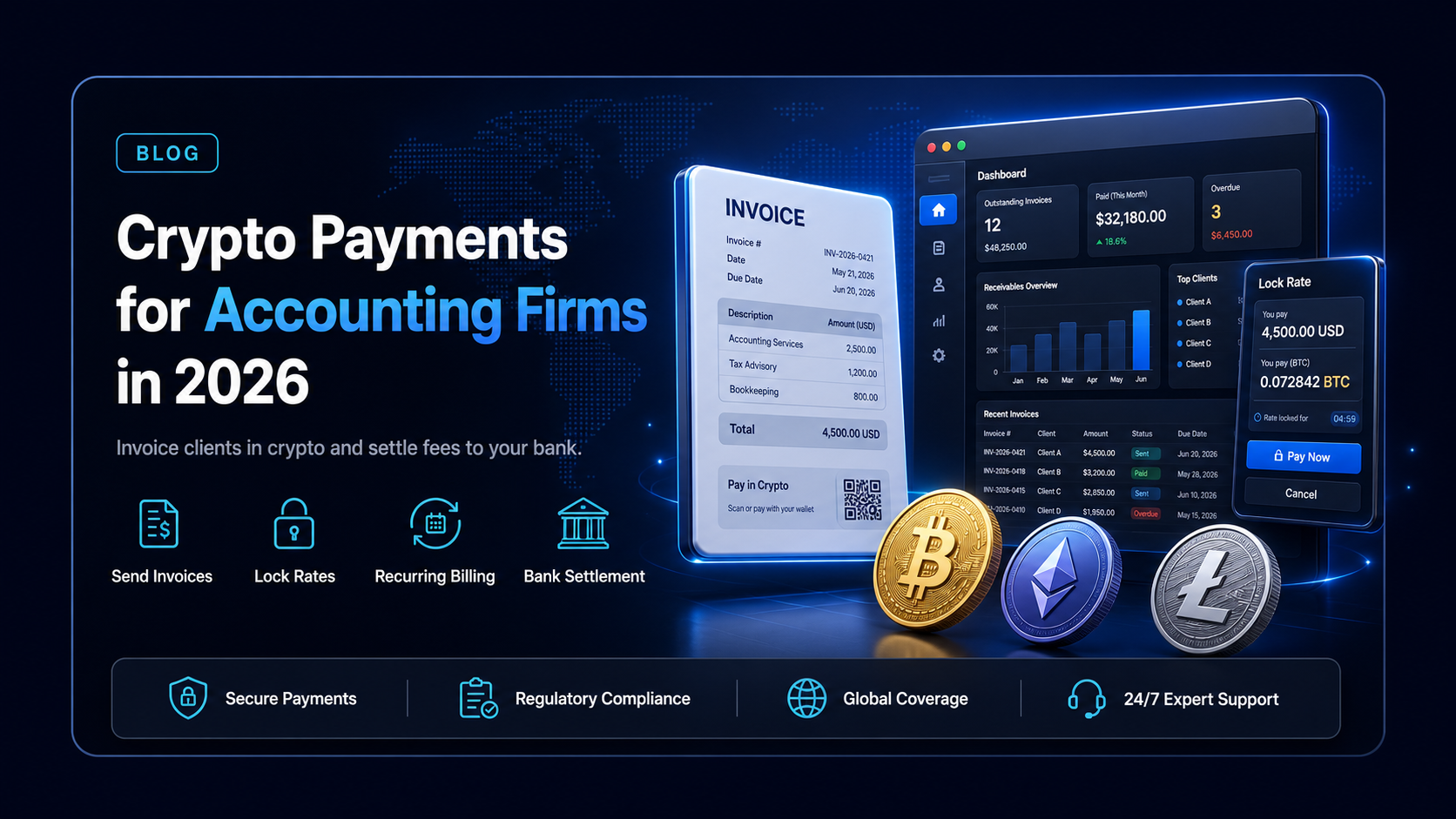
Accounting and bookkeeping practices bill the same clients on the same cycle, so the payment method is a standing decision instead of a one-off choice. A crypto payment gateway for accounting firms is the software that sends the invoice, takes the payment in stablecoins or crypto, and settles the fee to the firm's own bank account.
Some clients now hold stablecoins and would rather pay a five-figure engagement fee from a wallet than from a card. Others sit outside the firm's home market and pay by wire, which adds a fee and a cut-off time to every invoice. This guide covers which fees a practice can collect in stablecoins or crypto, what the setup looks like, and which EukaPay product fits which billing pattern.
In this guide, you'll learn:
Which client fees an accounting or bookkeeping firm can collect in stablecoins or crypto
What to look for in a crypto payment gateway for accounting firms
The step-by-step flow for sending a crypto invoice and receiving the fee in fiat
How to choose between invoices, payment links, and subscriptions
Why accounting firms are taking stablecoins or crypto for client fees
The client base changed before the billing did. A mid-sized practice today often carries trading firms, digital-asset businesses, funds, and software companies whose own treasury already holds USDC or USDT. Those clients can pay a professional-services invoice straight from a wallet. Some of them ask for the option by name.
The second reason is the size of the invoice. Card pricing is usually a percentage of the amount, so the cost scales with the fee. On a monthly retainer that percentage is a nuisance. On a year-end fee or a transaction-advisory engagement, the same percentage is large enough for the partners to notice.
The third reason is reversibility. Professional services are delivered over months and invoiced after the work is done, so a card dispute can arrive long after the file is closed. A settled crypto payment cannot be reversed by the payer, so a fee collected in stablecoins or crypto is not exposed to a chargeback.
Taking stablecoins or crypto does not require the firm to change what it sells. The engagement letter, the scope, and the invoice all stay the same. Only the payment instrument is new.
What to look for in a crypto payment gateway for accounting firms
Gateway comparisons are usually written for ecommerce, where the buyer is anonymous and the amount is small. An accounting practice is the opposite case: a known client, a large amount, and a schedule that repeats. Our guide on
how to choose a crypto payment gateway
covers the general criteria. The three capabilities below are the ones that decide it for a practice.
Recurring invoices - the same clients bill on the same cycle
Retainers are the base of the practice, and they do not change month to month. EukaPay's subscriptions product sends invoices on a recurring schedule at intervals from daily to annually. A monthly retainer or a quarterly review fee can be set up once and left alone. It is a scheduled invoice, not a billing engine. There is no plan management, no retry logic, and no programmatic control of the billing cycle. The firm keeps its own client list and its own decisions about who gets billed what.
Chargeback protection - a settled crypto payment cannot be reversed by the payer
Card networks give the payer a dispute window that opens long after the work is finished. A crypto payment settles on-chain, and the payer has no equivalent way to reverse it. For a practice that invoices in arrears, that difference removes a category of loss.
Fiat settlement - the fee reaches the firm's bank account
A practice that does not want to hold the asset can settle in fiat. With EukaPay the merchant chooses fiat or crypto settlement. Fiat settlement reaches the firm's own bank account in USD, EUR, GBP, or CAD. The client pays in stablecoins or crypto, and the firm receives the currency it already banks in.
How to collect a client fee in stablecoins or crypto, step by step
Create the EukaPay account.
Sign up, complete verification, and provide the legal business information for the practice. A staging environment is available for development if the firm wants to build against the API.
Choose the settlement option.
Fiat settlement sends the money to the firm's bank account in USD, EUR, GBP, or CAD. Crypto settlement keeps the asset. Firms that do not want price exposure usually pick fiat.
Build the invoice.
Invoices is a friendly user-interface where you enter the amount, add line items for each part of the engagement, and enter the client's information.
Send it.
EukaPay sends a formatted PDF invoice to the client's inbox with the payment link embedded, so the client does not need a EukaPay account to pay it.
The client pays.
The client reviews the invoice, follows the payment screens, and pays in most major cryptocurrencies like BTC, ETH, LTC, SOL, USDC, USDT.
Convert at a locked rate.
EukaPay offers instant crypto-to-fiat conversion at a locked exchange rate to remove your exposure to crypto price swings. The fiat value of the fee is fixed at the moment of payment.
Set the recurring ones to repeat.
For a retainer, create the same invoice as a subscription and it can go out on the interval you set.
Firms that want the full mechanics of the document itself, including line items and what the client sees, can read our walkthrough of
.
Can a CPA or bookkeeping firm accept crypto as payment for services?
Yes. A practice can accept crypto payments for accounting services the same way it accepts them for any other professional service. The firm issues an invoice for the engagement. The client pays it. The proceeds settle to the firm's bank account. The gateway handles the payment the same way whether the line item says "audit support" or "web design".
The parts that are specific to a firm are the ones covered above: the schedule, the invoice size, and the preference for fiat settlement.
There is a practical limit worth naming. The client still has to hold the asset. Crypto invoicing for accountants works best where some share of the client list is already crypto-native, or already holds stablecoins for treasury reasons. For every other client it can run alongside the existing bank and card options instead of replacing them.
How to choose between invoices, payment links, and subscriptions
Invoices | Payment links | Subscriptions | |
|---|---|---|---|
Who sends the request? | The firm, to a named client | The firm, as a URL you share anywhere | EukaPay, on the schedule you set |
Coding required? | No | No | No |
Line items and client details? | Yes | Amount and description | Yes, on the invoice that goes out |
Repeats on its own? | No | No | Yes, from daily to annually |
Best for | Year-end fees, advisory engagements, one-off project work | Deposits, ad-hoc charges, a fee quoted over a call | Monthly retainers, quarterly review fees |
Typical user | Partner or practice manager billing a named client | Anyone in the firm who needs to collect a set amount | The person who runs the billing cycle |
A practice often uses more than one. It may run retainers as subscriptions, bill year-end work as individual invoices, and keep a payment link ready for the odd out-of-scope request. Our breakdown of
invoices vs payment links vs custom checkout vs API
sets out where each one stops being the right tool. If the firm is still choosing its billing stack, the
top international invoicing platforms roundup
covers the wider category.
One platform for invoicing, recurring billing, and fiat settlement
Invoices, payment links, checkout, and subscriptions run on the same EukaPay account, so a firm does not pick a product and then live inside it. All four give you instant crypto-to-fiat conversion at a locked exchange rate to remove your exposure to crypto price swings, protection against chargebacks, support for most major cryptocurrencies, and settlement in USD, EUR, GBP, and CAD to your bank account.
That makes the choice a question of fit, not a question of which product is better. A retainer needs a schedule. A year-end fee needs a document with line items. An unexpected charge needs a link you can paste into an email. The practice picks per billing pattern, and the settlement behaves the same way in every case. Firms comparing EukaPay against the wider market can start with our
best crypto payment gateway for small business
guide.
Get started with EukaPay
Create an account at
, complete verification, and provide the practice's legal business information. From there you can send your first invoice from the dashboard without writing any code. If the firm wants stablecoin client payments raised from its own practice-management system instead, the endpoints and the staging environment are documented at
.
Frequently asked questions
Can an accounting firm accept crypto payments from clients?
Yes. A firm can invoice a client through EukaPay and the client can settle it in stablecoins or crypto. The workflow is the same one any business uses to invoice for services.
Which cryptocurrencies can a firm accept for client fees?
EukaPay supports most major cryptocurrencies like BTC, ETH, LTC, SOL, USDC, USDT for pay-ins. Firms billing large fees often see clients choose a stablecoin, because the amount owed and the amount sent match.
Does the firm have to hold crypto after a client pays?
No. The merchant chooses fiat or crypto settlement. With fiat settlement the proceeds reach the firm's own bank account in USD, EUR, GBP, or CAD.
Can EukaPay send the same retainer invoice every month?
Yes. Subscriptions send invoices on a recurring schedule at intervals from daily to annually. There is no plan management or retry logic, so the firm keeps control of who is billed and when.
When is the fiat value of a crypto invoice fixed?
EukaPay offers instant crypto-to-fiat conversion at a locked exchange rate to remove your exposure to crypto price swings. The fiat value is fixed at the point of payment, not left floating.
Can a client reverse a crypto payment the way they dispute a card charge?
No. A settled crypto payment cannot be reversed by the payer, which is the main reason firms invoicing in arrears look at this route in the first place.
What does a practice need to set up before sending the first crypto invoice?
Sign up, complete verification, and provide the firm's legal business information. Once the account is live you can create invoices in the dashboard, and generate an API key if you want to raise them programmatically.
Related articles
Crypto invoicing for professional services
- how the invoice document, line items, and embedded payment link work end to end
Recurring crypto billing for retainer businesses
- setting up scheduled invoices for clients you bill every month
Cross-border fee collection for advisory firms
- collecting from clients outside your acquirer's footprint without a wire
Products
Use Cases
© 2026 EukaPay. All rights reserved.
FINTRAC: M22233887