Best crypto payment gateway for small business in 2026: how to accept stablecoins or crypto
August 17, 2026
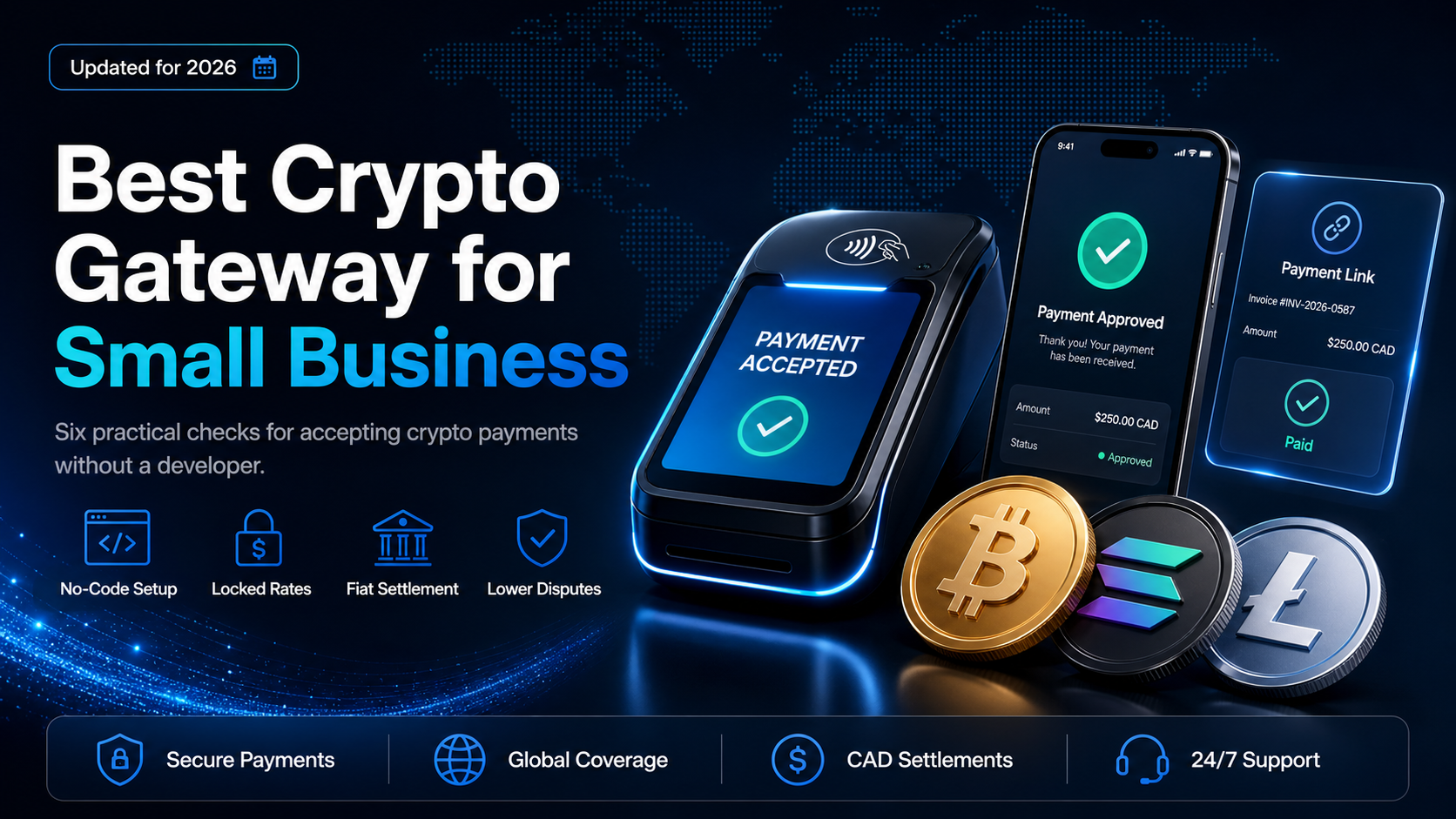
Most gateway comparisons are written for online stores with an engineering team, so this one is written for the small business that has neither and still wants to accept stablecoins or crypto.
August 17, 2026 . 10 min read
A small business evaluating a crypto payment gateway in 2026 is not running the same test as an enterprise retailer. The retailer asks which provider handles four million transactions a month without falling over. A three-person consultancy, a local studio, or a two-location shop asks something narrower: can I send a customer something they can pay today, and will the money be in my bank account in a currency I can pay rent with.
Those are different questions, and they produce a different shortlist. A gateway that wins on throughput benchmarks can still be the wrong choice for a company that invoices eleven clients a month and has nobody on payroll who writes code. This guide sets out the checks that decide the outcome for a small business, and shows which EukaPay product fits each way of selling.
In this guide, you'll learn:
Why small business gateway selection turns on setup effort and settlement, not on transaction throughput
The six checks that separate a workable gateway from an expensive one at low volume
Which EukaPay product fits each way a small business sells, from a quoted job to a storefront
What a stablecoin or crypto payment actually costs a small business compared with a card payment
Why small businesses evaluate gateways differently
Three conditions shape the decision, and none of them apply to a large merchant.
Volume is low and uneven - percentages matter less than fixed costs
A company processing 40,000 USD a month is not going to negotiate its way to a better rate. What it can control is the fixed cost of each mistake. One disputed card transaction, one wire that arrives short, or one week of an owner reconciling payments by hand costs more at this size than a few basis points on the processing rate.
There is no developer on staff - setup effort is the real price
Enterprise gateway reviews treat integration as a solved problem because the reader has a team to solve it. A small business does not. The right question is not whether a gateway has a good API, but whether the business can take its first payment without touching one. A developer (or coding agent) can build a custom API integration later if the business grows into it.
The owner does the reconciliation - the format of the money matters
At small scale, the person choosing the gateway is often the person who will match payments to invoices at the end of the month. A payment that arrives as a single settled amount in a familiar currency takes minutes to reconcile. A payment that arrives as a coin balance requiring a manual conversion takes an afternoon.
What a crypto payment gateway does for a small business
A crypto payment gateway sits between the customer who wants to pay in stablecoins or crypto and the business that wants ordinary money in its bank account. The customer picks an asset and sends it. The gateway confirms the transaction on-chain, applies the exchange rate, and settles the value to the business.
The part that decides whether this is useful to a small business is what happens in the middle. With instant crypto-to-fiat conversion at a locked exchange rate to remove all crypto volatility, the amount quoted to the customer is the amount the business receives, and the business never holds a coin position it did not ask for. That single mechanic is what turns crypto acceptance from a treasury decision into a payments decision, which is the only version a small business has time for.
For a broader framework that is not size-specific, see our guide on
how to choose a crypto payment gateway
. For online stores specifically, see
the best crypto payment gateways for e-commerce
.
Six checks that decide the outcome
1. Who absorbs the price movement between quote and confirmation
A stablecoin or crypto payment is not instant in the way a card authorisation is. There is a gap between the moment the customer sees a price and the moment the network confirms the transaction. Somebody carries the risk in that gap.
Ask the provider directly whether the rate is locked when the customer is quoted. If it is locked, the business receives the invoiced amount. If it is not, the business is accepting a small currency position on every sale, which is a poor trade for a company that took the payment to avoid friction in the first place.
2. Where the money lands, and in which currency
A gateway that settles to a coin balance has moved the problem rather than solved it. The business still needs to convert and withdraw, and it now needs a process for doing so.
Check that the provider settles to a bank account in a currency the business actually spends. EukaPay settles in USD, EUR, GBP, CAD, and Canadian businesses can also use Interac withdrawals. Confirm the settlement currency before anything else, because a gateway that cannot pay a business in its operating currency is not a candidate regardless of its rate card.
3. What a disputed payment costs
This is where the arithmetic favours small businesses most clearly, and it is routinely left out of rate comparisons.
Card processing fees for small businesses in 2026 generally run at an all-in effective rate of roughly 2.5 to 3.5 percent, with card-not-present sales sitting at the higher end. The processing rate is only part of the cost. Industry estimates put the average all-in cost of a single disputed card transaction at around 110 to 128 USD once the processor fee, the lost goods, and the staff time are counted, and card-not-present merchants commonly see dispute rates near half a percent of transactions.
For a business doing 40,000 USD a month at an average order value of 400 USD, that is roughly 100 orders, and a half-percent dispute rate produces about one dispute every two months. The processing rate difference between a card and a crypto payment is real, but the disputes are frequently the larger number. A stablecoin or crypto payment settles on-chain, so protection against chargebacks is a property of the payment method rather than a separate service the business buys. Our guide to
covers how this works in practice.
4. How the business takes its first payment
A gateway is only worth evaluating if the business can get to a first live payment without an engineering project. The practical test is whether the provider offers a way to request money that works before a website exists.
EukaPay covers this with payment links and invoices, both created from the dashboard. A
is a formatted PDF sent to the customer's inbox with the payment link embedded. A
is a URL the business sends over email, chat, or a quote document. Neither requires a store, a plugin, or a line of code.
5. Which assets customers actually hold
Long supported-asset lists are a weak signal. What matters is coverage of the assets customers turn up with, which in practice means the major stablecoins and the largest networks. EukaPay supports most major cryptocurrencies like BTC, ETH, LTC, SOL, USDC, USDT, which covers the overwhelming majority of what a small business will be offered.
6. What onboarding involves
No provider worth using onboards a business in a single click. Every EukaPay merchant goes through onboarding and a business review before going live, and a sandbox environment for development during onboarding review is available in the meantime. Treat a provider that promises otherwise with caution, and plan the launch around a review period rather than a same-day start.
Matching the product to how the business sells
Most small businesses sell in one of five ways, and each has a product that fits it without additional work.
How the business sells | Fitting product | Setup effort | Best for |
|---|---|---|---|
Quoted jobs billed after delivery | Invoices | Dashboard only | Companies, consultants, freelancers billing per project |
Ad hoc requests over email or chat | Payment links | Dashboard only | Studios, trades, and service businesses with no storefront |
Ongoing retainers and memberships | Recurring invoices | Dashboard or API | Agencies and service companies on monthly arrangements |
An existing online store | E-commerce plugins | Plugin install | Shops already running WooCommerce, Shopify, or BigCommerce |
Payments taken while with the customer | Online POS terminal | Dashboard only | Counter service, appointments, and on-site work |
A custom booking or billing system | Custom API integration | Developer (or coding agent) | Companies with their own software and a technical resource |
Three of these six require nothing beyond the dashboard, which is the point. A business can start with invoices or payment links this quarter and add a plugin or a
when volume justifies it. For businesses taking payment face to face, the
runs in a browser rather than requiring a hardware purchase.
A worked comparison
Consider a design studio invoicing 40,000 USD a month across roughly 100 projects, with a share of overseas clients.
On cards, an all-in effective rate of 2.9 percent costs about 1,160 USD a month. Add one disputed transaction every two months at an all-in cost near 120 USD, and the running cost is closer to 1,220 USD a month before any international payment charges. International clients paying by bank transfer add a separate cost, since banks commonly apply a spread over the mid-market rate and deduct a receiving charge from the incoming amount.
On stablecoins or crypto, published crypto gateway processing rates in 2026 generally sit between 0.5 and 1 percent, with network fees handled separately. At 1 percent the same volume costs about 400 USD a month, disputes are not a line item, and an overseas client settles on the same rail as a domestic one because cross-border and international settlement is the default rather than a separate product.
The saving is meaningful, but it is not the main argument. The main argument is that the studio adds a payment method its overseas clients can actually use, without adding a reconciliation process, because the money arrives converted and settled.
One platform underneath
Whichever product a small business starts with, the same infrastructure sits beneath all of them: instant crypto-to-fiat conversion at a locked exchange rate to remove all crypto volatility, protection against chargebacks, support for a wide range of cryptocurrencies, and settlement in USD, EUR, GBP, CAD to your bank account.
That consistency is what makes starting small a reasonable decision rather than a temporary one. A business that begins with payment links and later adds a storefront plugin does not change how it gets paid, how it reconciles, or what it can promise a customer. It adds a surface. Crypto payouts are available on the same account for businesses that also need to send funds to contractors or suppliers.
Get started with EukaPay
Create an account on the
to begin onboarding and business review, and review the
if a custom API integration is on the roadmap. A sandbox environment is available for development during the review period, so a developer (or coding agent) can build and test the integration before the account goes live.
Frequently asked questions
What is the best crypto payment gateway for a small business in 2026?
The best choice for a small business is the provider that settles in the currency the business spends, locks the exchange rate at the point of quote, and offers a way to take a payment without an integration. EukaPay meets all three with invoices, payment links, and an online POS terminal created from the dashboard, and settlement in USD, EUR, GBP, CAD to your bank account.
Can a small business accept stablecoins or crypto without a website?
Yes. Payment links and invoices are created in the EukaPay dashboard and sent directly to the customer, so no website, storefront, or plugin is required. Businesses that later build a site can add an e-commerce plugin to the same account.
Does the business have to hold cryptocurrency?
No. EukaPay applies instant crypto-to-fiat conversion at a locked exchange rate to remove all crypto volatility, so the business receives the invoiced amount as fiat and never carries a coin position from a sale.
Which cryptocurrencies should a small business accept?
Start with the assets customers actually hold. EukaPay supports most major cryptocurrencies like BTC, ETH, LTC, SOL, USDC, USDT, which covers the large majority of payments a small business will be offered without adding assets nobody uses.
How does accepting stablecoins or crypto reduce dispute costs?
A stablecoin or crypto payment settles on-chain and is not reversible by the payer after confirmation, so protection against chargebacks is built into the payment method. For a business with a card-not-present dispute rate near half a percent, removing that exposure on a share of orders is often worth more than the difference in processing rate.
How quickly does a small business receive its money?
Settlement is made to the business bank account in USD, EUR, GBP, CAD, and Canadian businesses can also use Interac withdrawals. The amount is the converted value locked at the point of quote, so the figure on the invoice is the figure that arrives.
Is there a minimum volume to open an account?
EukaPay works with businesses across a wide range of volumes, including companies taking their first stablecoin or crypto payments. Every account goes through onboarding and a business review before going live, with a sandbox environment for development during onboarding review.
Can the same account also send payments out?
Yes. Crypto payouts run on the same EukaPay account, so a business can collect from customers and pay contractors, suppliers, or affiliates without a second provider.
Related articles
Products
Use Cases
© 2026 EukaPay. All rights reserved.
FINTRAC: M22233887